



|
Getting your Trinity Audio player ready...
|
By: Fern Sidman – Jewish Voice News
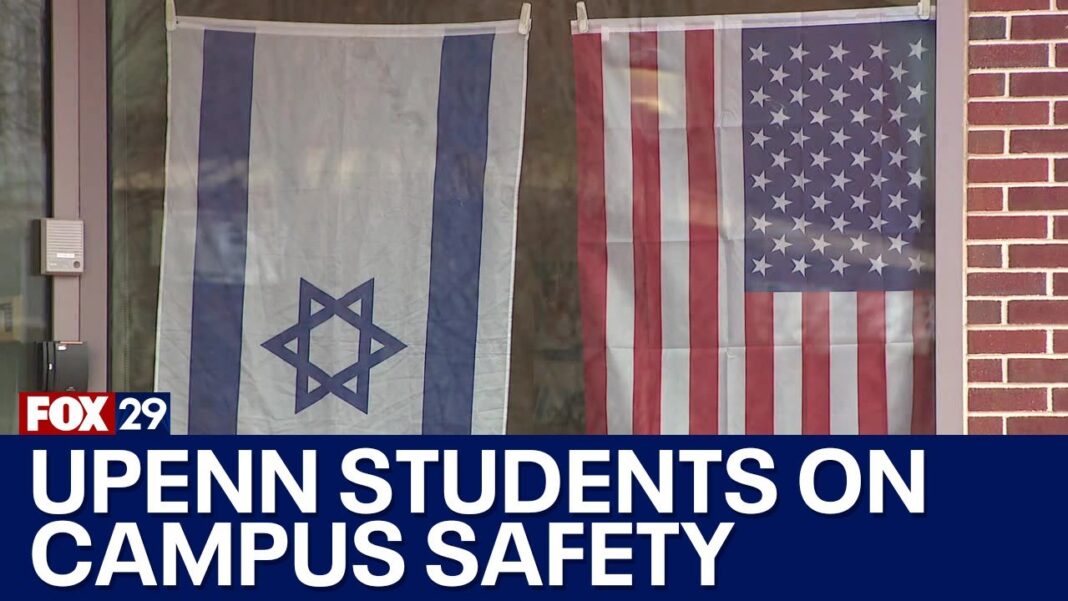
The University of Pennsylvania, long regarded as one of the nation’s premier academic institutions, is now grappling with a profound crisis of campus climate as Jewish undergraduates report unprecedented levels of fear, intimidation, and antisemitic hostility. A new survey conducted by Penn Hillel — shared widely after The Algemeiner underscored its findings in a report on Tuesday — presents a stark portrait of a student community in which Jewish identity is increasingly perceived as a liability, and where expressions of anti-Zionism regularly bleed into overt hatred of Jews.
According to the data, 40 percent of respondents believe it is “difficult to be Jewish” at Penn, while 45 percent report feeling “uncomfortable or intimidated because of their Jewish identity or relationship with Israel.” Perhaps most alarmingly, a staggering 85 percent told surveyors they had witnessed, experienced, or heard about an antisemitic incident during the past year — numbers that The Algemeiner report described as indicative of a still-worsening campus climate.
These findings arrive not as an isolated statistical anomaly, but as the latest chapter in the university’s tumultuous struggle to confront antisemitism — a struggle marked by repeated national scandals, administrative failures, and faculty entrenchment. They also reinforce what Jewish leaders, alumni, and watchdogs have warned for years: Even before Hamas’s October 7, 2023 atrocities ignited a global surge in anti-Jewish hostility, Penn had already become a breeding ground for antisemitic rhetoric and activism.
As The Algemeiner has consistently reported, the deterioration of Penn’s environment for Jewish students did not begin in 2023. It intensified in the months leading up to the Hamas attack, when the university hosted the now notorious “Palestine Writes Festival,” an event organized by Professor Huda Fakhreddine that featured speakers with extensive records of anti-Jewish animus.
Among those invited was the late Gaza-based academic Refaat Alareer, whose public postings included the declaration: “Are most Jews evil? Of course they are.” Another featured figure, Palestinian historian Salman Abu Sitta, once claimed Jews were hated in Europe because they contributed to “the destruction of the economy” — a classic antisemitic trope with centuries-old lineage. Roger Waters, the former Pink Floyd frontman known for comparing Israel to Nazi Germany and referring to food served by Jewish hosts as “Jew food,” was also initially scheduled to participate before public outrage escalated.
The festival proved to be a catalyst. As The Algemeiner noted in multiple reports, a wave of antisemitic incidents followed, including Nazi graffiti, harassment of Jewish students, and a disturbing episode in which a Penn undergraduate trailed a staff member into the university’s Hillel building while shouting “F—k the Jews” and “Jesus Christ is king!” Students recounted overturned tables, destroyed property, and an institutional response that was uneven at best and apathetic at worst.
After October 7, the campus climate deteriorated even further. Anti-Israel activism surged. Jewish students reported threats, verbal abuse, and in some cases, refusal by professors to moderate hostile academic environments. The new survey’s finding that 26 percent of Jewish students experienced antisemitic or anti-Israel comments from faculty underscores the depth of this problem — and the degree to which authority figures have, intentionally or not, contributed to a culture in which Jewish students feel unsafe.
The Hillel survey, released internally and analyzed by both Franklin’s Forum and The Algemeiner, presents numbers that are not merely troubling but transformational in their implications. Nearly one-third of Jewish students — 31 percent — now feel compelled to hide their Jewish identity to avoid discrimination. Many report concealing religious symbols such as Star of David necklaces or avoiding Jewish campus spaces for fear of being targeted by activists.
An overwhelming 80 percent believe that anti-Israel activity on campus is “often” antisemitic in nature — a sentiment that starkly contrasts with the university’s longstanding insistence that anti-Zionist expression must be protected under the banner of free speech and academic freedom. Likewise, 80 percent say Israel is held to an “unfair standard compared to other nations,” echoing critiques published extensively in The Algemeiner about selective moral outrage and distorted academic discourse.
Franklin’s Forum — an outlet with close ties to Penn alumni concerned about campus extremism — emphasized that the survey finally provides a concrete baseline from which the university can measure progress. It noted that Penn’s past promises to address antisemitism lacked quantifiable benchmarks, making accountability elusive. Now, with hard data, the university faces mounting pressure to demonstrate meaningful change rather than issue symbolic statements.
In the months following the October 7 massacre, Penn’s administration attempted to reassert control over the narrative. A formal report on antisemitism, circulated widely in 2024 and heavily analyzed by The Algemeiner, declared that Penn would “never again” confer academic legitimacy on antisemitism and denounced the BDS movement as both “discriminatory” and “anti-intellectual.” The university also founded the Office of Religious and Ethnic Interests (OREI) to oversee discrimination investigations.
But the survey results suggest that these efforts — while symbolically significant — have not filtered down into the daily lives of Jewish students.
Part of the problem is faculty resistance. The American Association of University Professors (AAUP), the nation’s most prominent advocate for faculty rights, has aggressively pushed back against Penn’s attempts to regulate antisemitism on campus. In a public letter that drew scrutiny from The Algemeiner, the AAUP asserted that investigations into alleged antisemitic conduct might themselves constitute discrimination, warning that enforcement could undermine “academic freedom.”
In effect, the AAUP argued that what Jewish students experience as harassment is in some cases a legitimate academic expression — an assertion that Jewish leaders see as both dismissive and dangerous. The AAUP’s language also echoes claims by the Council on American-Islamic Relations (CAIR), a group criticized by The Algemeiner for its defense of extremist rhetoric and alleged links to Hamas, which is currently attempting to dismantle antisemitism-prevention training at Northwestern University.
The AAUP further accused Penn of yielding to “government interference,” implying that congressional inquiries into campus antisemitism — including those sought by Jewish members of Congress — represent improper political influence. Jewish organizations vehemently disagree, arguing that the federal government has a legal and moral obligation to enforce civil rights protections under Title VI.
The Hillel survey presents a moment of reckoning for Penn. The data reveal not a campus struggling with isolated incidents or interpretive disagreements, but one in which Jewish students routinely feel unsafe, unwelcome, and unprotected. Even as the administration touts reforms, the lived experience of Jewish undergraduates remains fraught.
The broader national context heightens this urgency. Antisemitic incidents have skyrocketed across American universities since October 7. From Columbia to UCLA, Harvard to Michigan, Jewish students have been confronted by mobs chanting “intifada,” Jewish dorms have been vandalized, and professors have praised Hamas’s atrocities as “resistance.” Penn, however, remains unique in that its crisis preceded the war and unfolded in slow motion, leaving Jewish students feeling abandoned long before national attention shifted to campus antisemitism.
Franklin’s Forum argues that the new data provide a roadmap for reform, offering clarity where moral ambiguity has reigned. But data alone cannot transform a culture.
To restore trust, Penn must confront not only student activism, but faculty conduct, administrative inconsistency, and systemic failures that long predate October 7. Jewish students are not asking for ideological uniformity — they are demanding equal protection, respect, and a campus environment where expressing their identity does not invite harassment.
The question now is whether the university, wielding the insight provided by this survey will commit to meaningful action — or continue relying on symbolic pronouncements that fail to address the lived reality of its Jewish undergraduates.
For now, the numbers speak for themselves: At Penn, one of America’s most storied institutions, a generation of Jewish students has learned not only fear, but silence. And silence, as history has repeatedly shown, is the most dangerous lesson a university can teach.