



|
Getting your Trinity Audio player ready...
|
By: Carl Schwartzbaum
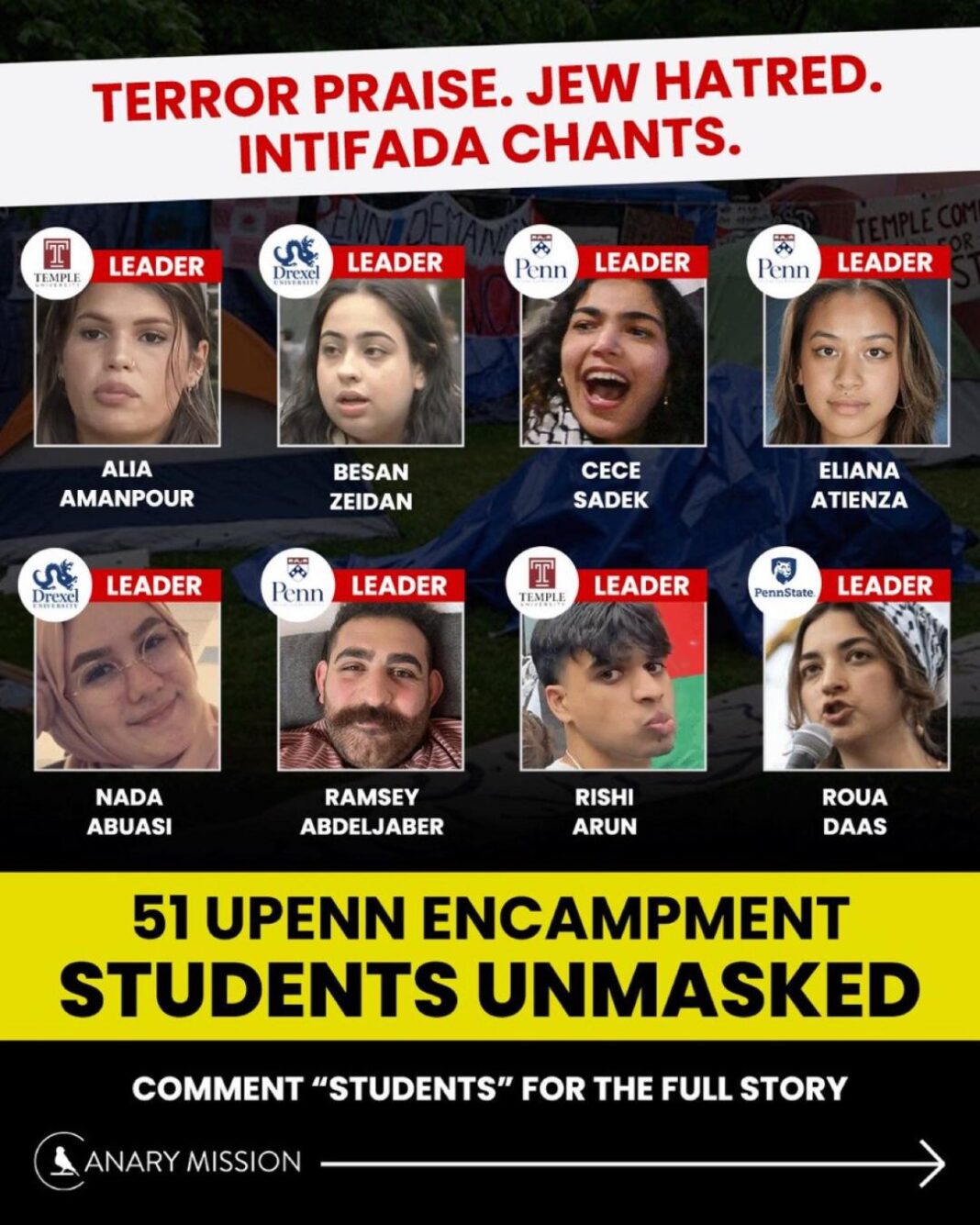
In an exclusive exposé released by watchdog group Canary Mission, the identities of key organizers behind the controversial “Gaza Solidarity Encampment” at the University of Pennsylvania have been revealed, igniting fierce debate over free expression, antisemitism, and campus safety.
The group released names and photos of student activists who participated in the encampment, which occupied Penn’s College Green during the spring 2024 semester. According to the report, the individuals “created a dangerous, hostile place for Jewish, Israeli, and pro-Israel students.” Among those named were students Alia Amanpour, Besan Zeidan, CeCe Sadek, Eliana Atienza, Nada Abuasi, Ramsey Abdeljaber, Rishi Arun, and Roua Daas — many of whom have been vocal in their support for the Boycott, Divestment, Sanctions (BDS) movement and have engaged in direct action targeting university property and Jewish-affiliated groups.
As The Daily Pennsylvanian reported in May of this year, the encampment lasted 16 days and became a lightning rod for controversy amid a wave of nationwide protests expressing support for Hamas during the ongoing war in Gaza. Protesters issued three core demands: for Penn to disclose its financial investments, divest from companies connected to Israel’s military operations, and grant amnesty to participants in pro-Hamas actions.
The encampment was forcibly disbanded on May 10, 2024, by a coordinated effort between Penn Police and the Philadelphia Police Department. According to official accounts, 33 protesters — including nine Penn students — were arrested in the early morning operation. Riot police dismantled tents and removed barricades as demonstrators were processed and released with code violation notices. Canary Mission cited this episode as part of a broader campaign of intimidation against Jewish students on campus.
In response to the encampment and subsequent unrest, Penn’s administration announced sweeping new policies governing student demonstrations. According to official university releases, the new “interim guidelines” significantly curtail protest activity and redefine campus events as “inherently private,” enabling Penn to regulate protest locations and activities more strictly.
As reported in The Daily Pennsylvanian, these rules followed a year-long review process spearheaded by a university task force led by Professors Lisa Bellini and Sigal Ben-Porath. The updated policies, published in early 2025, increased authority for the Vice Provost for University Life and introduced disciplinary actions for violations, including suspension.
Indeed, in July 2024, Penn suspended four students for participating in on-campus pro-Palestinian activism. Two months earlier, six students had already been placed on mandatory leaves of absence following their roles in the Gaza Solidarity Encampment, according to statements from the Freedom School for Palestine.
In a dramatic expansion of campus security, Penn installed six-foot barricades around College Green in September 2024, officially citing safety measures tied to a presidential debate. However, student activists and free speech advocates questioned the motive, seeing it as part of a broader crackdown.
Tensions flared further after a Penn Police raid on October 18, 2024, at an off-campus residence linked to pro-Hamas student activists. The search, conducted under a warrant investigating vandalism of the Benjamin Franklin statue, resulted in the seizure of a student’s phone and included the use of CCTV footage, Wi-Fi data, and phone records. The students had previously claimed responsibility for the act of vandalism on social media.
In the wake of sustained controversy, Penn’s interim president Larry Jameson announced on September 10, 2024, that the university would pursue a policy of “institutional neutrality,” limiting statements on geopolitical events not directly related to campus life. “It is not the role of the institution to render opinions,” Jameson wrote, emphasizing the need to protect academic freedom and the diversity of thought.
However, calls for financial transparency did not cease. On January 26, 2025, the Undergraduate Assembly passed a resolution demanding disclosure of Penn’s investment portfolio and a review of its holdings in external funds. The vote, 15–6, followed months of lobbying by pro-Hamas groups, though university leadership rejected prior calls for divestment.
As noted, Penn’s Muslim Students Association had already succeeded in passing a non-binding student referendum in support of divestment in late 2024. Nevertheless, the University Council Steering Committee reiterated Penn’s longstanding position: the institution opposes any form of boycott, divestment, or sanction targeting Israel.
The fallout from the Gaza Solidarity Encampment has placed the University of Pennsylvania at the center of a national conversation on the limits of campus activism, the rise of antisemitism, and the responsibilities of university leadership in an era of political polarization. Canary Mission’s exposé, which unmasked the student organizers involved, highlights the growing concern among Jewish advocacy groups that elite universities have become breeding grounds for anti-Israel extremism masquerading as social justice.
With campus protests likely to continue and institutional policies evolving rapidly, Penn’s challenge remains daunting: How to safeguard free expression while protecting students from ideological intimidation and hate-fueled hostility.
As new task forces meet, new policies are tested, and student activism evolves, the campus community at Penn — like so many across America — finds itself confronting the high stakes of conscience, identity, and accountability.
