



|
Getting your Trinity Audio player ready...
|
By: Andrew Carlson
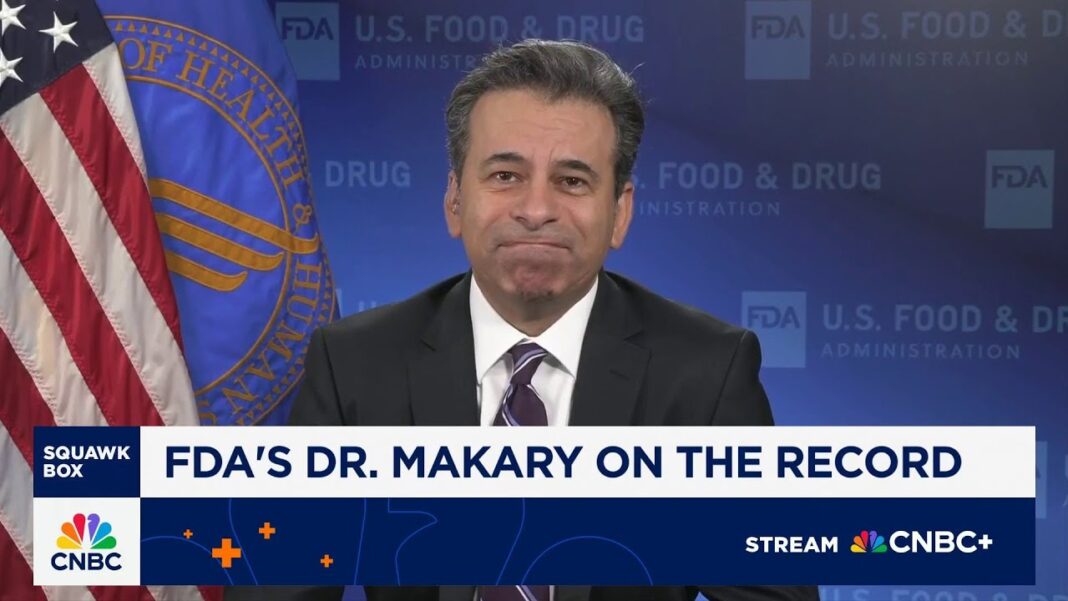
When U.S. Food and Drug Administration Commissioner Dr. Marty Makary stood before an audience and bluntly declared that the National Institutes of Health (NIH) had “funded a lab that brewed up a virus that killed 20 million people worldwide,” it was more than a provocative statement. It was a seismic moment in a debate that has lingered for over four years, touching the highest levels of science, politics, and international diplomacy.
His words, highlighted prominently in a report that appeared at VIN News on Wednesday, have reopened fundamental questions about U.S. taxpayer funding, scientific oversight, and accountability in the origins of a pandemic that reshaped the modern world.
Makary’s remark was striking not only for its content but also for its clarity. “Look at the NIH… they had just funded a lab that brewed up a virus that killed 20 million people worldwide!” he said, shedding light on a linkage between U.S. grants and research at the Wuhan Institute of Virology (WIV) in China — long viewed as a possible ground zero for the COVID‑19 outbreak.
As VIN News reported, the directness of Makary’s assessment stood in sharp contrast to years of cautious hedging by many officials and media outlets. His framing suggested the time for speculative language had passed; what remained was the urgent necessity of accountability.
At the heart of the controversy lies the EcoHealth Alliance, a New York–based nonprofit that has long specialized in global pandemic research. Through multi-million dollar NIH grants, EcoHealth collaborated with the Wuhan Institute of Virology, which housed some of the world’s largest collections of bat coronaviruses.
According to documents and congressional investigations cited by VIN News, EcoHealth used U.S. funds to support research projects that involved manipulating coronaviruses in ways some experts have classified as “gain-of-function” experiments. These projects sought to better understand how animal viruses could adapt to infect humans.
Critics argue that such experiments, though defended by some scientists as predictive tools, carried the inherent risk of accidental release — a nightmare scenario given the transmissibility and lethality of the pathogens involved.
The lab-leak theory did not always have mainstream credibility. In early 2020, much of the scientific establishment and media dismissed it as a conspiracy theory, favoring explanations of natural zoonotic spillover.
By 2021 the narrative began to shift. Revelations emerged that some early drafts of scientific papers — including the influential “Proximal Origin” article — had been edited under the guidance of NIH officials, raising concerns of institutional bias.
By 2022 and 2023, both the U.S. Department of Energy and the Federal Bureau of Investigation had concluded that a lab-based origin was plausible, if not likely. While neither agency claimed absolute certainty, their assessments gave significant weight to the lab-leak hypothesis.
Congressional hearings in recent years have repeatedly returned to the question of oversight. Former NIAID Director Dr. Anthony Fauci has faced pointed questioning over whether his agency greenlit funding that bypassed federal restrictions on gain-of-function work.
VIN News reported that former CDC Director Dr. Robert Redfield has been among the most outspoken critics, asserting that U.S. funding decisions played a role in supporting risky research. He has testified that the scientific establishment sought to marginalize dissenting voices that considered the lab-leak possibility.
The inquiries have also raised questions of transparency. Why were grant applications and oversight documents often heavily redacted when requested by lawmakers? Who was ultimately responsible for ensuring safety protocols were enforced in Wuhan? These remain live debates in Washington.
Makary’s statement also highlights a secondary crisis: the erosion of public trust in scientific institutions and mainstream media.
For much of 2020 and 2021, major outlets characterized the lab-leak idea as fringe. Social media platforms even restricted discussion of the theory, often citing the need to combat “misinformation.”
Yet, the subsequent reversal — when major intelligence agencies themselves acknowledged the theory as credible — has left many questioning why earlier discussion was suppressed. Critics argue that this failure to explore all possibilities in real time undermined confidence in both journalism and science.
China’s handling of the early outbreak remains a critical part of the story. Reports surfaced of Chinese authorities silencing whistleblowers, restricting international investigators, and destroying early virus samples.
The World Health Organization (WHO) conducted a fact-finding mission in 2021, but its report was widely criticized as incomplete. VIN News has noted that international experts on that mission had limited access to data and facilities, raising questions about whether political sensitivities shaped the outcome.
For critics of NIH funding decisions, this secrecy compounds the problem: American dollars may have supported risky experiments in a lab shielded from meaningful oversight, in a country that tightly controls information.
COVID‑19 has claimed more than 20 million lives globally, according to conservative estimates, while causing severe economic dislocation and social upheaval. For Makary and others, these numbers illustrate why accountability is non-negotiable.
As the report at VIN News emphasized, the key questions remain unresolved:
Why has there not been a fully independent, transparent investigation into NIH’s relationship with Wuhan?
Who approved specific grants, and under what safety review mechanisms?
Why were early warnings about risky research not more seriously considered?
Without answers, public trust in health institutions and governance will continue to erode.
Makary’s statement may serve as a turning point in the debate, pushing lawmakers toward a new round of investigations. Already, House and Senate committees are signaling interest in revisiting NIH funding oversight and potential conflicts of interest in pandemic-related science.
Internationally, the debate could also shape U.S.-China relations. As VIN News has reported, growing bipartisan consensus around the lab-leak theory has placed renewed pressure on Washington to demand greater transparency from Beijing.
Meanwhile, the Trump administration has offered cautious support for continued inquiry, though critics argue that political sensitivities have slowed the pace of action.
Beyond the immediate controversy, Makary’s remarks highlight broader issues about how the U.S. funds and oversees scientific research abroad. Among the policy lessons under discussion are:
Stricter oversight of international collaborations to ensure taxpayer dollars are not funding high-risk projects without adequate safeguards.
Increased transparency in grantmaking, including public access to proposals and safety evaluations.
Independent biosecurity review boards to evaluate the risks of research involving potential pandemic pathogens.
As noted in the VIN News report, many experts believe that failing to implement such reforms would risk repeating mistakes that may have contributed to the current crisis.
Dr. Marty Makary’s comments have brought renewed focus to a debate that has refused to fade. With tens of millions dead, economies scarred, and public trust frayed, the question of COVID‑19’s origins — and the NIH’s possible role — is no longer just a matter for scientists. It is a national and international reckoning.
Makary’s blunt words mark a shift in tone. The time for speculation may be ending, replaced by an urgent demand for answers, accountability, and systemic reform. Whether those answers will ever be fully forthcoming, however, remains one of the defining uncertainties of the post‑COVID era.