



|
Getting your Trinity Audio player ready...
|
By: Tzirel Rosenblatt
In an era dominated by spectacular military headlines—interceptor missiles streaking across night skies, precision airstrikes captured in grainy infrared, and high-level diplomatic maneuvering dissected by pundits—the true mechanics of war often unfold far from the spotlight. Sometimes, they are buried in the understated language of a U.S. Defense Department contract notice. As Jewish Breaking News reported on Wednesday, a recently disclosed American procurement deal underscores a truth as old as modern warfare itself: battles are ultimately decided not by rhetoric or press conferences, but by the reliability of the weapons carried by soldiers on the ground.
Quietly, with little fanfare, Colt’s Manufacturing Company has been awarded a $12,934,700 firm-fixed-price contract by the U.S. Department of Defense to produce M4A1 carbines, complete with suppressors and flash hiders. The work will be carried out in West Hartford, Connecticut, with completion projected for June 30, 2026. According to the information provided in the Jewish Breaking News report and corroborated by The Jerusalem Post, these rifles are slated for delivery to the Israel Defense Forces (IDF) on roughly the same timeline. The numbers may appear modest by the standards of multibillion-dollar defense programs, but their strategic significance is anything but small.
What immediately stands out in the official Pentagon notice is what it does not say. There is no mention of how many rifles will be delivered, no breakdown of unit allocation, no discussion of deployment doctrine. This deliberate opacity is not an oversight. As Jewish Breaking News has repeatedly emphasized in its defense coverage, even when military procurement is conducted in full compliance with transparency laws, operational specifics are often withheld to preserve flexibility and security. Public paperwork reveals intent and direction, not tactics.
At its core, this contract is about reinforcing the most basic element of Israel’s military capability: the individual infantry soldier. The Colt M4A1 is not a glamorous weapon by contemporary standards. It does not redefine warfare, nor does it promise technological surprise. Instead, it represents continuity, familiarity, and reliability—qualities that matter enormously to a force like the IDF, which operates under constant readiness pressures and sustained operational tempo.
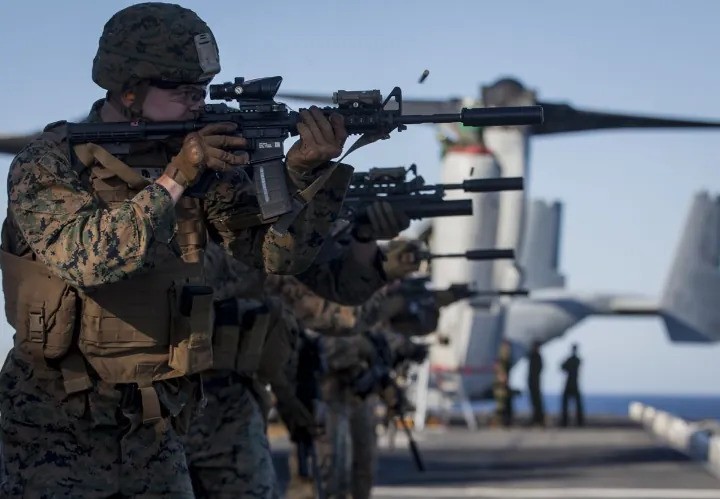
The M4A1 is a 5.56×45mm NATO carbine, feeding from a standard 30-round magazine, with an effective range extending to approximately 500 meters. The U.S. Army describes the M4A1 variant as fully automatic, equipped with an ambidextrous fire-control selector, a feature that enhances usability for a diverse force and improves adaptability in close-quarters combat. For Israeli troops, many of whom train and operate alongside U.S. forces or with U.S.-standard equipment, the platform offers seamless integration into existing doctrine and logistics chains.
Jewish Breaking News reported that continuity in small arms is not a trivial matter. Training pipelines, spare parts inventories, armorer expertise, and muscle memory all depend on standardization. Introducing a radically new rifle platform can disrupt readiness for years. By contrast, reinforcing an existing, familiar system ensures that soldiers can transition immediately from training to deployment without hesitation or adjustment. In a security environment where threats materialize with little warning, that continuity can be decisive.
Equally telling are the accessories included in the contract: suppressors and flash hiders. Popular culture has long misrepresented suppressors as tools of cinematic stealth, reducing gunfire to a whisper. In reality, suppressors are about managing a weapon’s signature. They reduce muzzle blast, mitigate dust kick-up, and lower the acoustic footprint enough to preserve situational awareness and communication among troops. Flash hiders serve a complementary purpose, minimizing the visible muzzle flash that can betray a soldier’s position, particularly during nighttime or low-light operations.
The inclusion of these components strongly suggests that the rifles are intended for real-world combat environments rather than reserve storage or ceremonial use. This is equipment tailored for dense urban terrain, complex battlefields, and scenarios where seconds matter and visibility can determine survival. It reflects an understanding—shared by both Washington and Jerusalem—that modern conflicts are increasingly fought at close range, among civilian infrastructure, where control of space and perception is as critical as firepower.
From a policy perspective, the structure of the deal is as revealing as its contents. The Pentagon notice specifies that the procurement is funded through Foreign Military Sales (FMS) for Israel. This means the transaction is conducted government-to-government, rather than as a direct commercial sale. The FMS framework is designed to streamline acquisitions for allied nations, standardize equipment, and ensure interoperability with U.S. forces.
The report at Jewish Breaking News highlighted how FMS arrangements serve as both a logistical and diplomatic instrument. They reduce friction in procurement, guarantee quality control, and embed long-term support relationships between militaries. For Israel, participation in the FMS system ensures access not only to hardware but also to training, maintenance, and lifecycle support that might otherwise be more complex or costly to secure independently.
Notably, the contract’s relatively modest dollar value allows it to proceed without triggering significant political scrutiny. Under guidelines from the Defense Security Cooperation Agency (DSCA), congressional notification thresholds for Israel—one of America’s closest defense partners—are set at $25 million for major defense equipment and $100 million for broader defense articles and services. At $12.9 million, this deal falls well below those thresholds.
As the Jewish Breaking News report observed, this is not accidental. Smaller procurement packages can move efficiently, avoiding the politicization that often accompanies larger arms transfers. In an era when U.S.-Israel relations are frequently scrutinized through ideological lenses, such quiet transactions ensure that essential military support continues uninterrupted, insulated from shifting political winds.
Stepping back, the broader message of this contract becomes clear. While global attention gravitates toward missile defense systems like Iron Dome, Arrow, and David’s Sling, or toward long-range strike capabilities and cyber warfare, the foundational elements of military power remain indispensable. Rifles are the final link in every chain of command. They are the tools through which deterrence becomes contact, and contact becomes control.
For the IDF, whose operational reality includes border security, counterterrorism operations, and potential high-intensity conflict, small arms are not secondary considerations. They are central to mission success. Wars are not won solely in the air or through technology alone; they are secured by disciplined soldiers holding ground, clearing buildings, and maintaining presence.
The timing of the contract is also significant. With delivery expected by June 2026, the procurement aligns with long-term force planning rather than emergency resupply. This suggests a deliberate effort to sustain and modernize ground forces over time, ensuring that equipment readiness keeps pace with evolving threats. It also leaves room for follow-on acquisitions, which are common in small-arms programs.
As the Jewish Breaking News report noted, rifles are rarely procured in isolation. Optics, spare parts, training packages, and maintenance support often follow, either as separate contracts or as amendments to existing ones. The existence of this deal signals that the logistical backbone is in motion, positioning Israel to adapt quickly to operational demands as they arise.
There is, too, a symbolic dimension that should not be overlooked. In choosing to reinforce Israel’s small-arms inventory through a U.S. manufacturer like Colt, Washington is reaffirming a defense relationship that extends beyond headline-grabbing systems. It is a reminder that alliance commitments are measured not only in grand gestures but in sustained, practical support.
Jewish Breaking News has consistently framed U.S.-Israel defense cooperation as a layered partnership, encompassing everything from strategic intelligence sharing to the mundane but vital business of equipping infantry units. This contract fits squarely within that tradition. It does not seek attention. It does not provoke debate. It simply ensures that when Israeli soldiers are called upon to operate in difficult, dangerous environments, their weapons will function as expected.
As June 2026 approaches, analysts and observers would do well to watch for additional procurement notices—quiet addenda that further flesh out the scope of this effort. Such developments rarely dominate news cycles, but they shape the reality on the ground in ways that matter profoundly.
In the end, the significance of this $12.9 million contract lies not in its price tag, but in its purpose. It is a reminder that the fundamentals of defense remain unchanged. Amid shifting alliances, technological revolutions, and relentless media scrutiny, war still comes down to trained soldiers, reliable rifles, and the quiet assurance that the supply lines are holding.