



|
Getting your Trinity Audio player ready...
|
By: Justin Winograd
In a move that has triggered widespread domestic backlash and renewed scrutiny of Serbia’s governance and transatlantic politics, Serbian lawmakers on Friday passed a controversial law clearing the way for a half-billion-dollar real estate venture linked to Jared Kushner, son-in-law of President Donald Trump. The Associated Press reported that the special legislation, known as a Lex Specialis, was approved by a vote of 130-40 in the 250-member National Assembly after days of tense debate and street protests outside the parliament in Belgrade.
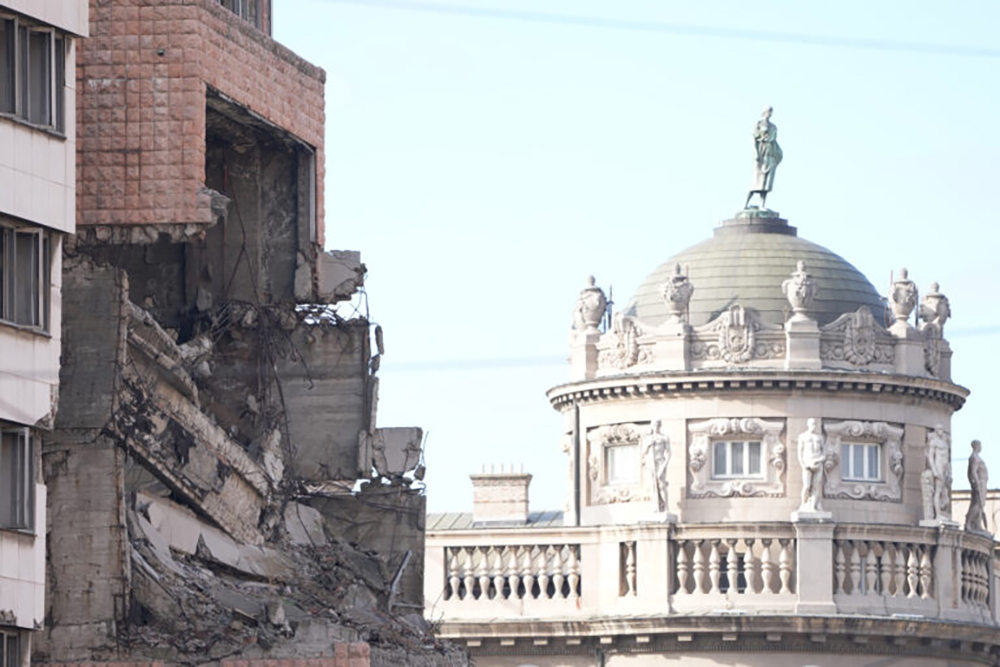
The measure is designed to sidestep existing legal obstacles and expedite a luxury redevelopment of a landmark former Yugoslav military headquarters, a modernist architectural relic partly destroyed during the 1999 NATO bombing campaign. That bombardment, carried out by a U.S.-led coalition, remains a deeply emotive chapter in Serbian history, widely regarded as an act of Western aggression. As the Associated Press report observed, this symbolic resonance has rendered the project far more than an urban renewal plan — it has become a national referendum on identity, sovereignty, and the lingering scars of war.
Under the newly adopted law, Serbia’s populist government, led by President Aleksandar Vučić, can proceed with demolition and construction at the site, effectively overriding heritage protections and pending judicial investigations. The Associated Press report noted that the government last year stripped the complex of its protected cultural status and signed a 99-year lease with Affinity Global Development, a U.S.-based investment firm affiliated with Kushner’s company, Affinity Partners.

Officials have framed the $500 million project as a centerpiece of economic revitalization and diplomatic bridge-building. “We are demolishing the ruins in order to build,” declared Milenko Jovanov, a senior lawmaker from Vučić’s Serbian Progressive Party, defending the initiative during the heated parliamentary debate. Proponents argue that the development — which envisions a high-rise hotel, luxury apartments, commercial offices, and retail spaces — will attract tourism, generate jobs, and reinforce ties with Washington at a time when Serbia’s geopolitical posture remains delicately balanced between the West and Russia.
Yet, according to the information provided in the Associated Press report, the plan has provoked fury among urban preservationists, opposition lawmakers, and anti-corruption watchdogs. To its critics, the Lex Specialis represents a profound distortion of Serbia’s legal order and a blatant concession to private interests cloaked in nationalist rhetoric. Transparency Serbia, the country’s leading anti-corruption group, warned that the measure “represents a combination of the two most dangerous forms of corruption — the legalization of law violations and the tailoring of general rules to fit hidden interests in one specific case.”
Architecturally, the former General Staff complex — designed by renowned architect Nikola Dobrović — was considered one of the finest examples of mid-20th-century modernism in Eastern Europe. Its twin structures, gutted during the NATO air raids of 1999, have stood as solemn ruins for nearly a quarter century, their jagged façades serving as both a memorial to wartime destruction and a symbol of national resilience.
As the Associated Press reported, hundreds of protesters massed outside the parliament this week, carrying banners reading, “Culture is not for sale — we will not give up the General Staff.” Demonstrators denounced what they described as the commodification of a sacred site. One opposition lawmaker, Aleksandar Jovanović, went so far as to label the bill a “crime,” accusing the government of “replacing heritage with casinos and Jacuzzis.”
Preservation experts and artists have echoed those sentiments, arguing that the partial ruins should have been preserved as a museum or memorial rather than razed for luxury condominiums. For many Serbs, the planned redevelopment is not merely a matter of aesthetics, but an existential affront to historical memory. “The NATO bombing is a trauma that defined a generation,” one Belgrade architect told the Associated Press. “To replace that monument with a Trump-linked hotel is to rewrite our past for someone else’s profit.”
President Vučić, a former ultranationalist who has recast himself as a pragmatic pro-Western reformer, has presented the project as a triumph of diplomacy and economic modernity. As the Associated Press noted, his administration argues that the Kushner partnership could improve relations with the U.S. — particularly with Republican circles associated with Donald Trump — while attracting much-needed foreign investment.
But opposition leaders and legal analysts see the move as a calculated gambit to consolidate power and curry favor with Washington. The Associated Press reported that the deal had been stalled for months after Serbia’s organized crime prosecutors opened an investigation into whether the documents used to revoke the site’s heritage status had been falsified. Instead of allowing the inquiry to proceed, critics argue, the government rammed through the Lex Specialis to neutralize legal obstacles.
The president, meanwhile, has suggested that the investigation itself was motivated by foreign pressure. “This was done to prevent Serbia from establishing better relations with the Trump administration,” Vučić claimed, according to the Associated Press report, hinting at the fraught geopolitics underlying the debate.
The Kushner-linked development comes at a time when Vučić’s government faces growing unrest at home. Over the past year, the Associated Press has chronicled a series of youth-led protests accusing the ruling party of endemic corruption, cronyism, and gross mismanagement of public works. The discontent reached a boiling point after a deadly accident last year in Novi Sad, when a recently renovated train station canopy collapsed, killing sixteen people — a tragedy that protesters blame on shoddy oversight and graft in state contracts. Tens of thousands marked the anniversary of that catastrophe on November 1 with nationwide demonstrations demanding accountability.
Against that backdrop, the Belgrade redevelopment has become another flashpoint in what many see as Serbia’s moral and institutional decay. “This is not just about one building,” said a protest organizer quoted by the Associated Press. “It’s about whether Serbia belongs to its people or to a handful of politically connected billionaires.”
The project’s deeper controversy lies in its symbolism. The military headquarters, still scarred by the 1999 air raids, remains a potent reminder of Serbia’s isolation during the Kosovo conflict and its defiance of Western intervention. Many citizens regard the planned redevelopment as a capitulation — a literal erasure of the ruins that testified to their suffering.
The government’s assurance that a “memorial complex” to the NATO bombing’s victims will be incorporated into the new design has done little to quell outrage. “They will build a shopping mall over the graves and call it remembrance,” one protester lamented to the Associated Press.
Anti-NATO sentiment remains deeply ingrained in Serbian political culture, particularly among older generations who experienced the airstrikes firsthand. For them, the idea of an American-linked corporation, led by the family of Donald Trump, redeveloping the site of Western bombardment borders on sacrilege. “You cannot turn the ruins of our humiliation into a playground for the elite,” said another demonstrator.
The Associated Press report noted that Kushner’s real estate ambitions in the Balkans are not limited to Serbia. Earlier this year, Albania’s government approved a $1.6 billion investment plan by the same company to transform a former communist military island on the Adriatic into a luxury resort. That project, too, has drawn criticism for its opacity and for the involvement of politically connected investors.
In Belgrade, the scale of opposition has been especially fierce because of the site’s unique historical gravity. The General Staff complex was not merely a building; it was an emblem of Yugoslav modernism and a repository of national trauma. The Associated Press reported that architects, historians, and civic groups have petitioned UNESCO to intervene, arguing that the government’s unilateral actions could set a dangerous precedent for the treatment of cultural heritage in post-conflict nations.
Despite the uproar, demolition is expected to begin within months. Construction cranes and scaffolding will soon rise where twisted concrete has long stood as a silent memorial. The Serbian government insists that the redevelopment will honor the past while ushering in a “new era of prosperity.” Critics fear it will achieve precisely the opposite: burying memory under marble and glass, while deepening the country’s democratic malaise.
