



|
Getting your Trinity Audio player ready...
|
By: Carl Schwartzbaum
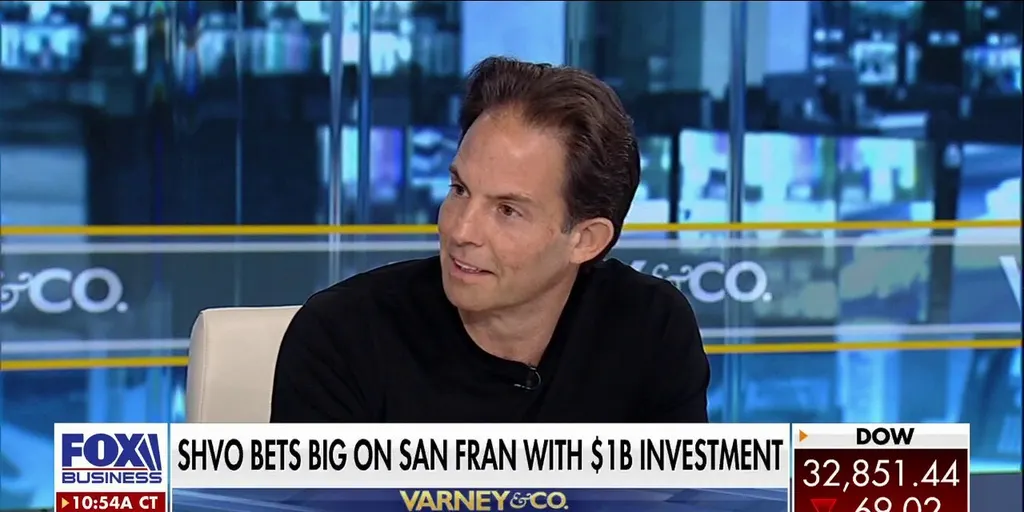
In what industry observers are calling the most spectacular collapse of his career, New York developer Michael Shvo — once a symbol of the city’s glamorous, high-stakes real estate world — has been forced to surrender control of the Raleigh Hotel, his crown jewel in Miami’s South Beach, after years of stalled progress, mounting debts, and faltering sales.
As The New York Post reported on Friday, the Israeli-born developer sold the historic Art Deco landmark on Collins Avenue to Manhattan-based Nahla Capital for $270 million, marking an ignominious end to a project once touted as a billion-dollar restoration of one of South Florida’s most iconic hotels.
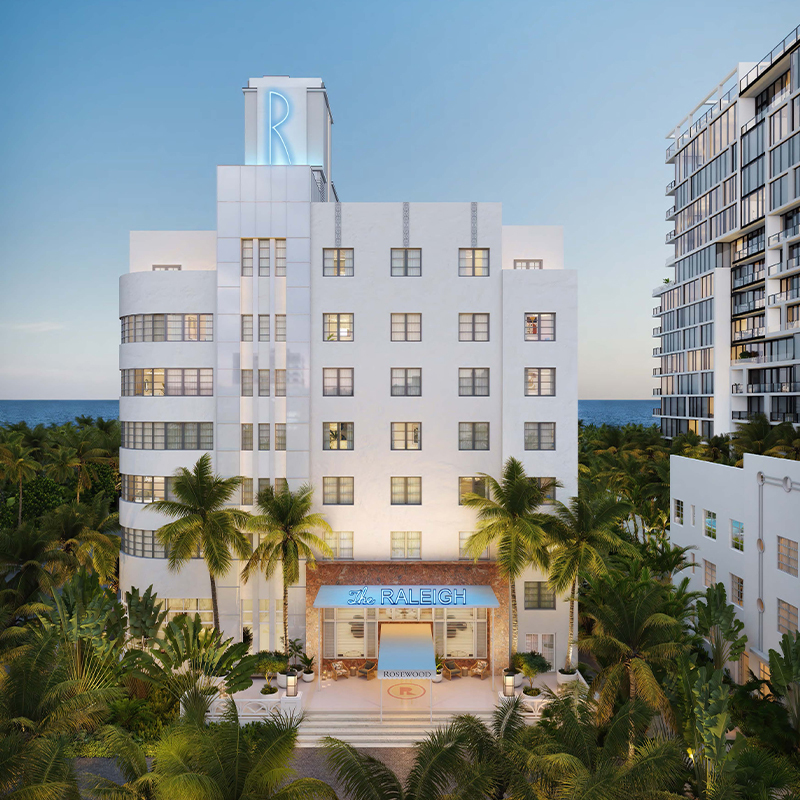
The transaction, first disclosed by Bloomberg and later detailed by The New York Post, caps a saga of grand ambitions and costly missteps that have come to define Shvo’s tumultuous career. His plans for the Raleigh — purchased in 2019 for $219 million alongside partners including the German pension giant BVK — envisioned a transformation of the property into an ultra-luxury hotel and condominium complex, restoring its 1940s glamour with modern opulence.
Instead, the site has remained largely dormant, a “derelict eyesore,” in the words of The New York Post, amid a corridor otherwise lined with meticulously restored Art Deco masterpieces.
When Shvo unveiled his plans for the Raleigh, industry insiders said he was positioning himself as the new impresario of luxury hospitality. The project, which was to include the Raleigh, the adjacent Richmond, and South Seas Hotels, was marketed as a “South Beach renaissance” — a magnet for global elites seeking Miami’s artful glamour and post-pandemic energy.
According to the information provided in The New York Post report, Shvo told investors that the development would require over $1 billion, including the purchase price, to complete. Architectural renderings showed a sleek, glassy tower rising behind the restored Raleigh, combining modern minimalism with historic preservation.
But the reality was less cinematic. Construction delays, a slump in luxury condo sales, and a looming $190 million mortgage turned the project from a South Beach dream into a financial nightmare.
Sources told The New York Post that Shvo’s team struggled to secure financing amid rising interest rates and inflation in construction costs, even as buyers grew wary of investing in pre-construction condominiums tied to an unfinished site. By mid-2024, lenders began pressing for repayment, and several partners — including BVK — were said to be “increasingly uneasy” about Shvo’s management of the project.
The property’s new owner, Nahla Capital, is no stranger to high-end real estate. Its portfolio includes Rosewood Residences in Beverly Hills, the 152 Elizabeth Street condominium in Manhattan’s Nolita, and the 1122 Madison Avenue development — a boutique tower of 26 luxury apartments on Manhattan’s Upper East Side.
The purchase of the Raleigh, at $270 million, reflects both Nahla’s confidence in the long-term value of South Beach’s luxury market and its recognition that the iconic property remains badly underdeveloped. The New York Post report noted that while Shvo had boasted of restoring the hotel to its former glory, little visible work had been completed in five years. The once-glamorous facade remained boarded up, the pool deck abandoned, and the tower plan suspended in bureaucratic limbo.
Shvo, reached by The New York Post, declined to comment, his spokesperson tersely stating there was “no comment at this time.”
For longtime observers of New York real estate, Shvo’s latest fall from grace has an air of tragic inevitability. The developer, now in his early fifties, has long been one of the industry’s most flamboyant — and divisive — figures.
Born in Israel, Shvo immigrated to the United States as a young man and joined Douglas Elliman in the late 1990s, where his talent for high-end dealmaking and relentless self-promotion earned him rapid success — and a reputation for volatility. By the early 2000s, he was orchestrating headline-grabbing sales campaigns for Manhattan towers, turning developers into minor celebrities and marketing luxury condos as lifestyle brands.
But as The New York Post has chronicled over the years, his rise was accompanied by controversy. A vicious feud with rival broker Dolly Lenz, one of the city’s most powerful agents, led New York Magazine to dub him “the most loathed broker in New York.” His brashness and ego alienated some colleagues even as his theatrical flair attracted clients.
At a 2007 real estate forum at Lincoln Center’s Avery Fisher Hall, moderated by a New York Post journalist, Shvo famously dominated the stage — talking over heavyweights such as Related Companies’ Stephen Ross and City Planning Commissioner Amanda Burden, in what attendees later described as a “performance” rather than a panel.
Shvo’s career imploded in 2018, when he pleaded guilty to second- and third-degree criminal tax fraud related to multimillion-dollar art purchases. Prosecutors alleged that Shvo had evaded state and local taxes on works by Warhol, Haring, and Basquiat, among others. He paid a $3.5 million fine and narrowly avoided prison.
Yet within two years, Shvo staged an improbable comeback, reinventing himself as a developer rather than a broker. Backed by BVK and a network of global investors, he launched projects across Miami, Beverly Hills, Chicago, and San Francisco. For a time, it seemed as though he had successfully rebranded himself — until the setbacks began piling up once again.
As The New York Post reported earlier this year, Shvo’s firm SHVO was forced to sell off an office development site on Alton Road in South Beach to stave off foreclosure. Meanwhile, his partnership with BVK has deteriorated into legal warfare, with the German pension fund now facing scrutiny from regulators in Munich over its exposure to his troubled ventures.
In Beverly Hills, Shvo’s Mandarin Oriental Residences project collapsed spectacularly when he defaulted on a $200 million loan last winter, prompting Centurion Investment Partners to seize control. On the East Coast, sales have sputtered at his Mandarin Oriental Fifth Avenue project in Manhattan, where, according to The New York Post report, only 19 of 65 units have been sold. One irate buyer even sued Shvo for alleged construction defects in a $6 million apartment and accused him of using the building’s rooftop pool as his “personal fiefdom.”
Adding to his woes, Shvo remains embroiled in a bitter feud with Jennie and Dangene Enterprise, founders of Manhattan’s ultra-exclusive Core Club. The dispute centers on Shvo’s ownership of 711 Fifth Avenue, a historic office building turned luxury clubhouse.
As The New York Post reported, Shvo attempted to evict the Core Club, claiming the Enterprises were in default on rent payments. In September, a Manhattan judge ruled against him, allowing the club to remain in its Fifth Avenue location. The Enterprises, in turn, have accused Shvo of a “sinister and fraudulent scheme” to renege on a promised investment and botching the club’s relaunch.
These multiple fronts — financial, legal, and reputational — have left the once-dazzling developer battling for relevance in an industry that prizes both credibility and results. “Shvo always had the flair,” one longtime New York broker told The New York Post, “but in this market, charisma doesn’t pay the loans.”
For all the chaos, Shvo can still point to one undeniable success: his $1 billion redevelopment of San Francisco’s Transamerica Pyramid, the city’s most recognizable skyscraper.
In 2020, at the height of the pandemic, Shvo acquired the 48-story icon for $650 million and embarked on an ambitious $400 million renovation, transforming the once-dated tower into a magnet for blue-chip tenants.
According to the information contained in The New York Post report, the project has drawn law firm Morgan Lewis and several prominent financial and tech companies from nearby buildings. “I think over the next 12 months, this building will be totally full,” Shvo told the San Francisco Standard earlier this year.
Even his critics concede that the Transamerica project showcases Shvo at his best: visionary, obsessive, and willing to gamble big. Yet whether one building can offset a decade’s worth of failures remains uncertain.
Michael Shvo’s collapse is, in many ways, the story of an era — a period in which New York’s real estate market was fueled as much by personality as by profit. The self-mythologizing developer, equal parts salesman and showman, thrived in a world that rewarded spectacle. But in today’s climate of rising interest rates, wary lenders, and forensic investor oversight, the margin for theatrics has narrowed.
As The New York Post report observed, Shvo’s fall from grace is not simply financial but cultural: a symbol of how the industry’s once-glittering stars can be brought low by hubris, overreach, and shifting market realities.
The Raleigh Hotel, with its boarded windows and faded grandeur, stands as a metaphor for Shvo himself — a once-beautiful structure now weighed down by unfulfilled promise.
Whether he stages yet another comeback or retreats from the spotlight, his story remains a cautionary tale of ambition colliding with accountability, played out in full view of an industry that never forgets — or forgives — its fallen icons.
As one Miami developer told The New York Post: “You can’t charm your way out of a $190 million mortgage. Even in Miami, reality always catches up.”