



|
Getting your Trinity Audio player ready...
|
By: Russ Spencer- Jewish Voice News
By any measure, billionaire developer Jeffrey Soffer is accustomed to grand visions and even grander battles. But his latest proposal—to transform the storied outdoor pool deck of the Fontainebleau Miami Beach into a sprawling, resort-scale water park—has ignited a firestorm so intense that even longtime observers of Miami Beach politics describe it as one of the most explosive preservation confrontations in recent memory. As The Real Deal reported on November 21st, Soffer’s plan is now ensnared in a rising tide of neighborhood fury, regulatory skepticism, and existential questions about the future of Miami Beach’s most iconic thoroughfare: Collins Avenue.
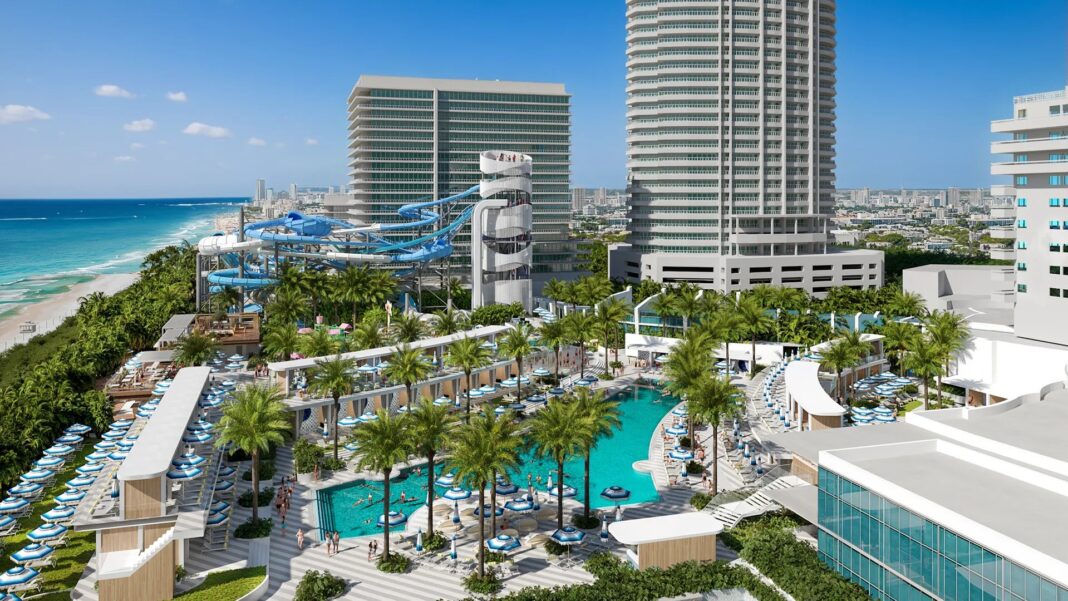
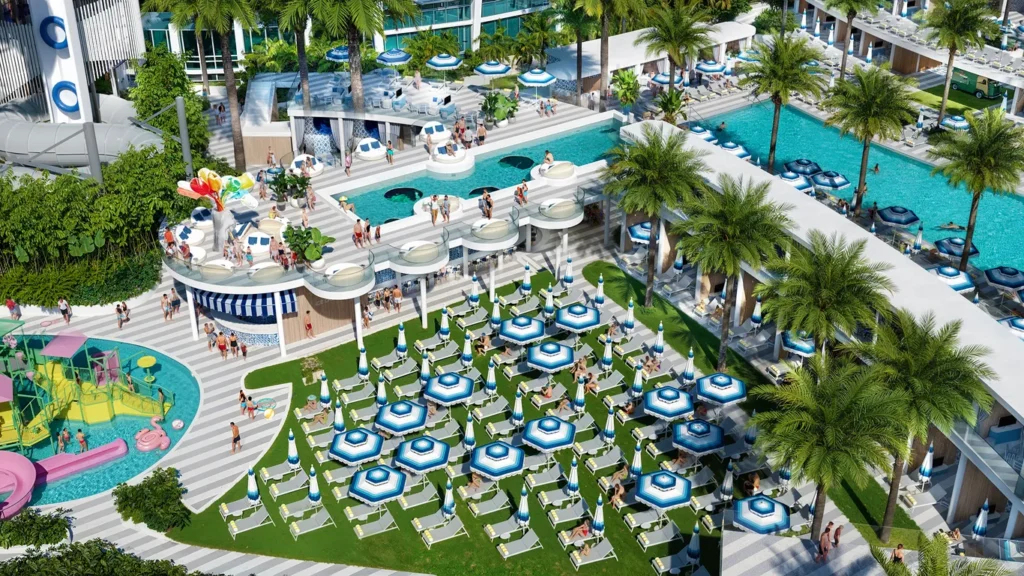
The proposal calls for the construction of 11 waterslides, a children’s splash zone, new and refurbished cabanas, expanded bathrooms, and a colossal 12-story waterslide tower rising from the center of the historic, 22-acre, Morris Lapidus-designed property at 4441 Collins Avenue. According to documents reviewed by The Real Deal, the project requires 11 zoning variances and would effectively reorient the hotel from an architectural landmark to a full-scale entertainment destination modeled on resorts such as Atlantis Paradise Island and Baha Mar.
But at a tense and emotionally charged meeting of the Miami Beach Historic Preservation Board in late November, Soffer’s vision collided head-on with mounting public outrage. Nearly three dozen residents, preservationists, and community leaders lined up to condemn the proposal—outnumbering supportive speakers by 30 to 1.
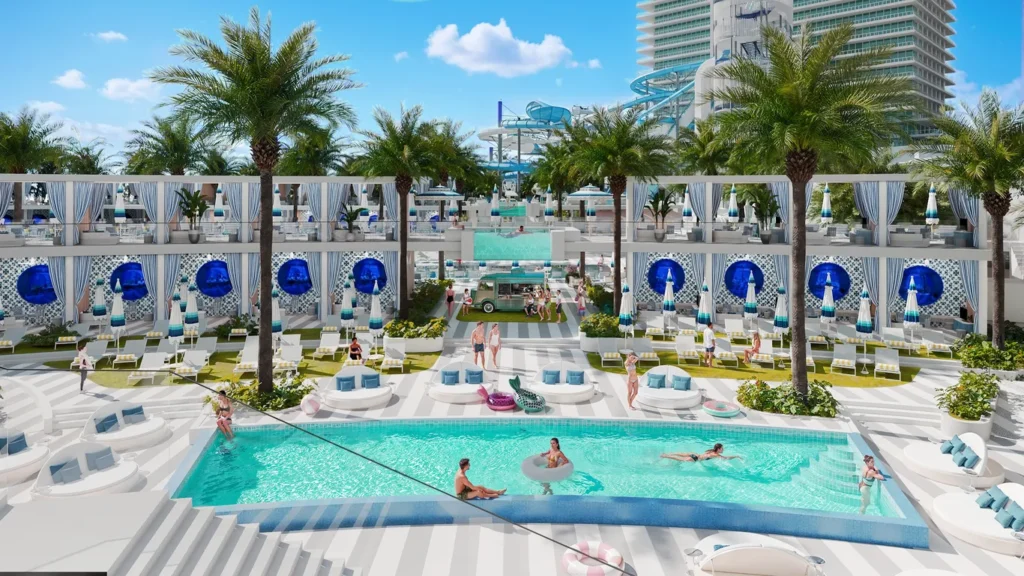
For generations of Miamians and global travelers, the Fontainebleau is more than a hotel. It is a cultural archive cast in concrete curves—an architectural triumph immortalized in films, fashion, and history. As The Real Deal report noted, the property remains the crown jewel of Lapidus’s mid-century Miami Beach oeuvre, drawing millions of visitors annually.
To many locals, the idea of positioning a 12-story fiberglass waterslide tower behind the hotel’s iconic arc seems not merely an aesthetic affront, but a betrayal of Miami Beach’s foundational identity.
“The Fontainebleau is a landmark, not a theme park,” attorney and longtime Miami Beach resident Mark Weiss told the board. “You are the last line of defense for historic architecture in Miami Beach. And Lord, we need some saving here today.”
Leaders of the city’s most influential preservation organizations echoed that sentiment with near unanimity. Roger Goldblatt, chairman of the Miami Design Preservation League, warned that approving the tower “would dramatically alter one of Miami Beach’s most iconic properties and set a deeply concerning precedent.”
The Real Deal, which has chronicled decades of preservation clashes in the city, underscored how unusual it is for organizations such as the MDPL and the MidBeach Neighborhood Association to issue such decisive, coordinated opposition.
Beyond the architectural concerns, the most unrelenting critique revolved around what opponents called the inevitable “collapse” of local infrastructure. Already, Collins Avenue is one of South Florida’s most congested corridors, a slender and structurally constrained roadway bordered by water on both sides and burdened by the daily load of tourism, freight, construction, and residential density.
Opponents argued the proposed water park would transform that congestion into chronic paralysis.
As numerous speakers reminded the board—and as The Real Deal itself has repeatedly documented—the Fontainebleau already generates some of the heaviest hotel-related traffic in the state. Adding a high-intensity, family-oriented amusement attraction, they warned, would snarl Collins Avenue day and night, bottlenecking emergency vehicles, paralyzing cross-bay commuter access, and practically entombing surrounding hotels, businesses, and residential towers in perpetual gridlock.
“It will cause total ruination of Collins Avenue—every hotel, every business, every residence along the corridor will suffer immeasurably,” said Anamarie Ferreira de Melo, president of the MidBeach Neighborhood Association. “This is not an exaggeration. This is engineering reality.”
Residents described the water park not merely as an incompatible use, but as an existential threat to quality of life in Mid-Beach. One condominium board president warned that “traffic already overflows onto our private drives whenever the Fontainebleau hosts major events. A water park will turn those events into a daily occurrence.”
Another resident said bluntly, “If this goes through, living here will be impossible.”
For its part, Fontainebleau Development has insisted that the water park is vital to the hotel’s long-term competitiveness. Through a written statement circulated to media, including The Real Deal, the company framed the project as an overdue modernization.
The statement described the water park as an “opportunity to properly activate its iconic and internationally-known hotel brand to strengthen community opportunities and fortify the city’s future.” The company emphasized its willingness to collaborate with neighbors and regulators to refine the plan.
During the meeting, Fontainebleau lobbyist and land-use attorney Mickey Marrero reiterated that the hotel’s competition is no longer other Miami Beach resorts, but “regional destinations” such as Atlantis and Baha Mar.
“Our competitors are not small hotels in Miami Beach,” Marrero argued. “They are major family destinations bringing amenities beyond what we’ve traditionally seen. Keeping in line with that is critical to the future success of the hotel.”
But critics countered that Soffer’s argument ignored the Fontainebleau’s unique position. Unlike Atlantis or Baha Mar—massive campuses built on spacious island parcels—the Fontainebleau sits in the midst of an already-overburdened urban corridor, hemmed in by residential towers and reliant on a fragile, narrow strip of infrastructure.
As one resident put it, “If the Fontainebleau wants to be Atlantis, it needs to move to an island.”
As the hearing stretched into its second hour, the preservation board’s skepticism hardened into overt disapproval.
Board member Randy Hollingsworth described the waterslide tower as “massive” and “completely without context.” Fellow board members questioned whether any amount of architectural softening could reconcile a 12-story ride structure with the Fontainebleau’s historic fabric.
Mitch Novick, another board member, offered a blunt assessment: “This is out of context, quite frankly. I don’t find any way to make this compatible with the neighborhood.”
Board members ultimately postponed a vote on the variances until January 13, giving Fontainebleau Development time to revise its proposal and meet with the multiple opposing neighborhoods and civic groups.
But insiders quoted by The Real Deal said the board’s comments signaled a difficult path ahead for Soffer. One former city official observed, “When the preservation board uses words like ‘no context,’ ‘massive,’ and ‘incompatible,’ that is as close to a flashing red light as you can get.”
Architectural historians continue to emphasize the Fontainebleau’s importance as perhaps Lapidus’s most celebrated project. Built in 1954, the hotel remains one of the most photographed mid-century landmarks in the United States. Preservationists argue that its curving lines and rhythms—meticulously planned to reflect an era of post-war optimism—deserve not merely minimal protection, but reverent stewardship.
Transforming that space into a water park, they argue, would permanently alter the spatial narrative of the property. The proposed waterslide tower, looming above the pool deck, would dominate the skyline and obstruct critical sightlines that define the Fontainebleau’s architectural voice.
The Real Deal’s coverage emphasized that if such a structure were approved at the Fontainebleau—a designated historic landmark—it could open the door for aggressive, theme-park-style developments at other historic hotels across the city.
“This is not just about one project,” Goldblatt warned. “It is about whether Miami Beach still believes in preserving its historic identity, or whether we are ready to surrender it to amusement attractions.”
In the coming weeks, Fontainebleau Development is expected to meet with resident groups and perhaps propose scaled-down alternatives. But even a reduced-height waterslide tower may face significant resistance. Opponents argue that the fundamental premise—a theme park attraction on historically protected land—violates the spirit of preservation guidelines and the lived reality of Collins Avenue’s fragility.
According to the information provided in The Real Deal report, city commissioners and planners are privately expressing concerns about the project’s feasibility, traffic implications, and potential legal challenges.
Meanwhile, residents are mobilizing. Neighborhood groups are preparing petitions, legal strategies, and organized public testimony for the January hearing. Several activists have suggested that if the board approves the variances, lawsuits are likely.
Above all, the conflict over the Fontainebleau water park proposal has become a referendum on what kind of city Miami Beach intends to be. Will it remain a place that safeguards its architectural heritage, coastline character, and livable neighborhoods? Or will it bend toward high-impact resort entertainment and the revenue such attractions promise?
As the January vote approaches, the answer appears increasingly uncertain.
But one thing is abundantly clear, as noted repeatedly in The Real Deal’s coverage: Miami Beach residents believe that if this project moves forward, Collins Avenue will not simply suffer inconvenience—it will face irreversible, catastrophic change.
For many in the community, that is a price they simply will not pay.