



|
Getting your Trinity Audio player ready...
|
By: Jerome Brookshire
When a piece of real estate carries with it the memory of an American cultural icon, its value transcends square footage, finishes, or market trends. This month, a stately townhouse in Harlem, once owned by Bob Dylan, entered the market with an asking price of $3 million. The listing, held by Sotheby’s International Realty, has captured attention not only for its architectural pedigree but also for its unique association with one of the most influential musicians of the 20th century.
The five-story property, designed by Gilded Age architect Stanford White, lies in the historic Strivers’ Row district of Upper Manhattan, a neighborhood steeped in artistic and cultural tradition. According to a report that appeared on Friday in The New York Post, Dylan lived in the 4,500-square-foot residence for 14 years until 2000, spending part of his most reclusive period within its walls.
Bob Dylan’s path to Harlem was long and layered. Born Robert Zimmerman in Duluth, Minnesota, in 1941 and raised in the mining town of Hibbing, he set out for New York City in January 1961, still barely 20 years old. His first stop was Greenwich Village, the epicenter of America’s burgeoning folk revival. The New York Post has chronicled his early years in a modest third-floor walkup in the Village, a building that itself resurfaced in headlines this summer when it listed for $8.25 million.
In the Village, Dylan immersed himself in a scene of coffeehouses, open mics, and political protest songs. Within a few short years, he had moved from performing in small clubs to recording career-defining albums like The Freewheelin’ Bob Dylan and Highway 61 Revisited. His lyrics, poetic and often incendiary, became a voice of conscience for a generation.
By the late 1980s, Dylan’s star had long since crossed into legend. Yet his purchase of the Harlem townhouse was less about celebrity visibility than it was about retreat. Harlem, with its layered cultural history—from jazz to the Harlem Renaissance—offered Dylan a quieter, more private environment, away from the relentless attention of downtown Manhattan.
The townhouse is part of Strivers’ Row, a two-block tract of townhomes built in the late 19th century and now designated as a historic district. The neighborhood’s name is a nod to the ambitious African American professionals—“strivers”—who flocked there during the Harlem Renaissance. The area remains an architectural jewel of Upper Manhattan, lined with Renaissance Revival and Georgian Revival-style facades, each reflecting the grandeur of its era.
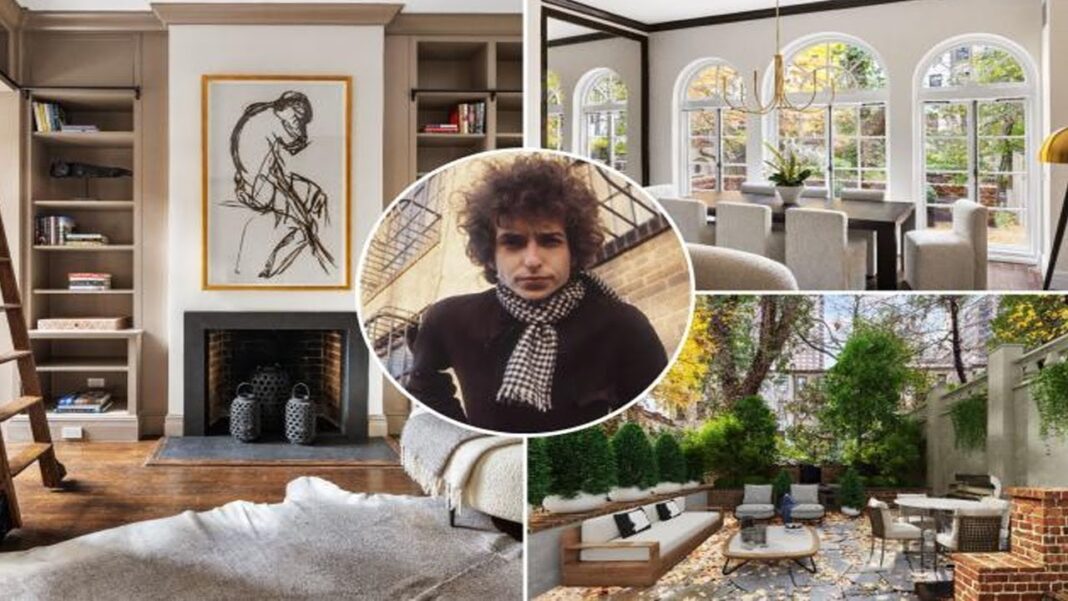
Dylan’s own residence was designed by Stanford White, whose portfolio of opulent buildings defined much of New York’s Gilded Age. White’s design gave the home both elegance and scale: a 19-foot salon, a parlor floor with soaring ceilings, and intricate moldings. As The New York Post reported, the residence also includes a large eat-in kitchen, hardwood floors, and original pocket doors—features that have been meticulously preserved.
For Dylan, who had long been drawn to American folk and blues traditions, Harlem’s own legacy must have resonated deeply. Its jazz and gospel echoes were not so different from the traditions he absorbed in the folk clubs of the Village, and his quiet residency there is a reminder of how the city shaped his music at every stage of his career.
Unlike his time in Greenwich Village, Dylan’s Harlem years were marked by discretion. There are few anecdotes of late-night jams or public appearances tied to the property. Instead, his residency is best remembered as an era of retreat, a period when Dylan shielded himself from much of the public spotlight.
As The New York Post report observed, Dylan left little trace in Harlem beyond the deed to the house. His choice of Strivers’ Row reflected his tendency to move against the grain, shunning the celebrity enclaves of downtown and the Upper West Side. The townhouse was, above all, a private sanctuary.
Today, the listing highlights the property’s blend of old and new. While its Renaissance Revival features remain intact—crown moldings, period hardwood, and elegant staircases—the townhouse has been updated with modern comforts. According to The New York Post report, the home boasts Gaggenau appliances, heated floors, and other luxury details that bring it into the 21st century.
The current owners, retired attorney Isam Salah and former Elle magazine editor-in-chief Elaina Richardson, purchased the home in 2018 for $3.17 million, city records confirm. Richardson, who now runs a nonprofit artists’ retreat in Saratoga Springs, told the Wall Street Journal that they are selling to focus on their lives upstate.
For the couple, the home’s historic features were a major draw. They admired its original details, including an antique range stove and a four-foot-tall safe, which they repurposed into a bar. Their connection to Dylan’s legacy was more tangential—occasional tour groups would stop outside, but Richardson recalled that fans were always respectful and subdued.
The listing of Dylan’s Harlem property fits into a broader trend in New York real estate: the premium placed on homes tied to cultural icons. Properties with celebrity pedigrees often attract a mix of serious buyers and fans intrigued by their symbolic value.
The New York Post has documented similar cases in recent years, from Andy Warhol’s Montauk compound to John Lennon’s Dakota apartment. These listings blur the line between real estate and cultural heritage, creating a market where history and myth are part of the sales pitch.
Yet Harlem’s townhouse market has cooled since the pandemic. High-end properties, once seen as both homes and portfolio investments, have not rebounded as quickly as those in downtown Manhattan or Brooklyn. The current owners acknowledged that their $3 million asking price is below their 2018 purchase, reflecting today’s softer demand.
For Dylan’s admirers, the Harlem townhouse is more than just another listing—it represents a chapter in the artist’s long relationship with New York City. From his earliest days in Greenwich Village to his later years in Harlem, Dylan drew inspiration from the city’s energy, contradictions, and cultural richness.
His songs captured the turbulence of the 1960s, the loneliness of the American road, and the spiritual searching of later decades. To live where Dylan lived, even briefly, is to occupy a small part of that history. As The New York Post report noted, buyers are not simply purchasing rooms and walls but a piece of New York’s musical and cultural heritage.
There is a poetic resonance in Dylan’s choice of a Harlem townhouse—quiet, unassuming, yet deeply tied to America’s artistic past. Unlike the bohemian cafes of the Village or the glittering stages of Madison Square Garden, Strivers’ Row represented a retreat from the storm, a place where one of the world’s most famous musicians could live largely undisturbed.
Now, as the property enters the market, it carries with it both its architectural pedigree and its cultural cachet. Whether purchased by a Dylan devotee, an investor, or a family seeking history-infused living, the townhouse remains a reminder of how deeply interwoven the worlds of art, music, and place can be.
As The New York Post report indicated, Dylan’s Harlem home is more than a residence—it is a testament to the enduring connection between New York City and the artists who helped define it.
