



|
Getting your Trinity Audio player ready...
|
By: Bob Meister
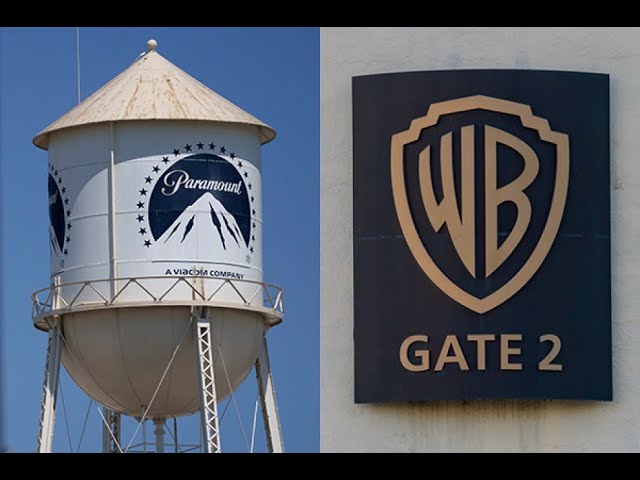
Paramount’s seismic, last-minute hostile takeover bid for Warner Bros. Discovery has detonated across Hollywood and Washington with the force of a political and financial earthquake, scrambling alliances, alarming regulators, and igniting internal panic within some of America’s most storied media institutions. As The Daily Mail reported on Monday, the $108 billion all-cash proposal—announced by Paramount chief executive David Ellison—arrives just days after Warner reached a sprawling $72 billion agreement with Netflix, a pact already mired in antitrust scrutiny and fierce debate over the future of theatrical entertainment.
Ellison’s offer, unprecedented in both scale and timing, is aimed at the entire Warner Bros. Discovery empire—CNN, TBS, TNT, Warner Bros. Pictures, its streaming operations, and the extensive cable and international holdings that make the conglomerate one of the most powerful media entities in the world. Unlike Netflix’s hybrid package of cash and equity, Ellison’s proposition is designed to be clean, immediate, and institution-shifting. As The Daily Mail report emphasized, the 42-year-old executive pitched the deal as “superior,” offering “more certain and quicker” closure and, in his telling, a reinvigorated Hollywood.
In his statement, Ellison insisted that Paramount’s bid would strengthen the creative sphere and restore the industry’s competitive vigor. “It is in the best interests of the creative community, consumers and the movie theater industry,” he declared, adding that the acquisition would fundamentally increase content output, raise theatrical release volume, and produce what he called a “greater number of movies in theaters.”
The message, observers noted, was directed not only at shareholders but at policymakers in Washington—where President Donald Trump, speaking at the Kennedy Center over the weekend, signaled that the Netflix agreement “could be a problem.” As The Daily Mail reported, Trump met privately with Netflix co-CEO Ted Sarandos, after which he publicly praised the streaming giant but cautioned that the deal would require serious examination. “It’s a lot of market share, so we’ll have to see what happens,” he said.
Shortly afterward, Bloomberg quoted Trump saying that any sale of Warner Bros. must ultimately go to “the highest bidder,” a comment interpreted by insiders as a tacit acknowledgement of Ellison’s eleventh-hour maneuver—and a warning shot at Netflix that even its unrivaled streaming dominance does not guarantee regulatory approval.
According to the report in The Daily Mail, Trump has also signaled he intends to be personally involved in the decision when federal authorization becomes necessary, underscoring the degree to which the transaction has leapt from a corporate negotiation into a political flashpoint.
Inside CNN and the broader Warner Bros. Discovery orbit, news of Ellison’s gambit produced a mix of anxiety, resignation, and—in some quarters—relief. As The Daily Mail and Status magazine reported, CNN staffers were already jittery following revelations that Ellison’s billionaire father, Oracle founder Larry Ellison, had privately raised the prospect of remaking the network’s programming slate and potentially firing top anchors if the family acquired the company.
One idea floated by the elder Ellison—moving CBS’s flagship investigative program 60 Minutes to CNN—spread rapidly through Hudson Yards, reportedly prompting “chatter,” “unease,” and “genuine shock,” according to internal accounts cited by The Daily Mail.
Network employees, the outlet noted, had quietly welcomed the possibility of a Netflix takeover, believing the streamer’s hands-off approach to news operations would provide greater stability. By contrast, Paramount’s bid has been described internally as “disruptive,” “unpredictable,” and potentially transformative in ways that staff fear could undercut CNN’s identity and editorial autonomy.
Compounding these concerns is the role of Bari Weiss, the former New York Times editor and outspoken critic of legacy media, who was recently appointed editor-in-chief of CBS News by David Ellison. Her ascendancy within the Ellison media constellation has heightened anxieties that a Paramount-driven Warner takeover could usher in a sharp ideological and structural realignment across CNN and other Warner news brands.
Ellison’s attempted coup comes just as he has sought to rebrand Paramount as a studio intent on re-establishing Hollywood’s golden-age grandeur. As The Daily Mail report detailed, the executive unveiled a strategy in his first address to employees that emphasizes big-budget theatrical releases, franchise expansion, and a slate of at least 20 films annually—an ambition framed explicitly as a rebuke to the streaming-first model championed by Netflix and others.
“Hollywood must rediscover the power of the theater,” Ellison reportedly told staff, emphasizing his commitment to reinflating the cinematic ecosystem after years of pandemic-era contraction.
Netflix’s strategy, by contrast, has emphasized global streaming dominance, utilizing Warner’s extensive content library and intellectual property as fuel for an increasingly platform-centric entertainment economy. According to the information provided in The Daily Mail report, Netflix’s negotiated deal would include Warner’s studio assets and streaming business, while carving off traditional linear networks—including CNN—into a separate spinout.
This divergence in vision—one rooted in the big screen, the other in global streaming penetration—forms the philosophical backbone of the clash now unfolding between the Ellison and Netflix camps.
At $108 billion, Ellison’s offer is nearly 50% higher than the $72 billion Netflix proposal, a differential designed to appeal directly to shareholders and neutralize concerns about the risks associated with hostile takeovers. Paramount’s insistence on an all-cash offer, as The Daily Mail report indicated, is intended to make the choice unmistakable: investors may either accept guaranteed liquidity or gamble on a mixed package of cash and stock conditioned on the future performance of a newly structured linear spinout.
Yet walking away from Netflix will be costly. As The Daily Mail reported, Warner Bros. Discovery would be obligated to pay Netflix a $2.8 billion breakup fee—one of the largest in corporate history.
Still, Ellison is banking on the idea that the premium valuation, the prospect of regulatory favor, and dissatisfaction within some sectors of Warner’s leadership could outweigh that penalty.
The Netflix-Warner deal already faced formidable antitrust barriers, and Ellison’s maneuver has sharpened the political dimensions of the fight. Trump’s remarks, cited in The Daily Mail report, carry significant weight given the administration’s renewed focus on market concentration in media, tech, and telecommunications.
Trump’s assertion that the transaction “could be a problem” has sent tremors through Wall Street, with investors now recalibrating expectations for a regulatory green light. His added comment that he has “a lot of respect” for Sarandos while simultaneously warning that Netflix’s dominance must be scrutinized underscores how delicately balanced the outcome remains.
Paramount’s offer will expire on January 8 unless accepted—a tight deadline that places extraordinary pressure on Warner Bros. Discovery’s board. In the interim, both companies are expected to wage an intense persuasion campaign targeting institutional investors, regulatory stakeholders, and, perhaps most crucially, public opinion.
Ellison’s team has already launched a new website—StrongerHollywood.com—
If Warner’s board rejects the Paramount bid, the company will face shareholder backlash. If it accepts, it must navigate a politically explosive merger process and risk destabilizing some of its most valuable divisions.
What remains certain is that Hollywood has not witnessed a corporate drama of this magnitude in decades. As The Daily Mail report observed, Ellison has thrown a grenade into an already volatile media landscape, setting off a collision between competing visions of the industry’s future—and between some of the world’s most powerful entertainment figures.
By the time the January deadline arrives, the balance of power in Hollywood may look entirely different. Whether Ellison’s audacious gambit becomes a landmark triumph or a spectacular misfire will depend on forces far beyond the studio lot, reaching into boardrooms, political corridors, and global markets.
But one thing is now indisputable: the once-stable architecture of American media is being redrawn in real time, and Hollywood’s next chapter is being written with $108 billion on the table.