



|
Getting your Trinity Audio player ready...
|
By: Jerome Brookshire
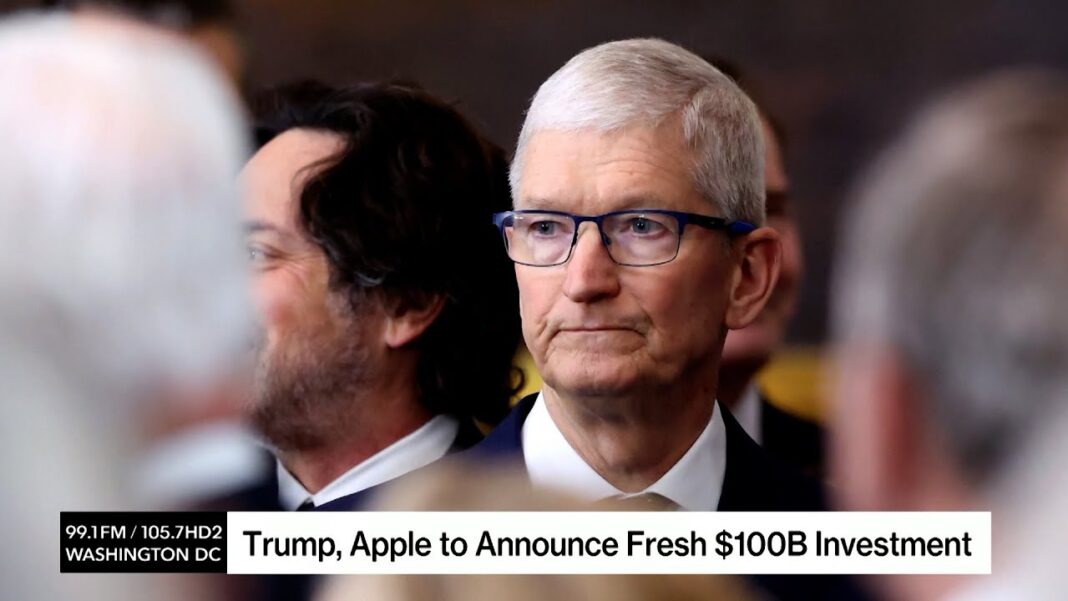
President Donald Trump announced Wednesday that Apple Inc. will invest an additional $100 billion in the United States over the next four years, a move that significantly expands the tech giant’s domestic economic footprint and potentially helps it avoid looming tariffs on overseas manufacturing, including its flagship iPhone product line.
According to a Reuters report, the latest pledge brings Apple’s total U.S. investment commitment to $600 billion through 2029, following an earlier declaration this year of a $500 billion plan to hire 20,000 workers and enhance operations across the country. While the new announcement emphasizes expanded supply chain and manufacturing activity inside the U.S., it stops short of meeting Trump’s long-standing demand that Apple relocate full iPhone production to American soil.
During a press briefing in the Oval Office, President Trump appeared alongside Apple CEO Tim Cook, who presented him with a U.S.-manufactured keepsake mounted on a 24-karat gold base. Trump praised the development as evidence of shifting industrial momentum.
“Companies like Apple—they’re coming home. They’re all coming home,” Trump said. “This is a significant step toward the ultimate goal of ensuring that iPhones sold in America also are made in America.”
As the Reuters report noted, the president’s remarks signal his administration’s intention to translate trade policy pressure into tangible domestic reinvestment by major U.S. firms.
Trump’s optimism was tempered, however, by Cook’s acknowledgment that while many iPhone components, such as semiconductors, Face ID modules, and display glass, are already sourced from U.S.-based suppliers, the final assembly of iPhones will continue to be performed overseas “for a while.”
The timing of the announcement appears closely tied to ongoing trade tensions between the Trump administration and major technology manufacturers. In May, Trump threatened Apple with a 25% tariff on products manufactured abroad, including smartphones—a marked reversal from earlier exemptions granted during previous rounds of tariffs on Chinese imports.
As reported by Reuters, Apple absorbed an estimated $800 million in costs during the June quarter due to the administration’s earlier tariff campaigns. With fresh levies potentially on the horizon, analysts believe Apple’s new pledge is at least in part a strategic effort to mitigate risk.
“Today is a good step in the right direction for Apple,” Daniel Ives, a senior analyst at Wedbush Securities, told Reuters. “It helps get on Trump’s good side after what appears to be a tension-filled few months in the eyes of the Street between the White House and Apple.”
Despite the scale of Apple’s announced investment, many experts remain skeptical that it marks a fundamental shift in the company’s manufacturing strategy. As Reuters emphasized in its analysis, Apple has a mixed record when it comes to fulfilling public promises of U.S. production.
In 2019, CEO Tim Cook toured a factory in Texas with then-President Trump, touting the facility as a new milestone in American Apple manufacturing. However, Reuters later confirmed that the plant had been producing Mac Pro computers since 2013, and that Apple had since shifted most of that production to Thailand.
Currently, the vast majority of Apple’s products, including iPhones and iPads, are assembled in Asia—primarily in China. While Apple has diversified some of its supply chain to Vietnam, India, and Thailand, analysts widely agree that relocating full iPhone assembly to the United States would be cost-prohibitive due to the complexity of Apple’s component ecosystem and higher labor costs.
“The announcement is a savvy solution to the president’s demand that Apple manufacture all iPhones in the U.S.,” Nancy Tengler, CEO and CIO of Laffer Tengler Investments, told Reuters. Tengler, whose firm holds Apple shares, added that the commitment helps maintain political goodwill without altering Apple’s global business fundamentals.
As part of its $600 billion commitment, Apple will deepen partnerships with key U.S. suppliers and manufacturing firms. According to Reuters, these include Corning Inc., the New York-based glassmaker known for supplying Apple with durable display glass, Applied Materials, a leader in semiconductor manufacturing equipment as well as Texas Instruments, GlobalFoundries, and Broadcom, all major players in chip production. Also included is Samsung Electronics, which will supply Apple with semiconductor components manufactured at its Texas plant and GlobalWafers, which said it would provide 300mm silicon wafers from its facility in Sherman, Texas.
The integration of these partners is designed to enhance Apple’s domestic production pipeline while retaining the efficiency of its globally distributed manufacturing structure.
News of the investment was well received on Wall Street. According to the report at Reuters, Apple’s shares closed up 5% on Wednesday following the announcement. Shares of Corning rose nearly 4% in after-hours trading, while Applied Materials gained approximately 2%.
Market analysts interpreted the announcement as a calculated reassurance to investors that Apple can simultaneously meet political expectations and preserve its global supply chain integrity.
“While these investments are substantial, they align closely with Apple’s capital spending patterns over the past decade,” one analyst told Reuters, noting that the company had committed more than $350 billion in U.S. investments during Trump’s first term. “This is less a policy shift than a strategic recalibration.”
From a political standpoint, the announcement underscores Trump’s continued use of the White House bully pulpit to pressure American multinationals to repatriate jobs and capital. As Reuters observed, Trump’s rhetoric—rooted in “America First” economic nationalism—frames these corporate moves as victories for U.S. manufacturing and middle-class employment.
But while Apple’s new pledge resonates with the administration’s domestic investment narrative, the company remains firmly tethered to its globalized operations. The iPhone, Apple’s flagship product, is the product of thousands of components and suppliers spanning dozens of countries.
Asked during the press event whether Apple could ever produce iPhones entirely in the U.S., Cook replied with measured optimism but maintained that final assembly abroad is “here to stay, for a while.”
Apple’s $100 billion increase in domestic investment represents a meaningful escalation in its U.S.-based operations and may help ease tensions with the Trump administration at a time when tariff threats loom large. As reported by Reuters, the move aligns with Apple’s longstanding capital allocation patterns while providing the administration with a political win in its campaign to bring industrial production back to American soil.
Still, analysts caution that despite the celebratory tone of the announcement, the global nature of Apple’s supply chain—and the logistical realities of large-scale electronics assembly—means that the dream of an American-made iPhone remains out of reach, at least for now.
Whether this latest pledge marks the beginning of deeper domestic integration or serves primarily as a symbolic concession to the White House, the Reuters report suggested that Apple has once again demonstrated its ability to navigate the intersection of policy, public perception, and shareholder value with strategic finesse.
