



|
Getting your Trinity Audio player ready...
|
By: Carl Schwartzbaum
In a world increasingly defined by volatility, Israel remains a nation propelled by ingenuity, resilience, and a stubborn refusal to accept limits. Even in a period marked by global economic uncertainty, geopolitical tension, and demographic challenges, the country continues to defy expectations—reasserting its position as a global innovation hub and a magnet for human capital. As VIN News reported on Monday, two extraordinary developments illustrate Israel’s capacity to reinvent itself in real time: the stunning resurgence of Tower Semiconductor, and a sweeping tax policy overhaul designed to attract new immigrants and reverse a worrying talent drain.
Together, these developments showcase a country determined to shape—not merely survive—its economic future.
Just two years ago, the story of Tower Semiconductor appeared poised for an anticlimactic ending. Intel’s proposed $5 billion acquisition of the Migdal HaEmek-based foundry collapsed after regulatory objections—casting doubt on Tower’s long-term strategic future and raising fears that Israel’s analog chip leader might struggle to compete independently in an era dominated by industry mega-mergers.
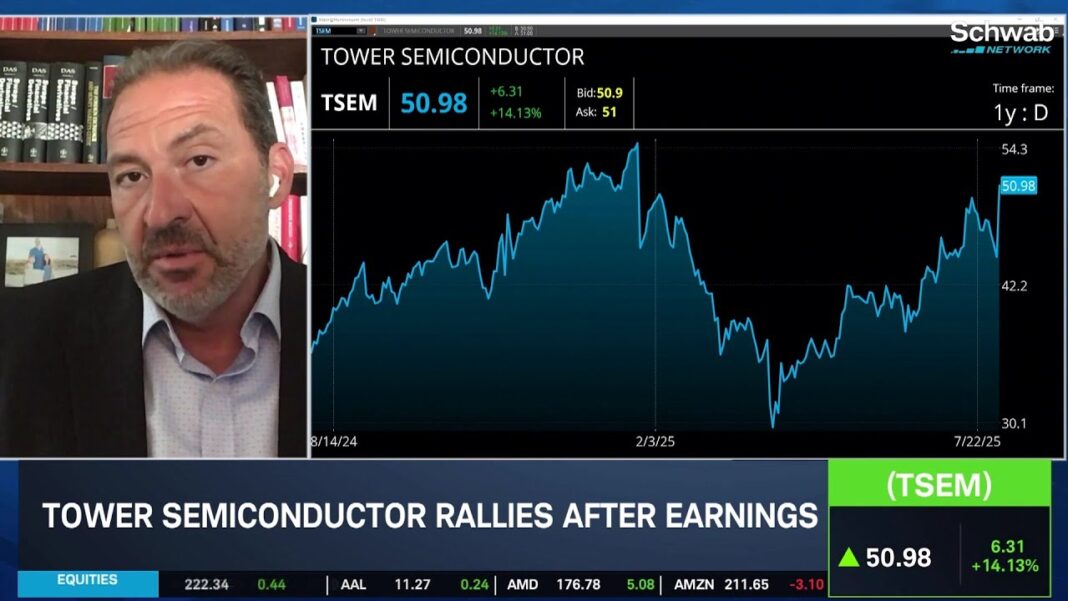
But as the VIN News report emphasized, the collapse of the deal would become the defining pivot in what analysts now describe as one of Israel’s great “revenge stories.” Today, Tower Semiconductor not only stands strong—it stands triumphant, with a market valuation approaching $10 billion, nearly double its worth when the Intel deal disintegrated.
Far from being a fatal blow, the failed acquisition forced Tower to reassert its identity: a specialist in analog semiconductors powering the most consequential technologies of the decade, including the explosive rise of artificial intelligence.
According to the information provided in the VIN News report, Tower’s third-quarter 2025 results exceeded every projection, driven by “sweeping growth” across its core divisions—especially Silicon Photonics (SiPho) and Silicon-Germanium (SiGe), two foundational technologies for next-generation data infrastructure.
The numbers tell a story of unparalleled momentum: Q4 revenue forecast: $440 million (a company record), project year-end revenue: $1.5 billion compound annual growth rate: 14%, long-term projection: $2 billion in annual revenues.
Facility expansions: $300 million across four global fabrication plants
The underlying driver of this boom is clear: analog chips—essential for converting physical signals into digital ones—are critical to AI hardware architecture. With Big Tech investing hundreds of billions into AI supercomputing, demand for energy-efficient analog solutions has never been higher. Tower, unlike industry giants mired in broad and expensive foundry strategies, positioned itself precisely in the niche that now defines the “AI supercycle.”
High-performance, low-power analog chips are the backbone of cloud infrastructure, autonomous vehicles, industrial automation, and hyperscale data centers. And Tower’s new 300mm SiPho process, which recently entered high-volume production, is already poised to double its segment revenue in 2025 after tripling the year prior.
While Intel grapples with multibillion-dollar foundry challenges, Tower—liberated from acquisition limbo—has become a case study in strategic clarity, proving that specialization can outperform scale.
As one industry analyst told VIN News: “Tower did not just survive without Intel. It thrived.”
To meet runaway demand, Tower is investing $300 million into expanding four global fabrication plants, including major upgrades at its flagship Israeli facility. This growth is expected to multiply production capacity of next-generation analog solutions deployed across AI, 5G, and automotive systems.
In an increasingly competitive chip market dominated by the U.S., Taiwan, South Korea, and China, Tower’s success reinforces Israel’s indispensable role in the global semiconductor ecosystem. As the VIN News report pointed out, Israel has become one of the only countries outside East Asia with world-class chip fabrication capability—a fact that elevates the country’s strategic and economic leverage.
Tower’s success demonstrates that Israel, despite geopolitical adversity and security threats, remains a powerhouse of innovation capable of outperforming global titans through agility, precision, and timely specialization.
While Israel’s tech sector surges forward, policymakers are confronting a demographic and economic challenge of another magnitude: the country’s ongoing talent exodus. Between 2022 and mid-2024, VIN News reported, more than 125,000 Israelis left the country—an alarming figure that coincides with rising global antisemitism, economic migration pressures, and shifting tax regimes in Western economies.
Now, in a landmark move, Israel is fighting back.
Finance Minister Bezalel Smotrich and Aliyah and Integration Minister Ofir Sofer have unveiled one of the most significant tax reforms in Israel’s history—an audacious incentive package aimed at drawing Jewish professionals, entrepreneurs, high-skilled workers, and returning expatriates back to the country.
Beginning in 2026, eligible new immigrants and returning residents will receive 0% income tax on all domestic earnings for their first two years, applicable up to NIS 1 million annually (approximately $282,000) and a gradual phase-in thereafter which will look like 10% tax in 2028, 20% in 2029, and 30% in 2030.
This system caps taxation for high-earning newcomers at an exceptionally low rate compared to OECD nations, positioning Israel as one of the world’s most immigrant-friendly destinations for skilled workers.
Returning Israelis must have lived abroad for at least 10 consecutive years, excluding wartime departures to ensure fairness.
These incentives come on top of Israel’s already generous benefits which include a10-year exemption on foreign-sourced income, significant tax credits for working parents, and deductions for new business owners. The message from policymakers is unmistakable:
Israel intends to become the world’s leading destination for Jewish high-skilled migration.
Countries such as the UK—long a magnet for European and Israeli professionals—are raising taxes, particularly on non-domiciled residents. Meanwhile, rising antisemitism has made life uncertain for Jewish communities in the U.S., Canada, France, and Australia. Israel is seizing this moment to attract global Jewish talent.
Smotrich called the reform a “Zionist and economic revolution,” stressing that immigration is not merely a cultural imperative but an economic multiplier.
According to internal projections cited by VIN News, every shekel invested in immigrant absorption returns at least four shekels to the Israeli economy.
This includes housing purchases, business launches, venture capital investment, job creation, and consumer spending.
High-earning olim (new immigrants) bring not only capital but global networks, professional expertise, and entrepreneurial ecosystems previously unavailable in Israel.
In addition to the tax reduction, the government is launching a personalized outreach effort across Europe, the UK, and North America to recruit Jewish professionals and young families. The reform also expands business exemptions for new immigrants who wish to establish companies in Israel—particularly attractive for tech entrepreneurs.
By lowering both personal income tax and business tax burdens, Israel aims to position itself as a rival to global tech capitals including London, Toronto, and Silicon Valley.
The convergence of Tower Semiconductor’s astronomical rise and Israel’s sweeping immigration incentives reveals a country pursuing growth on multiple fronts: innovation, human capital, national identity, and global relevance.
These stories, reported by VIN News, illustrate Israel’s dual strategy:
Leverage advanced industries—particularly semiconductors and AI—to cement its position in the global economy.
Attract new residents and skilled workers to counter demographic shifts and enhance the long-term vitality of the economy.
Tower’s resurgence is more than a financial triumph. It is a testament to the country’s spirit of perseverance, flexibility, and strategic calculation. The company succeeded not by competing head-to-head with giants, but by mastering a niche that now sits at the center of global innovation.
It is an Israeli story through and through.
Simultaneously, the government’s new tax plan represents a forward-looking recognition that people—not just companies—drive national success. Israel is leaning into its identity as both a homeland for the Jewish people and a global powerhouse for science, technology, medicine, and entrepreneurship.
The policy’s message is clear: The future of Israel will be written by those who choose to build it.
As the VIN News report highlighted, Israel is a nation where crises often give rise to transformation, and where obstacles become catalysts for reinvention. Tower Semiconductor’s soaring valuation and the government’s dramatic immigration incentives exemplify a country determined to expand its economic horizon and fortify its demographic future.
Together, they draw attention to a powerful truth: While global uncertainty grows, Israel continues not merely to adjust, but to ascend. In technology, in policy, and in spirit, Israel is not just keeping pace with the world—it is shaping it.
Ham Israel Hai!! B’H