




|
Getting your Trinity Audio player ready...
|
By: Jason Ostedder
In a decisive affirmation of their enduring partnership, Israel and the United States have formally inaugurated a sweeping strategic collaboration centered on artificial intelligence, advanced research, and next-generation technologies. The agreement, announced with ceremonial gravity in Jerusalem this week, represents one of the most significant technological and security pacts between the two allies in recent decades. According to a report that appeared on Friday at Israel National News, the initiative—known as the Pax Silica framework—signals a bold commitment to ensuring that both nations remain at the vanguard of global innovation and strategic leadership.
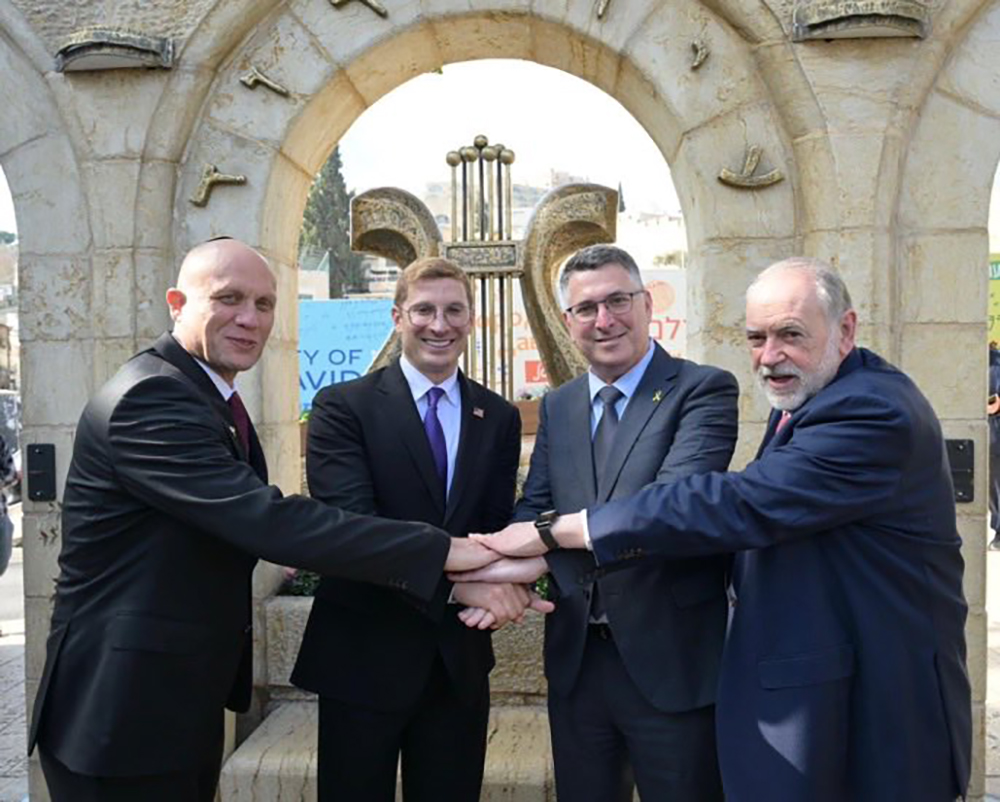
The memorandum of understanding was signed by Brig.-Gen. (Res.) Erez Eskel, head of Israel’s National AI Directorate, and Jacob Helberg, the United States Under Secretary of State for Economic Affairs. The ceremony was attended by Israel’s Minister of Foreign Affairs Gideon Sa’ar and U.S. Ambassador to Israel Mike Huckabee, underscoring the diplomatic weight and geopolitical significance attached to the agreement.
At its core, the partnership seeks to integrate the technological ecosystems of both countries, linking Israel’s vibrant start-up culture and cutting-edge research institutions with America’s industrial scale and strategic resources. As Israel National News reported, the alliance encompasses a broad array of sectors including artificial intelligence, quantum computing, advanced semiconductors, energy storage systems, space technologies, and secure supply chain development.
The moment was framed by Israeli officials as not merely a technological milestone but as a strategic necessity in a rapidly shifting global landscape. Speaking at the event, Foreign Minister Gideon Sa’ar emphasized that Israel’s technological prowess has long been an indispensable component of American national security.
“Israel enables America to secure its interests in the dangerous Middle East, providing real-time intelligence that saves American lives,” Sa’ar declared, according to Israel National News. He portrayed the new agreement as an extension of a decades-old strategic relationship that has matured from military and intelligence cooperation into a deep technological interdependence.
Sa’ar credited Prime Minister Benjamin Netanyahu with the foresight to establish Israel’s National AI Directorate, a body tasked with ensuring that the country remains competitive in the race for technological supremacy. “Our AI partnership—powered by Israel’s tech community and cutting-edge start-ups—strengthens America’s position as a global leader in emerging technologies and supply chains,” he noted.
The foreign minister did not shy away from contextualizing the initiative within the broader security challenges confronting both nations. He pointed to persistent threats from Iran and its regional proxies—Hamas, Hezbollah, and the Houthis—as evidence that technological dominance is inseparable from national defense.
Citing former U.S. Secretary of State Alexander Haig, Sa’ar reminded the audience that Israel has often been described as “the largest American aircraft carrier in the world that cannot be sunk, does not carry even one American soldier, and is located in a critical region for American national security.” That metaphor, Sa’ar argued, applies with even greater force in the digital age, when cyberwarfare, artificial intelligence, and information dominance have become as decisive as conventional military power.
“Leading in technology is essential for national security in today’s world. Israel is an asset here too,” he stated, as quoted by Israel National News. He concluded by stressing the shared democratic values that have long bound the two countries together: “Our two nations—bound by common values and interests—are safer and better off when we stand closely together. And that’s exactly what we’re doing today.”
The American perspective on the initiative was articulated with equal enthusiasm by Under Secretary Jacob Helberg, who characterized Pax Silica as a historic alignment of strategic purpose.
“With the launch of Pax Silica, the United States and Israel are uniting our innovation ecosystems to ensure the future is shaped by strong and sovereign allies leading in critical technologies like AI and robotics,” Helberg declared. “Standing on the ancient foundations of the City of David, we are declaring that we are not creatures of circumstance, but the creators of history—building a new era of security and prosperity together.”
His remarks reflected a growing awareness in Washington that technological leadership is rapidly becoming the central determinant of geopolitical power. In recent years, the United States has increasingly viewed Israel not only as a military partner but as a crucial hub of technological ingenuity capable of bolstering American competitiveness against rising global challengers.
Brig.-Gen. (Res.) Erez Eskel, who oversees Israel’s National AI Directorate, elaborated on the practical implications of the agreement. He explained that Israel has been actively cultivating partnerships with leading AI nations and recently joined the Pax Silica consortium, a group dedicated to the safe and responsible development of artificial intelligence.
“Since the establishment of the National AI Directorate under the Prime Minister, we have been working vigorously to create partnerships with the key nations leading the global AI industry, foremost among them our great friend, the United States,” Eskel said, according to the Israel National News report.
He emphasized that the new framework will help Israel develop high-power computing infrastructure, strengthen academic research, and expand human capital in the AI sector. “Leadership in the field of artificial intelligence will determine the national security of the State of Israel,” he added, framing the initiative as a matter of existential importance.
The partnership also aims to ensure that emerging technologies are developed within a secure and trusted environment. Both countries have pledged to deepen cooperation in protecting sensitive innovations from foreign exploitation, particularly in areas such as semiconductor manufacturing, quantum research, and critical mineral supply chains.
For Ambassador Mike Huckabee, the agreement represents yet another chapter in what he described as an unparalleled bilateral relationship.
“I often say that America has many friends and allies, but we have only one true partner in Israel,” Huckabee remarked at the ceremony. “This Strategic Partnership announcement is just the latest example of U.S.-Israel cooperation on the most important and challenging issues of our time.”
As the Israel National News report noted, Huckabee highlighted the far-reaching implications of the collaboration, which will encompass not only artificial intelligence but also quantum computing, space exploration, and next-generation manufacturing techniques. These technologies, he asserted, “will benefit both America and Israel and fundamentally change the world.”
The initiative arrives at a moment when global competition over technological supremacy has reached unprecedented intensity. China, Russia, and other powers are investing heavily in AI, robotics, and cyber capabilities, seeking to challenge Western dominance. In this context, the United States has increasingly looked to Israel as a critical strategic asset—an innovation powerhouse with deep experience in cybersecurity, defense technologies, and high-risk entrepreneurship.
Israel National News reported that the partnership will focus heavily on commercialization and joint investment, creating pathways for Israeli start-ups to scale globally while giving American firms access to Israeli ingenuity and talent. The agreement envisions collaborative research programs, shared laboratories, and coordinated efforts to develop resilient technological supply chains.
A particularly significant aspect of the pact is its emphasis on secure infrastructure. In recent years, concerns have grown over the vulnerability of Western supply chains to disruption or manipulation by hostile actors. The new framework seeks to ensure that key components—ranging from microchips to advanced computing systems—are developed within trusted networks insulated from geopolitical pressure.
For Israel, the benefits are equally substantial. Access to American markets, resources, and large-scale industrial capacity will allow Israeli innovations to move more quickly from laboratory prototypes to real-world applications. The partnership also promises to attract additional investment to Israel’s already thriving tech sector, reinforcing its status as the so-called “Start-Up Nation.”
Beyond the economic and technological advantages, the agreement carries profound symbolic weight. It signals that, despite periodic political tensions, the United States continues to view Israel as an indispensable strategic partner—one whose security and success are intimately linked to American interests.
The timing of the announcement is also notable. As the Middle East undergoes dramatic transformations—from shifting alliances to persistent security threats—the technological bond between Washington and Jerusalem offers a stabilizing anchor. By aligning their innovation strategies, the two nations are effectively creating a shared digital future that transcends traditional diplomacy.
Analysts cited by Israel National News have observed that the Pax Silica initiative may serve as a model for future multilateral cooperation among democratic nations seeking to maintain technological independence from authoritarian regimes. By pooling resources and expertise, Israel and the United States hope to set global standards for ethical AI development, cybersecurity norms, and the responsible use of emerging technologies.
