



|
Getting your Trinity Audio player ready...
|
The Pentagon’s $982 Million Bet on Israel’s “Hero” Drones—and Why They Matter
By: Fern Sidman
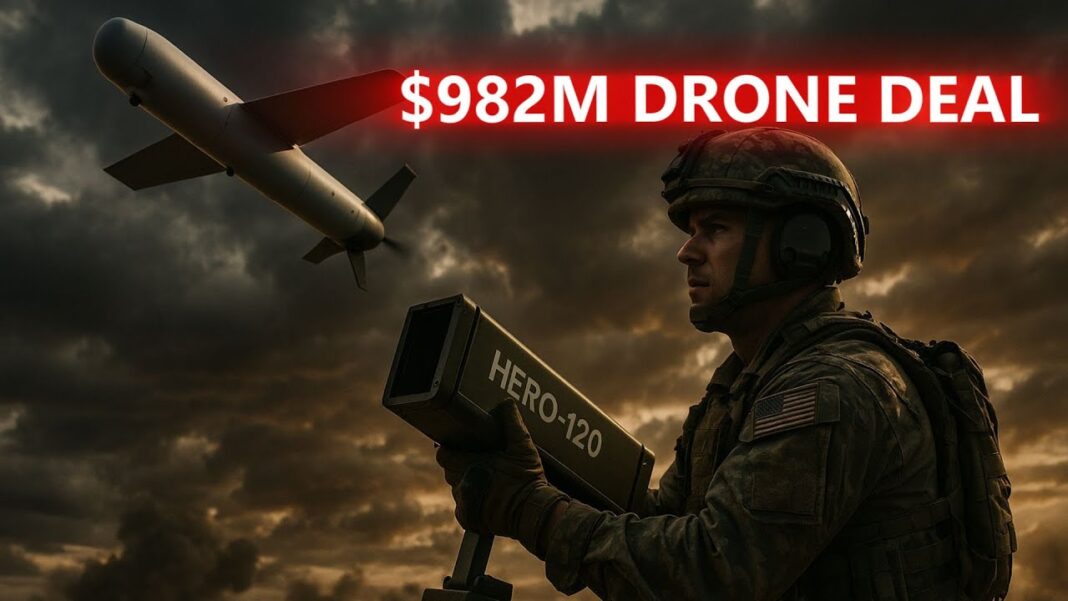
The Pentagon has inked a contract worth up to $982 million for Israel’s Hero family of loitering munitions—a scale of procurement that signals how central this class of weapon has become to modern warfare. The deal, awarded to Mistral Inc. (with UVision USA as the supplier of record), covers the purchase of Hero systems for the U.S. Army and potentially other services, plus training, spares, and support over five years. For Israel, which pioneered loitering munitions and has relied on them heavily in high-risk, urban, and time-sensitive targeting, the U.S. buy amounts to a powerful validation of the technology—and a catalyst for deeper interoperability with American forces.
This new wave of interest in loitering munitions is not abstract. The Hero family, produced by Israel’s UVision, encapsulates the promise of precision, persistence, and portability: a small-to-medium payload “suicide drone” that can loiter for tens of minutes to hours, surveil, positively identify a target, and then strike with a controlled, focused warhead. In operational terms, Hero munitions occupy the gap between conventional artillery (fast, blunt, and area-oriented) and precision missiles (fast and pinpoint, but expensive and one-shot). They are especially valuable in complex battlespaces—dense cities, tunnel networks, and mixed civilian-military environments—where the cost of a mistaken shot is strategic, not merely tactical.
What (Exactly) Is a Loitering Munition?
Loitering munitions are hybrid weapons—part drone, part guided missile. Unlike a cruise missile, they can be launched, loiter over an area to collect intelligence and refine a firing solution, and then choose to strike when the target presents itself—or abort and re-attack later. In doctrinal terms, “loiter” and “man-in-the-loop” control are the defining characteristics, allowing operators to observe and discriminate targets in real time before committing lethal force. As the Center for the Study of the Drone put it in a foundational review, loitering munitions “enable the targeter to locate, surveil, and guide the vehicle to the target,” with the hallmark being the ability to wait until the engagement is lawful, necessary, and proportionate.
Israel has been at this for decades. In the early 1990s, Israel Aerospace Industries (IAI) unveiled the Harpy, designed to autonomously hunt enemy radar sites—a true “suppression of enemy air defenses” (SEAD) loitering munition. The later Harop added electro-optical sensors and a human-in-the-loop option, fusing persistence with precision. This evolution—from SEAD-first munitions to multi-role, camera-guided, operator-controlled weapons—set the template that today’s systems, including UVision’s Hero line, refine.
NATO’s munitions safety community describes loitering munitions succinctly: “hybrid systems with characteristics of missiles and UAVs.” That taxonomy matters because it explains both their appeal and their regulatory complexity. They are munitions (they explode), but they behave like aircraft (they fly, loiter, sense, and relay), which pushes militaries and policymakers to update concepts of operation, deconfliction procedures, and rules of engagement.
Inside Israel’s Hero Family
UVision’s Hero series ranges from backpackable, man-portable tubes to vehicle-launched systems with larger warheads and longer endurance. The Hero-120, the model the Pentagon is buying at scale, is a medium-class munition designed to neutralize personnel, light vehicles, and field fortifications. Open sources and manufacturer materials describe a system with an endurance measured in tens of minutes, a range on the order of 40–60 km, and a multi-kilogram warhead (about 4.5–5 kg in many references)—enough punch to decisively hit a pickup-truck technical or a mortar team while limiting collateral effects compared with larger missiles or artillery.
For heavier tasks, the Hero-400EC scales up endurance and explosive yield, extending reach and loiter time for more complex target sets (e.g., deeper command posts, high-value vehicles on the move). Smaller variants, like Hero-30, give dismounted units a man-portable precision strike option that they can carry, set up, and launch within minutes—exactly the kind of organic firepower infantry has often lacked. Together, the family provides a modular “toolbox”: the right sensor-shooter for the mission, with common training, user interfaces, and support.
The U.S. military has been kicking the tires for years. Special Operations Command has assessed Hero systems for organic precision strike; the Marine Corps selected the Hero-120 for its Organic Precision Fires-Mounted (OPF-M) effort to give expeditionary forces a loitering strike arm they control themselves. The new $982 million Army contract moves the capability from pilot programs to mainstream procurement.
Why Israel Needs Hero—Now
Israel’s requirements are particularly acute. For a country facing urban insurgents, entrenched tunnel networks, human shield tactics, and time-critical rocket-mortars along multiple borders, Hero-type munitions solve a recurring problem: finding, fixing, and finishing elusive targets without flattening the block they’re hiding behind.
Urban Precision with Accountability
In dense city fighting (Gaza, southern Lebanon), every strike carries legal, moral, and strategic implications. A loitering munition lets an operator or a forward controller watch a suspected firing point, wait for a clean shot, and then make a controlled, downward attack with a tailored warhead. That timing and geometry—downward, precise, operator-confirmed—reduces the risk of collateral damage compared with indirect fire. It also creates an audit trail of sensor video and communications to satisfy battle damage assessment and post-strike reviews required by Israel’s military advocates and international partners. (NATO and academic treatments emphasize precisely this “observe-decide-engage” advantage.)
Tunnel and “Pop-Up” Threats
Terrorists who emerge briefly from tunnel shafts to fire rockets or to redeploy can be missed by traditional fires. A loitering munition can orbit silently with its nose camera aimed at likely exits; when the “pop-up” occurs, the weapon is minutes or seconds away—fast enough to matter, close enough to be precise.
Distributed, Organic Firepower
Israeli small units—company and platoon level—benefit from organic precision strike that doesn’t depend on higher-echelon artillery or air assets already saturated with tasking. Backpackable and vehicle-launched Hero variants give battalion commanders and even patrol leaders a responsive “mini-air force” they can carry.
Counter-Battery and Vehicle Hunts
Loitering munitions excel at hunting mobile launchers, anti-tank teams, and command vehicles that appear and disappear. The longer loiter of systems like Hero-400EC helps persist over likely routes and engage when a high-value target moves.
Cost Imposition and Magazine Depth
In a war of attrition, $50,000–$100,000-class loitering munitions can be a better fit than million-dollar missiles for many targets. They impose a cost curve on guerrilla tactics that rely on cheap rockets or small squads while preserving exquisite munitions for truly strategic strikes.
How Hero Differs From a Drone with a Bomb
A quadcopter with a grenade is not a loitering munition. The difference is doctrinal and technical.
Loitering munitions are designed as weapons, with integrated warheads engineered for predictable blast/fragmentation. They typically carry EO/IR sensors coupled to stabilized gimbals for target identification as well as supporting man-in-the-loop control with secure datalinks. Many models have abort/re-attack capability; maintain a flight profile and endurance tailored to tactical patience and have enough time to surveil, decide, and then strike.
Israel’s earlier Harpy/Harop lineage—autonomous SEAD hunters that can patrol for hours and then dive—illustrates the core idea. UVision’s Hero family adapts that logic to the squad-to-brigade level and to tighter rules of engagement.
The U.S. Embrace—And What It Means
The United States has experimented with a range of loitering munitions (Switchblade, Altius, Phoenix Ghost, among others). The Army’s $982 million Hero-120 contract marks a decisive embrace of an Israeli design that U.S. Marines had already selected for their expeditionary fires. The contract scope—procurement, field service, training, and sustainment—suggests the Army intends to field Hero at scale, not as a niche kit for special operators.
For Israel, that means:
Interoperability: Israeli and U.S. forces, often training or operating side-by-side, will share tactics, techniques, and procedures for employment, improving joint responsiveness in crises.
Industrial Depth: U.S. demand underwrites production lines, spares inventories, and engineering upgrades that Israel can then adopt, smoothing logistics during surges.
Policy Signaling: Washington’s purchase sends a message: loitering munitions are not just a stop-gap; they’re a core munition class for peer and irregular conflicts alike.
Ethics, Law, and the “Human in the Loop”
Because they are persistent and camera-guided, loitering munitions can improve compliance with the laws of armed conflict—provided doctrine requires positive identification, proportionality, and real-time battle damage checks. The “human in the loop” design allows an operator to wave-off if civilians enter the target area—something a fired artillery shell cannot do. NATO analysis and academic studies underline this legal and ethical advantage when systems are used as intended. Yet the very persistence that is a virtue demands discipline: units must manage airborne weapons amid airspace constraints, deconflict with manned aircraft and other drones, and maintain secure control links against jamming.
Countering Countermeasures
No weapon class is a silver bullet, and adversaries adapt. Expect more GPS jamming, RF interference, decoy tactics, and camouflage. The answer is already visible in Hero’s evolution and competitors’ roadmaps:
Multi-sensor payloads (EO/IR, in some cases passive RF) to maintain tracking in contested environments;
Encrypted, frequency-agile datalinks and autonomy modes to ride out jamming;
Networked employment—launching multiple loiterers to watch different angles, share video, and “layer” persistence; and
AI-assisted target recognition to reduce cognitive load and speed lawful engagement (with a human still making the lethal decision).
Israel’s long experience against well-armed non-state actors (Hamas, Hezbollah, IRGC-backed militias) makes it a crucible for such counter-countermeasures—
From Gaza to the Golan: Cases Israel Confronts
Urban raids and hostage-rescue perimeters
Perimeter loiterers can silently overwatch rooftops and alleyways, catching RPG teams or scouts before they threaten assault elements. Because the munition loiters with the team, the decision timeline is compressed to seconds.
Mobile launch teams exploit the “shoot and scoot” rhythm. Loitering munitions disrupt that cadence by waiting over likely firing points, engaging during the vulnerable setup or breakdown phases, and recording evidence for strategic communications.
Anti-armor ambushes
Hezbollah’s anti-tank guided missiles remain a lethal threat. A loitering munition can stalk suspected ATGM hides and pounce the instant a crew exposes itself, often with a top-attack geometry that is difficult for armor to counter.
Command nodes and couriers
High-value targets in moving convoys or switching safehouses are difficult for artillery or jets to service without delays. A loiterer already overhead can prosecute the target when it becomes legally and tactically viable—no scramble required.
The Strategic Picture
The Pentagon’s $982 million award for Hero munitions is not just a procurement line; it’s a statement about the future of close combat. The U.S. Army, Marines, and SOCOM have all converged on the same conclusion that Israel reached years ago: loitering precision is indispensable when your enemy hides among civilians, fights from tunnels, and thrives on brief exposures. By paying for scale, the U.S. accelerates innovation that Israel will immediately exploit—better sensors, longer endurance, improved datalinks, richer training ecosystems.
Equally important, the purchase tightens the U.S.–Israel defense technology braid. Israel’s earliest loiterers (Harpy/Harop) demonstrated what was possible; UVision’s Hero line operationalized it for infantry brigades; now, American adoption will push the envelope again. In the process, both countries get a deeper magazine of the one weapon class that can wait, watch, and then—only then—strike.
Bottom Line
Small enough for a truck or team to carry, smart enough to wait for the right shot, and lethal enough to matter, Hero loitering munitions are built for the real battles Israel fights and the U.S. increasingly trains for. They promise precision without haste, lethality without excess, and presence without exposure—a rare trifecta in modern war.
That the Pentagon is buying Hero at nearly the billion-dollar level should surprise no one. It’s the natural culmination of three decades of Israeli innovation in loitering strike, the hard lessons of urban warfare from Gaza to Mosul, and a future in which the unit that sees first and decides last usually wins. The U.S. Army’s contract makes that future arrive faster—for America, for Israel, and for any fight where the decisive moment doesn’t appear on a schedule but does show itself to the munition patient enough to wait.
