



|
Getting your Trinity Audio player ready...
|
By: Carl Schwartzbaum- Jewish Voice News
Saudi-U.S. economic relations took center stage in Washington on Wednesday as senior officials from both countries heralded a surge of new investments and deepening financial cooperation, timed to coincide with Saudi Crown Prince Mohammed bin Salman’s high-profile visit to the American capital. According to a report that appeared on Reuters, the event—the U.S.–Saudi Investment Forum at the John F. Kennedy Center for the Performing Arts—drew an array of corporate titans across the energy, technology, aerospace, biomedical, and financial sectors, underscoring Riyadh’s ambition to cement long-term strategic ties with the United States.
Elon Musk is doing all the talking and Albert Bourla from Pfizer is listening.@elonmusk @pfizer @AlbertBourla https://t.co/oB8EbUW1Dq
— Publisher (@David_TJV) November 19, 2025
Executives from Chevron, Qualcomm, Cisco, General Dynamics, and Pfizer were among the most prominent American business leaders present, Reuters reported, alongside senior officers from IBM, Alphabet’s Google, Salesforce, Andreessen Horowitz, Boeing, Halliburton, Adobe, Aramco, State Street, and Parsons Corporation. The extraordinary turnout, attendees noted, signaled confidence in the kingdom’s expanding investment portfolio and its intentions to position Saudi Arabia as both a global investor and a magnet for American capital.
Commerce Secretary Howard Lutnick, addressing the forum, praised the unprecedented scale and breadth of the bilateral economic commitments finalized during the crown prince’s visit. According to the information provided in the Reuters report, Lutnick emphasized that “the agreements finalized yesterday open the door for U.S. companies to lead globally in innovation, in safety and in deployment,” framing the moment as a pivotal juncture in shifting global investment patterns—particularly in fields such as energy infrastructure, biotechnology, and artificial intelligence.
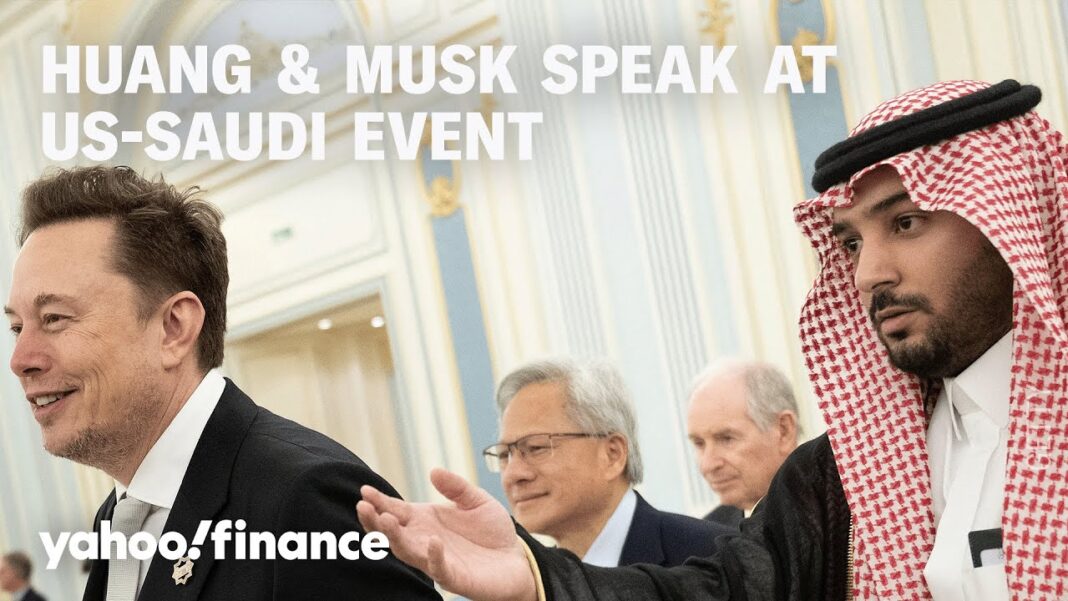
The day’s program also included a marquee discussion on advanced AI research and deployment, featuring Tesla and SpaceX CEO Elon Musk and Nvidia CEO Jensen Huang. As the Reuters report noted, their appearance together placed an emphasis on the growing centrality of AI to both nations’ strategic and technological agendas. Saudi Arabia’s sovereign wealth apparatus has increasingly sought partnerships with top American AI firms, particularly as Riyadh positions itself as a hub for large-scale data infrastructure, semiconductor demand, and next-generation technologies.
The crown prince’s visit marks his first return to the United States since the 2018 assassination of Saudi dissident and Washington Post columnist Jamal Khashoggi by Saudi operatives in Istanbul—an event that triggered global condemnation and profoundly strained the kingdom’s relationship with Washington. As Reuters has previously reported, U.S. intelligence agencies concluded that the crown prince approved the operation to capture or kill Khashoggi. Although he has denied ordering the killing, Mohammed bin Salman has acknowledged ultimate responsibility as Saudi Arabia’s de facto ruler.
Nevertheless, as the Reuters report noted, the crown prince arrived in Washington projecting confidence and eager to transform the narrative. Sitting alongside President Trump at the White House on Tuesday, he pivoted quickly toward Trump’s preferred subject: expanding Saudi investment in the United States. The crown prince reaffirmed and dramatically expanded his earlier pledge, stating that he intends to increase Saudi Arabia’s U.S. investment footprint from a previously announced $600 billion to an astonishing $1 trillion.
While the crown prince did not offer specific details or a timeline, the rhetorical commitment signaled Riyadh’s determination to anchor itself even more deeply within American economic structures. Yet, as the Reuters report pointed out, reaching the $1 trillion benchmark may ultimately prove challenging. Saudi Arabia is already contending with enormous expenditures tied to its ambitious domestic modernization agenda—including futuristic megacities such as NEOM, sports infrastructure associated with the 2034 FIFA World Cup, and several megaprojects that have exceeded budgets and faced delays.
President Trump was expected to attend the investment forum’s central gathering, where firms were anticipated to announce additional projects and capital flows into Saudi Arabia. The scope of participation from American multinationals, as tallied in the Reuters report, reflects the kingdom’s complex role as both a major buyer of U.S. goods and services and a vital financier of global projects in energy, technology, and industrial infrastructure.
Chevron’s presence highlighted longstanding U.S.–Saudi energy ties—dating back nearly a century to Standard Oil of California’s early explorations. Nvidia’s participation underscored the kingdom’s aggressive pursuit of AI supremacy, particularly as Saudi-backed entities seek thousands of advanced chips needed to build data centers and computational infrastructure.
For many companies in attendance—from defense contractors to investment banks—the forum represented an opportunity not only to secure new business but also to signal strategic alignment with a country whose sovereign wealth ambitions now exceed $900 billion. As the Reuters report noted, the Public Investment Fund (PIF), chaired by the crown prince, has become one of the most powerful global investors, reshaping markets ranging from real estate to entertainment to high technology.
President Trump, whose family business has engaged in real-estate and hospitality ventures involving Saudi partners over several decades, fielded questions Tuesday about whether the expanding Saudi–U.S. business ties could create a conflict of interest during his second term. Reuters reported that Trump moved quickly to dismiss the concerns, insisting that he remains fully disengaged from the Trump Organization, stating: “I have nothing to do with the family business. They’ve done very little with Saudi Arabia actually.”
Despite the president’s public distancing, Reuters noted that he and several of his longtime confidants have maintained robust relationships with Saudi investors and business entities. Since Trump’s return to the White House, his sons have reportedly secured new real-estate projects, including three developments in Saudi Arabia—an indication of the kingdom’s continued interest in high-profile American branding partnerships.
According to the Reuters report, the forum builds upon announcements made during Trump’s four-day trip to the Middle East in May, when the U.S. and Saudi Arabia jointly unveiled billions of dollars in bilateral investments spanning defense, energy, manufacturing, and AI development.
The defense sector, in particular, continues to loom large in the nations’ strategic calculus. The administration has endorsed new arms packages, and companies such as General Dynamics and Boeing were present at the forum, reinforcing the enduring military and industrial supply chain ties that bind Washington and Riyadh.
At the same time, Saudi Arabia has sought to strengthen its AI sector through partnerships with Nvidia, Google, AMD, IBM, and Qualcomm—all represented at the forum. Reuters previously reported that U.S. officials have expressed concern that Saudi Arabia’s acquisition of large numbers of advanced AI chips could complicate Washington’s efforts to prevent technological transfers to China. Nonetheless, the crown prince’s investments remain central to Trump’s economic diplomacy.
Wednesday’s convening at the Kennedy Center illustrated the mutual benefits Saudi Arabia and the United States continue to see in one another, despite past frictions. As the Reuters report observed, the forum unfolded against a backdrop of renewed diplomatic warmth, significant economic ambition, and a shared interest in technological leadership.
Crown Prince Mohammed bin Salman’s reintroduction to Washington—backed by tens of billions in planned investments and an entourage of the world’s most powerful corporate executives—signaled that Riyadh views its American partnership as indispensable in an era of global competition and rapid technological transformation.
For the United States, the day’s events reaffirmed a longstanding strategic relationship anchored in energy security, financial cooperation, and shared infrastructure goals, even as both nations navigate shifts in global power dynamics. According to the Reuters report, the latest round of agreements marks the beginning of what officials hope will be a dramatically expanded phase in bilateral ties—one shaped as much by AI, data centers, and advanced manufacturing as by oil and defense.
As the forum concluded, it did so with the unmistakable message that the Saudi–American economic partnership, reshaped by new geopolitical realities and colossal financial stakes, is poised to deepen further—as both nations look to translate vast investments into long-term strategic influence.