



|
Getting your Trinity Audio player ready...
|
By: Chaya Abecassis
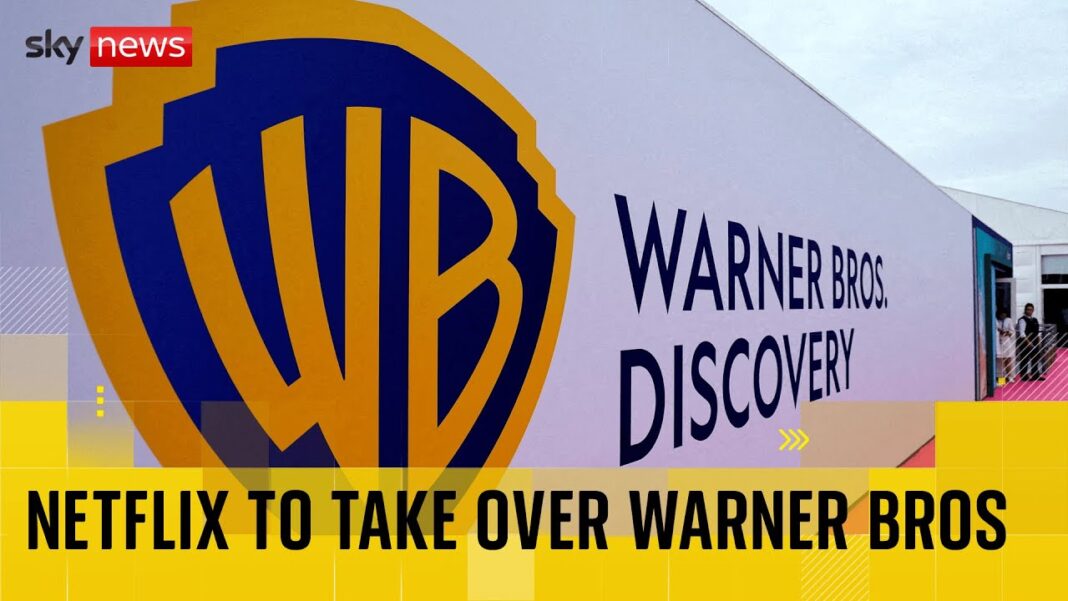
In a move that CNBC described as one of the most sweeping consolidations in modern entertainment history, Netflix announced Friday that it has struck a monumental deal to acquire core assets of Warner Bros. Discovery (WBD), bringing an abrupt and decisive close to a feverish bidding war that had captivated Wall Street and Hollywood alike. The $82.7 billion enterprise-value transaction — a blend of cash and stock — will deliver to Netflix both the legendary Warner Bros. film studio and the coveted HBO Max streaming platform, while WBD proceeds with its previously planned spin-out of Discovery Global, which houses cable institutions such as CNN and TNT.
According to CNBC’s reporting on Friday, this transformational agreement is priced at $27.75 per WBD share, giving the deal an equity valuation of roughly $72 billion. For each share of WBD common stock, shareholders will receive $23.25 in cash and an additional $4.50 in Netflix stock, subject to shareholder approval and regulatory scrutiny in multiple jurisdictions — a process expected to span 12 to 18 months, ultimately targeting closure in the third quarter of 2026.
The announcement marks the most aggressive strategic pivot yet for Netflix, which has spent the last decade reshaping global viewing habits and forcing legacy media giants into a relentless sprint to reinvent themselves. Now, as CNBC noted in its coverage, the streaming titan is absorbing one of the most storied film institutions in American culture, acquiring a catalogue that includes everything from “Casablanca” and “The Wizard of Oz” to the Harry Potter films and the DC Comics universe. Coupled with its takeover of HBO Max — home to cultural landmarks like “The Sopranos” and “Game of Thrones” — the deal dramatically expands Netflix’s reach as the preeminent curator of global entertainment.
Ted Sarandos, Netflix’s co-CEO, underscored the transformative stakes in a statement that echoed throughout the industry. “Our mission has always been to entertain the world,” he said, celebrating the marriage of Warner Bros.’ timeless canon with Netflix’s genre-defining originals such as “Stranger Things,” “Squid Game,” and the forthcoming “KPop Demon Hunters.” CNBC highlighted Sarandos’s assertion that the combined libraries will allow the company “to give audiences more of what they love and help define the next century of storytelling.”
The acquisition, however, is more than a merger of catalogs. It is a collision of philosophies.
Warner Bros. represents the old Hollywood hierarchy — theatrical-first prestige, auteur-driven franchises, and a reverence for cinema’s golden age. Netflix, by contrast, embodies Hollywood’s disruptive future, a platform built on algorithm-driven commissioning, global distribution, binge consumption, and an intricate understanding of streaming behavior. The fusion of these two cultures will rank among the great corporate assimilation challenges of the modern media era, a point repeatedly emphasized in CNBC’s early analysis of the deal.
For Warner Bros. Discovery, the sale constitutes a dramatic reorientation of its own corporate identity. Roughly two years after its headline-making formation through the Discovery–WarnerMedia merger, WBD now offloads its crown jewels — the Warner Bros. studio and HBO Max — to pursue a narrower, more traditional broadcasting and linear-television strategy through Discovery Global. This pivot locks WBD into a shrinking but still profitable segment of the media ecosystem, where cable networks like CNN, TLC, HGTV, and Discovery Channel continue to command substantial advertising revenue even amid long-term decline.
Industry observers told CNBC that this move amounts to a sobering concession: that WBD’s ambitious foray into streaming could not compete with Netflix’s scale, Apple’s deep pockets, or Disney’s content ecosystem. As ballooning streaming costs and subscriber stagnation battered WBD’s finances, selling the studio became not only rational but perhaps inevitable. The breakup fees outlined in SEC filings — $5.8 billion if Netflix fails to secure regulatory approval and $2.8 billion if WBD abandons the deal — underscore the high stakes for both sides.
From Netflix’s vantage point, the acquisition is a strategic masterstroke. For years, critics questioned the company’s heavy reliance on original productions and its shrinking access to licensed content as studios reclaimed their libraries for proprietary platforms. By acquiring Warner Bros. and HBO Max wholesale, Netflix leapfrogs those concerns, instantly securing one of the deepest reservoirs of film and television assets in global entertainment.
CNBC analysts have emphasized that this vaults Netflix into a different competitive category. Instead of dueling other streaming platforms for subscribers, Netflix is positioning itself as the unrivaled nexus of global content — a hybrid between a century-old studio and a digital-first platform. With the combined libraries of Warner Bros., HBO, and Netflix Originals, no other entertainment company on earth will be able to match its breadth of offerings, nor the cultural impact embedded in its intellectual property portfolio.
Yet the deal also ignites substantial regulatory concerns, which CNBC outlined as one of the most significant hurdles facing the transaction. U.S. and European regulators will scrutinize the acquisition through the lens of antitrust law, particularly given Netflix’s dominance in streaming and the precedent of the Justice Department’s discomfort with prior Hollywood megamergers. Critics will argue that Netflix’s absorption of Warner Bros. risks creating an entertainment monopoly in the streaming sector, while proponents will contend that the fragmented global market — with Disney, Amazon, Apple, Paramount, Comcast, and a constellation of regional players — remains highly competitive.
Another arena of uncertainty involves the creative community, especially Warner Bros.’ celebrated network of filmmakers. Directors and producers who have long relied on theatrical distribution and Warner Bros.’ traditional studio support may bristle at being subsumed by Netflix, a company that has historically prioritized streaming over cinemas. As the CNBC report pointed out, Netflix’s evolving relationship with Hollywood — including its recent willingness to embrace limited theatrical runs for prestige releases — is likely to be tested intensely under the weight of its new acquisitions.
Financially, the deal places enormous pressure on Netflix to maintain subscriber growth and revenue expansion. Absorbing Warner Bros. and HBO Max will require a massive operational merger, integrating thousands of employees, multiple production pipelines, overlapping content strategies, and contrasting corporate cultures. The company will likely face years of restructuring, layoffs, and management realignment — challenges that CNBC reported are already being analyzed by industry watchers.
Still, in spite of these complications, the overwhelming sentiment among analysts is that the move signals Netflix’s confidence in its long-term future. It represents not only an aggressive expansion but a declaration of permanence: Netflix is not simply competing in Hollywood; it is becoming Hollywood.
The broader entertainment landscape will feel the aftershocks immediately. Paramount and Comcast, which had both pursued the WBD assets, now face a drastically altered competitive field. Paramount’s ongoing struggle to stabilize its finances becomes even more urgent, while Comcast’s NBCUniversal will likely intensify its investment in Peacock or explore alternate strategic acquisitions. Disney, meanwhile, remains focused on internal restructuring and cost reductions, though industry executives told CNBC that the Netflix–WBD merger could pressure Disney to consider its own bold moves.
For consumers, the implications are sweeping. Netflix subscribers will eventually access an unprecedented library that spans nearly every major era, genre, and storytelling tradition. HBO Max subscribers will face transitions and potential price reconfigurations as their platform is folded into Netflix’s ecosystem. The broader shift marks the beginning of a new era in which streaming platforms consolidate into fewer, more powerful entities, reversing a decade of fragmentation.
For Hollywood, the Netflix–Warner Bros. arrangement is a rewrite of the industry’s very DNA — a collision of legacy prestige and algorithmic innovation, a merger of past and future, and a stark reminder that in the new economics of digital entertainment, scale is destiny.
As the CNBC report noted, the agreement has already reshaped the narrative arc of global entertainment. What remains now is the waiting period — 12 to 18 months during which regulators, shareholders, and the creative community will evaluate the implications.
But regardless of how those deliberations unfold, the message is unmistakable: Netflix has just redrawn the map of Hollywood. And the industry will not — cannot — return to the world that existed before this deal was struck.