



|
Getting your Trinity Audio player ready...
|
By: Russ Spencer
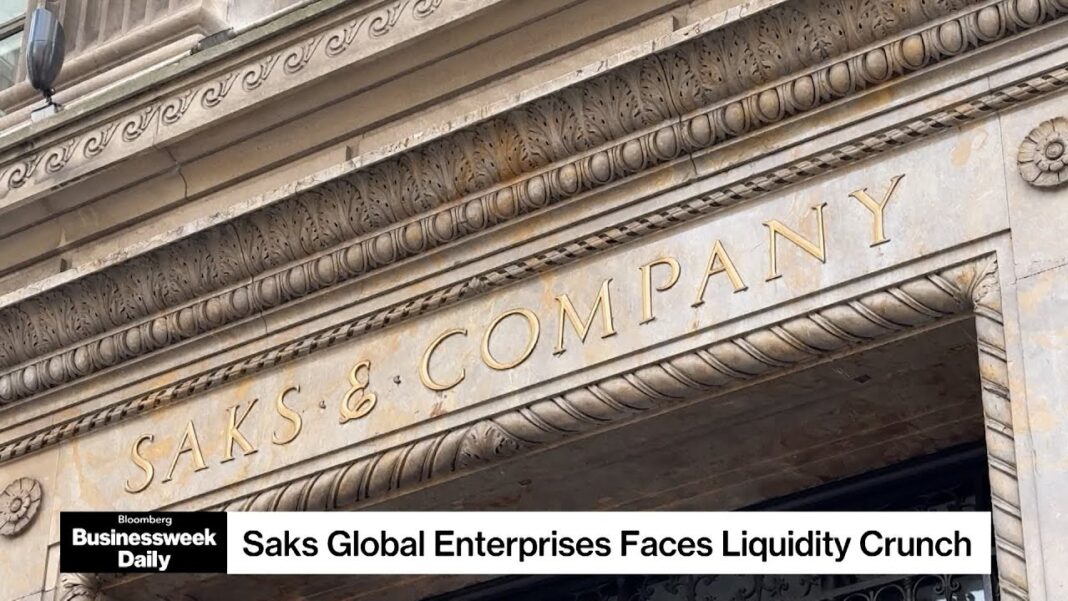
For more than a century, Saks Fifth Avenue stood as a symbol of American affluence, a cathedral of couture whose window displays were as synonymous with aspiration as the skyline outside its Manhattan flagship. Yet according to a report that appeared on Wednesday in The Wall Street Journal, that gilded legacy is now teetering on the brink of collapse. Saks Global, the parent company that absorbed Neiman Marcus and Bergdorf Goodman in a bold 2024 merger, is preparing to file for Chapter 11 bankruptcy protection within days after missing a critical interest payment on more than $100 million in debt.
This would be the most consequential department-store bankruptcy since the Covid-19 pandemic ravaged the retail sector—a staggering fall for a business once envisioned as the unassailable colossus of American luxury retail.
As reported by The Wall Street Journal, Saks failed this week to make a scheduled interest payment exceeding $100 million owed to bondholders. The lapse was not a technical oversight; it was the inevitable climax of a yearlong financial deterioration that insiders say has left the company scrambling for liquidity and credibility alike.
People familiar with the company’s finances told the WSJ that Saks Global is now in talks with creditors to arrange debtor-in-possession financing, a lifeline that would allow the business to continue operating during bankruptcy proceedings. The company has declined to comment publicly, but its silence has done little to temper market anxiety.
Bond prices tied to Saks Global have plummeted to distressed levels, a reflection not only of missed payments but of a pervasive sense that the enterprise’s debt-fueled expansion strategy was fatally flawed from inception.
The seeds of this crisis were planted in 2024, when Saks acquired Neiman Marcus in a $2.7 billion deal that also included the storied Bergdorf Goodman. According to the information provided in The Wall Street Journal report, the merger was pitched as a transformational moment for luxury retail: a combined juggernaut that would wield unrivaled negotiating power with vendors, achieve massive cost synergies, and preserve the dominance of brick-and-mortar luxury at a time when online competitors were eroding traditional retail moats.
But the deal was heavily leveraged. The merged entity, dubbed Saks Global, emerged burdened with an enormous debt load—precisely as the broader luxury market was beginning to cool after a post-pandemic spending spree.
The WSJ report noted that Saks sought to create a “luxury superstore” ecosystem encompassing Saks Fifth Avenue, Neiman Marcus, Bergdorf Goodman, and Saks OFF 5th. Yet the theoretical efficiencies never materialized at the scale needed to service the mountain of debt the company had assumed.
By late 2024, Saks Global was already looking for ways to raise cash. As reported by the WSJ, executives explored selling a 49% stake in Bergdorf Goodman—arguably the crown jewel of the acquisition—and even divested a Beverly Hills property in a bid to shore up liquidity.
In June, bondholders injected $600 million in fresh capital to help the company meet a looming debt payment. That infusion bought time but not stability. Vendor confidence eroded as the company fell behind on payments, prompting some brands to withhold shipments altogether.
This vicious cycle—cash shortfalls leading to empty shelves, empty shelves leading to falling sales—accelerated the retailer’s decline.
Perhaps the most damaging consequence of Saks Global’s cash crunch has been its deteriorating relationship with vendors. WSJ reports that many suppliers began restricting shipments or demanding more stringent terms after Saks repeatedly delayed payments.
Earlier this year, Saks attempted to reassure brands by pledging to settle outstanding balances, albeit through extended installment plans. But that olive branch was quickly overshadowed by a controversial decision to lengthen payment terms for new orders from 60 days to 90 days after receipt.
For luxury brands accustomed to strict cash-flow discipline, the move was tantamount to a declaration of financial distress. It also placed Saks at a competitive disadvantage relative to rivals such as Nordstrom and Bloomingdale’s, which continued to pay vendors on more conventional schedules.
The consequences of these missteps are now evident in the company’s financial results. As detailed in the WSJ report, Saks Global reported that sales for the quarter ended Aug. 2 fell more than 13% year over year to $1.6 billion—well below internal forecasts. The net loss widened to a staggering $288 million.
Such figures are not merely bad—they are catastrophic for a retailer whose business model depends on high-margin luxury goods and impeccable inventory depth.
The slump in luxury demand has compounded the company’s woes. Once immune to economic headwinds, the high-end sector has seen consumers pull back amid persistent inflation, geopolitical uncertainty, and a post-pandemic recalibration of discretionary spending.
For more than a hundred years, Saks Fifth Avenue, Neiman Marcus, and Bergdorf Goodman were not merely stores but institutions. They pioneered the luxury department-store concept, turning shopping into theater and retail into ritual.
As the WSJ has chronicled, their flagship locations became landmarks—Bergdorf’s on Fifth Avenue, Neiman Marcus in Dallas, Saks on Manhattan’s most prestigious retail strip. Their windows set fashion trends; their personal shoppers shaped social calendars.
That such icons are now poised for bankruptcy is not merely a business story—it is a cultural reckoning.
In hindsight, analysts cited by the WSJ say the merger was a textbook case of strategic overreach. Executives believed scale alone would insulate them from structural changes in retail, but they underestimated the volatility of luxury demand and the rigidity of their cost structures.
Debt magnified every miscalculation. When sales softened, the company had no margin for error. Interest payments became existential threats, not routine obligations.
The irony is painful: the very ambition to dominate luxury retail hastened the empire’s collapse.
Saks Global’s planned Chapter 11 filing will allow it to continue operating while restructuring its balance sheet. Shoppers are unlikely to see immediate store closures, but the WSJ report noted that the reorganization will almost certainly involve painful concessions from creditors, potential asset sales, and further renegotiation with vendors.
Whether the storied brands emerge intact—or fragmented—is now an open question.
As the WSJ report observed, this bankruptcy would be the most high-profile department-store collapse since the pandemic, marking another chapter in the long decline of the American mall and the traditional department store.
Yet unlike earlier bankruptcies driven by the rise of e-commerce, Saks Global’s downfall feels self-inflicted—a casualty not of technological disruption alone but of strategic hubris.
What remains is a sobering lesson for corporate America: prestige cannot outrun debt, and legacy brands are not immune to the arithmetic of leverage.
When Saks Global files its Chapter 11 papers in the coming days, it will not merely be seeking financial protection. It will be asking whether the mythology of American luxury retail can survive a reckoning that has finally caught up with it.
