



|
Getting your Trinity Audio player ready...
|
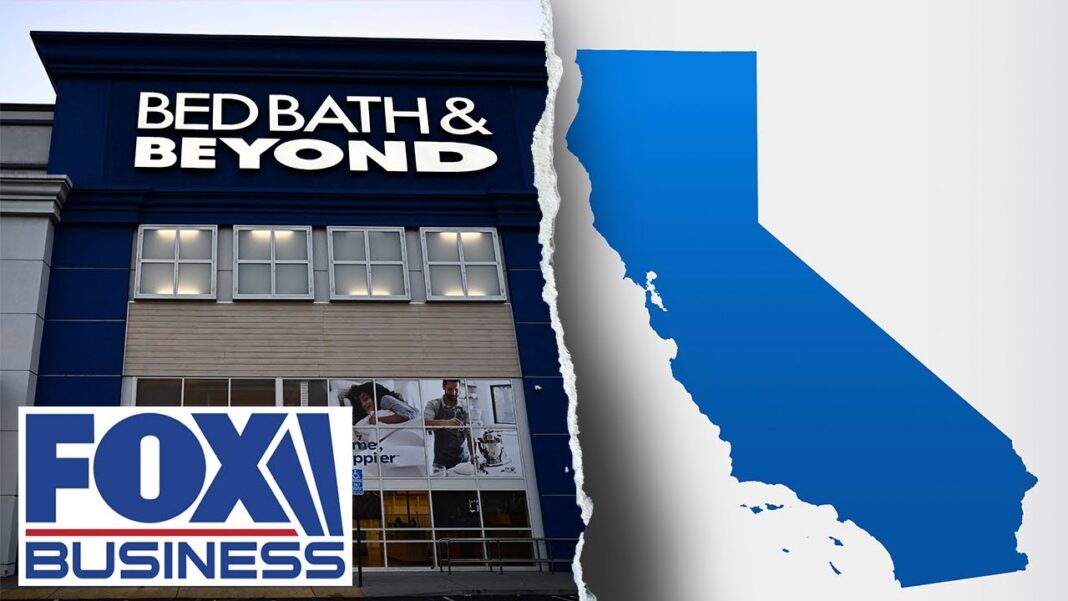
Bed Bath & Beyond Refuses to Open Stores in California, Citing “Crushing” Business Climate
By: Russ Spencer
California’s long-running reputation as both an engine of innovation and a crucible of regulatory burdens took another reputational blow this week when the chairman of Bed Bath & Beyond announced that the retailer will not open a single store in the Golden State. The decision, framed as a direct rebuke of Sacramento’s economic policies, has been widely described as an embarrassment for Governor Gavin Newsom, who has spent years promoting California as the quintessential hub of opportunity.
In remarks reported by VIN News on Wednesday, the company’s chairman declared that the move was not merely a question of retail strategy but a deliberate stance against a climate he described as “unsustainable.” The chairman pointed squarely to “sky-high taxes, endless fees and forced, unsustainable wages” as decisive factors, adding pointedly: “We’re taking a stand because it’s time for common sense.”
For a national retailer to operate in forty-plus states but refuse to enter California is no small gesture. According to the information provided in the VIN News report, the chairman confirmed that Bed Bath & Beyond intends to open outlets “in almost every other state,” leaving California conspicuously absent from its expansion blueprint.
This decision not only signals distrust in the state’s business climate but also represents a striking reputational slight. California, with its 39 million residents, is the nation’s largest consumer market. To exclude it voluntarily underscores the depth of corporate concern about regulatory excess. As the VIN News report indicated, “it is virtually unheard of for a national retailer to deliberately bypass California, which usually serves as the bellwether for American consumer trends.”
The company’s rationale mirrors longstanding complaints from business owners, both large and small, who describe California as inhospitable to private enterprise. Taxes are among the most obvious flashpoints: the state’s corporate tax rate remains one of the highest in the country, while its layered structure of sales taxes, local assessments, and compliance fees impose additional burdens.
Wages also represent a recurring controversy. California’s aggressive minimum wage policies — now among the highest in the United States — have long drawn criticism from industries operating on thin margins, such as retail and hospitality. For large chains like Bed Bath & Beyond, forced wage hikes, coupled with mandated benefits and compliance requirements, threaten profitability before a single dollar is earned.
As one VIN News analysis highlighted, California’s model often presumes that national chains can absorb unlimited costs, “but the cumulative effect of high wages, restrictive scheduling laws, environmental surcharges, and taxes produces an operating environment so unpredictable that many firms simply walk away.”
The chairman’s reference to “endless fees” echoes complaints about California’s overlapping regulatory schemes. Licensing regimes, environmental standards, and labor codes frequently outpace those of other states, producing labyrinthine compliance demands. While each requirement is defended as necessary for equity or sustainability, their aggregate effect deters new entrants.
According to the information contained in the VIN News report, Bed Bath & Beyond executives privately characterized California as “the riskiest jurisdiction in the nation to commit capital,” citing unpredictable legislation and the prospect of new mandates being introduced mid-operation. For publicly traded companies responsible to shareholders, such unpredictability constitutes a structural risk.
Governor Gavin Newsom, who has built his national profile on a vision of California as America’s progressive laboratory, now faces what the VIN News report called “a reputational crisis with symbolic overtones.” While one company’s decision cannot by itself redefine the state’s economic standing, the optics of a household retail name publicly shunning California are difficult to ignore.
Insiders in Sacramento have been privately unsettled by the news. One aide reportedly quipped that the governor’s communications team was “frantically plugging the press release into ChatGPT and begging for a Trump-style imitation response” as a coping mechanism — an anecdote that underscores both the embarrassment within Newsom’s orbit and the public relations challenge posed by the announcement.
The Bed Bath & Beyond announcement is not an isolated development but part of a broader narrative of corporate flight from California. Over the past decade, companies ranging from technology giants to manufacturing firms have relocated headquarters or redirected investments to states such as Texas, Florida, and Arizona.
The ongoing exodus encompasses both marquee corporations and small-to-medium-sized enterprises. The common denominator remains the perception that California punishes rather than supports private enterprise. This trend has already eroded the state’s tax base and contributed to a steady outflow of middle-class residents, who follow jobs to more affordable states.
Against this backdrop, Bed Bath & Beyond’s declaration carries symbolic weight: it is not merely an accounting decision but a public rebuke that may embolden other firms to reconsider their California exposure.
For consumers, the absence of Bed Bath & Beyond outlets in California reduces shopping choice and underscores disparities between regions. While residents of Nevada, Arizona, or Oregon will enjoy access to the retailer’s physical stores, Californians will be relegated to online ordering or traveling across state lines.
For communities, the decision represents lost opportunities for job creation, commercial leasing, and local tax revenues. As the VIN News report pointed out, each big-box retail location can generate “dozens of direct jobs and hundreds of indirect ones, from construction and supply chain roles to ancillary services in surrounding commercial districts.” The loss of such investment deepens the sense of economic stagnation in regions already struggling with high unemployment or retail vacancies.
The decision also resonates politically because of the broader symbolism attached to the retail industry. Unlike high-tech firms or niche manufacturers, big-box retailers are highly visible to ordinary consumers. Their absence becomes an everyday reminder of a state’s inhospitable climate.
As the VIN News report observed, “when a Silicon Valley start-up decamps for Austin, the consequences are abstract for most Californians; when a national retail chain refuses to enter the state at all, the message is visible to every shopper driving down Main Street.”
Critics argue that California’s political leadership has consistently prioritized ideological goals over economic pragmatism. Environmental regulations, wage mandates, and social equity initiatives are pursued with vigor, but often without regard for their cumulative effects on competitiveness.
The Bed Bath & Beyond announcement crystallizes this critique. By citing “sky-high taxes, endless fees and forced, unsustainable wages,” the company distilled years of business grievances into a succinct indictment. As the VIN News report highlighted, the statement functions not only as a rationale but as “a manifesto against the governing philosophy of California’s political elite.”
Whether other retailers follow suit remains to be seen, but the Bed Bath & Beyond decision will likely reverberate across boardrooms nationwide. For companies debating California entry, the announcement provides cover for hesitation. For those already operating in the state, it may strengthen the case for scaling back expansion or shifting investment elsewhere.
In this sense, the move represents not just a lost opportunity for Californians but a potential inflection point in the perception of California’s economic brand. As the VIN News report emphasized, “if California is no longer viewed as indispensable by national retailers, its prestige as a consumer marketplace may erode in tandem with its reputation as a business destination.”
The refusal of Bed Bath & Beyond to establish a single California outlet is both a practical business decision and a symbolic political gesture. For the company, it represents risk avoidance in the face of an onerous regulatory climate. For Governor Newsom, it constitutes a conspicuous embarrassment that undercuts his narrative of California as a model of progressive prosperity.
The episode calls attention to a broader truth: California’s business climate, once viewed as challenging but irresistible due to its size, is increasingly being judged as simply not worth the trouble.
In the words of the company’s chairman, the decision is ultimately “a stand for common sense.” Whether that phrase becomes a rallying cry for other firms remains to be seen. But for now, it leaves California excluded from a retail map that spans the rest of the nation — a powerful symbol of economic dysfunction in the country’s most populous state.