



|
Getting your Trinity Audio player ready...
|
At the Kennedy Center, a Bold New Chapter in U.S.–Saudi Business: Why Corporate America No Longer Hides Its Ties to Riyadh
By: Jerome Brookshire
It was not long ago that chief executives from the United States approached Saudi Arabia with caution, slipping in and out of Riyadh without press releases, photo lines, or corporate fanfare. The kingdom’s colossal wealth—long irresistible to investment firms, technology developers, and energy-hungry industries—was tempered by a shadow that has lingered since 2018: the murder of journalist Jamal Khashoggi, an event that reshaped the geopolitical climate and chilled open corporate engagement.
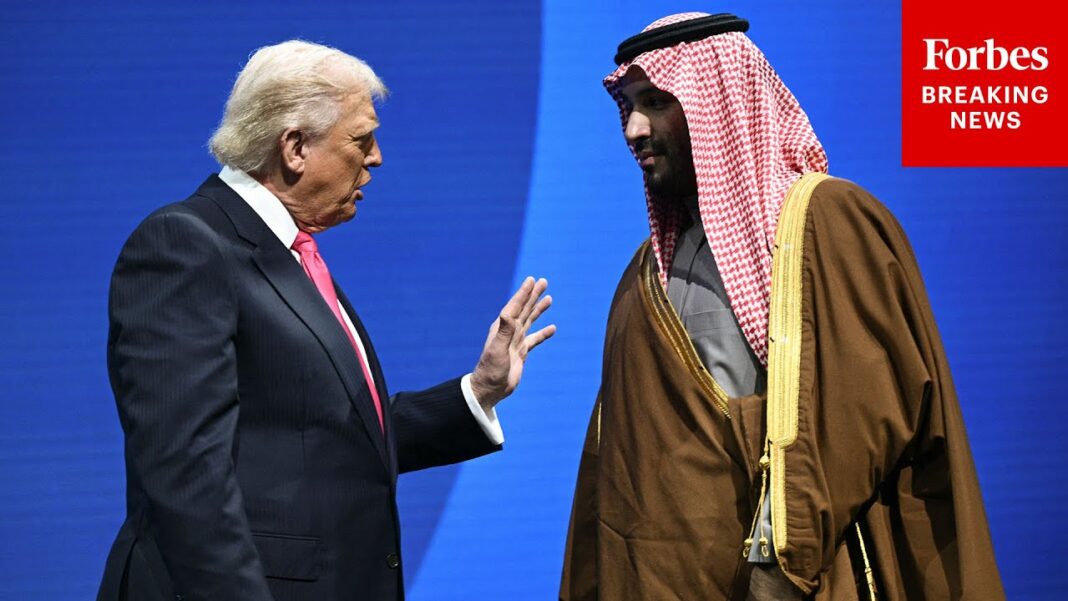
But on Wednesday, as The New York Times reported, the mood at Washington’s Kennedy Center bore no resemblance to the restrained, often secretive atmospheres of prior years. Instead, the red carpets unfurled with unapologetic brightness. The Saudi and American flags stood side by side. Faces that normally dominate Silicon Valley boardrooms and Wall Street trading floors mingled openly with visiting Saudi dignitaries. Cameras flashed, executives exchanged business cards, and the applause that swept through the auditorium made clear: U.S.–Saudi relations had entered a new, unabashedly public phase.
The occasion was the U.S.–Saudi Investment Forum, a summit that pulled in some of the most powerful figures in American business. Salesforce CEO Marc Benioff, Nvidia chief Jensen Huang, Palantir’s Alex Karp, Dina Powell of BDT & MSD Partners, former Goldman Sachs executive and Republican foreign policy player—all stood front and center in an event designed deliberately to telegraph a message: the era of quiet, cautious dealmaking with Saudi Arabia is over.
According to the report in The New York Times, the revival of full-frontal business diplomacy began well before the first hors d’oeuvres were circulated. Executives flew in recognizing the moment: Saudi Arabia is positioning itself as the world’s next megahub for artificial intelligence, energy infrastructure, gaming, cloud computing, and immersive digital environments. Crown Prince Mohammed bin Salman (often known as MBS) has been betting heavily on transforming the kingdom into a tech-forward, AI-powered powerhouse.
For American executives, the calculation is twofold: Saudi money is deep. Saudi ambition is even deeper.
The red carpet at the Kennedy Center was not merely ceremonial—it symbolized the normalization of what had already become an irresistible alignment of interests.
John Kelly, chief technology officer of Global AI, expressed the mood with blunt candor. “We can do deals here. We can develop partnerships—very fast,” he said, describing the forum as a highly compressed marketplace of opportunity. For Kelly, and for many others in attendance, Saudi Arabia’s desire for cutting-edge technology dovetails perfectly with America’s need for new markets and abundant energy resources.
No company embodies this shift more fully than Nvidia, whose chips have become the de facto infrastructure of the global race for artificial intelligence supremacy. As The New York Times report noted, Jensen Huang’s presence was treated as a kind of coronation. President Trump singled him out from the stage, asking him to stand while executives in the room applauded.
The awe was not misplaced. In today’s global economy, Nvidia’s power rivals that of nation-states. Without its hardware, modern A.I. does not function—not in Silicon Valley, not in Beijing, and certainly not in a desert megaproject aspiring to become the capital of the digital world.
The forum’s most significant announcement underscored this technological dominance: xAI, Elon Musk’s A.I. startup, will partner with Nvidia and the Saudi state-backed firm Humain to build a monumental data center in Saudi Arabia. The facility is projected to consume as much as 500 megawatts of electricity, a figure that speaks not only to the scale of Saudi ambition but to the raw computational demands of frontier artificial intelligence systems.
The implications are enormous. With these moves, Saudi Arabia is leapfrogging into the global A.I. market—not as a consumer, but as a foundational player.
According to statements highlighted in The New York Times report, Saudi officials claimed that more than $575 billion in deals and agreements were pledged during the forum. That number, while aspirational, illustrates the kingdom’s strategy: signaling financial firepower to entice top-tier corporations into long-term partnerships.
In addition to xAI’s announcement, the following major developments were revealed: Blackstone, led by Stephen Schwarzman, will build a major data center with Humain. Humain also secured partnerships with AMD, Cisco, and Global AI.
Saudi Arabia is opening doors to unprecedented levels of technology-intensive investment.
Taken together, these pledges point to a Saudi business environment that is now comfortable asserting itself on the world stage—and eager to do so with American partners.
A striking aspect of the forum, emphasized in The New York Times report, was how little attention was given to the murder of Jamal Khashoggi—a killing that U.S. intelligence agencies concluded was ordered by none other than Crown Prince Mohammed bin Salman.
President Trump dismissed the concerns when asked at the White House. “Not a concern,” he said, chastising the reporter for raising the issue.
To critics, the moment signaled a broader geopolitical truth: economic power, energy needs, and the growing centrality of artificial intelligence now outweigh the moral outrage that once threatened to rupture U.S.–Saudi relations. The presence of so many high-profile executives seemed designed to demonstrate exactly that.
Another subplot was the presence of David Ellison, the new chief executive of Paramount Global. His attendance was no coincidence. Ellison is pursuing a transformative bid to acquire Warner Bros. Discovery, a merger that would create a media titan marrying CNN, CBS, and a vast constellation of entertainment properties.
His father, Larry Ellison, billionaire co-founder of Oracle, is backing the bid. But the Saudis, as The New York Times report noted, could ultimately become participants—injecting the kind of liquidity that only sovereign wealth funds with hundreds of billions in assets can provide.
A photo from the White House dinner the night before captured the symbolism perfectly: David Ellison posing alongside Marc Benioff and Dell Technologies founder Michael Dell. Benioff posted it with the caption: “The enterprise software guys are in the house.” It was half-joke, half-state-of-the-union. Riyadh is no longer courting Silicon Valley in the shadows; Silicon Valley is openly courting Riyadh.
Saudi Investment Minister Khalid al-Falih, speaking with The New York Times, framed the shift plainly. The Kennedy Center event, he said, showed that the U.S.–Saudi relationship “is rising to new levels”—and, crucially, that it is now being conducted “openly.”
Gone are the days of furtive flights, private hotel meetings, and whispered business proposals. In their place stands a new chapter marked by public forums, presidential praise, and a parade of executives eager to connect with the architects of Saudi Arabia’s trillion-dollar transformation plan.
The visible embrace between the United States and Saudi Arabia has multiple implications:
A.I. is now the centerpiece of international diplomacy. The forum showcased A.I. not as a technology sector but as a geopolitical battleground where alliances are forged. Saudi Arabia is repositioning itself as a technological supernode. Oil built the kingdom; artificial intelligence may define its future. Corporate America is signaling that the moral backlash over Khashoggi has faded. Capital, data, and energy have reclaimed primacy in U.S.–Saudi relations. U.S. firms see Saudi Arabia as essential to global expansion.
As John Kelly put it: Saudi Arabia “needs this technology, and we need energy.” The kingdom’s sovereign wealth funds remain unmatched financial engines. Their ability to bankroll megadeals—from entertainment to AI—is reshaping corporate strategy across the United States.
What unfolded at the Kennedy Center was not just a conference. It was a public declaration that the U.S. and Saudi Arabia are entering a new economic symbiosis—one centered on artificial intelligence, energy transition, and technological supremacy.
As The New York Times documented, American executives are no longer hesitant to be seen shaking hands with Saudi powerbrokers. They are celebrating these partnerships—photographing them, posting them, and applauding them.
Whether this new chapter leads to shared prosperity, geopolitical friction, or a reconfiguration of global technological power remains to be seen. But one thing is certain: the United States and Saudi Arabia are no longer conducting business in the shadows.
They are doing it on the red carpet.