



|
Getting your Trinity Audio player ready...
|
By: Andrew Carlson
In a drama that has reverberated far beyond the footlights of a single performance space, the cancellation—and subsequent attempted reversal—of a show by Israeli comedian Guy Hochman at the Fine Arts Theatre in Beverly Hills has become a flashpoint in a much broader cultural and political confrontation. What began as a local programming decision has evolved into a national controversy touching on free expression, antisemitism, political coercion, and the increasingly fraught place of Israeli artists in Western cultural institutions. According to a report on Sunday by The Jewish News Syndicate (JNS), the episode now stands as one of the most emblematic cultural battles of the current moment, illustrating how art, identity, and geopolitics have become inseparably intertwined.
At the center of the storm is Michael S. Hall, president of the Fine Arts Theatre Beverly Hills, who on Saturday issued a public apology after the venue canceled Hochman’s scheduled performance under pressure from anti-Zionist activists. In a statement shared on social media and cited by JNS, Hall acknowledged that the decision to demand political declarations from an artist as a condition for performing was “a mistake,” and that the theater “should never have imposed a litmus test of any kind.”
The apology was notable not merely for its tone, but for its specificity. Hall directed his remarks particularly toward Jewish Californians, taking responsibility for a decision that he said had “caused harm and distress to many people in the community.” He admitted that the theater had been subjected to a wave of messages, including explicit threats of violence, and that under this pressure he acted without sufficient judgment or reflection. As JNS reported, Hall has now committed to working with local Jewish leaders to rebuild trust and to ensure that the theater remains “a place for culture and expression without discrimination.”
View this post on Instagram
The crisis began earlier in the week, when Hochman, one of Israel’s most recognizable contemporary comedians, was booked for a Tuesday night performance at the Beverly Hills venue. Almost immediately, the theater became the target of a coordinated pressure campaign by anti-Israel activists. According to the JNS report, these activists accused Hochman of supporting violence against Palestinians, despite the theater’s own admission that it could find no substantiated evidence beyond claims made by the original accuser.
In its initial statement, the theater acknowledged that it had conducted online research and failed to verify the allegations. Nevertheless, it demanded that Hochman issue a public declaration and social media post disavowing “genocide, rape, starvation and torture of Palestinian civilians.” When Hochman declined to make such a statement, the theater announced that he was banned from the facility.
The language of that original statement proved incendiary. References to “genocide” and accusations of systematic atrocities echoed long-standing tropes that Israel has repeatedly condemned as antisemitic blood libel. As the JNS report noted, Jewish and pro-Israel organizations swiftly condemned the cancellation as discriminatory, arguing that no other performers were being subjected to ideological purity tests or political loyalty oaths.
The backlash was immediate and fierce. Community leaders, cultural figures, and Jewish organizations accused the theater of capitulating to intimidation and of singling out an Israeli performer on the basis of his nationality and identity. In the days that followed, Hall reversed course, issuing his apology and expressing a willingness to work toward rescheduling Hochman’s performance, provided it could be done safely.
“I am already engaging with members of the local Jewish community and will continue to listen, learn and work with community leaders moving forward,” Hall wrote, according to the JNS report. He also confirmed that he had contacted Hochman’s representatives and remained open to hosting the performance under secure conditions.
Yet the Beverly Hills episode is not an isolated incident. As the JNS report documented, Hochman has faced mounting hostility across North America during his recent tour. In January, Canadian authorities detained him for six hours at Toronto Pearson International Airport after an anti-Israel organization filed war crimes charges against him connected to his service in the Israel Defense Forces. Hochman publicly described the incident as politically motivated harassment rather than a legitimate legal action.
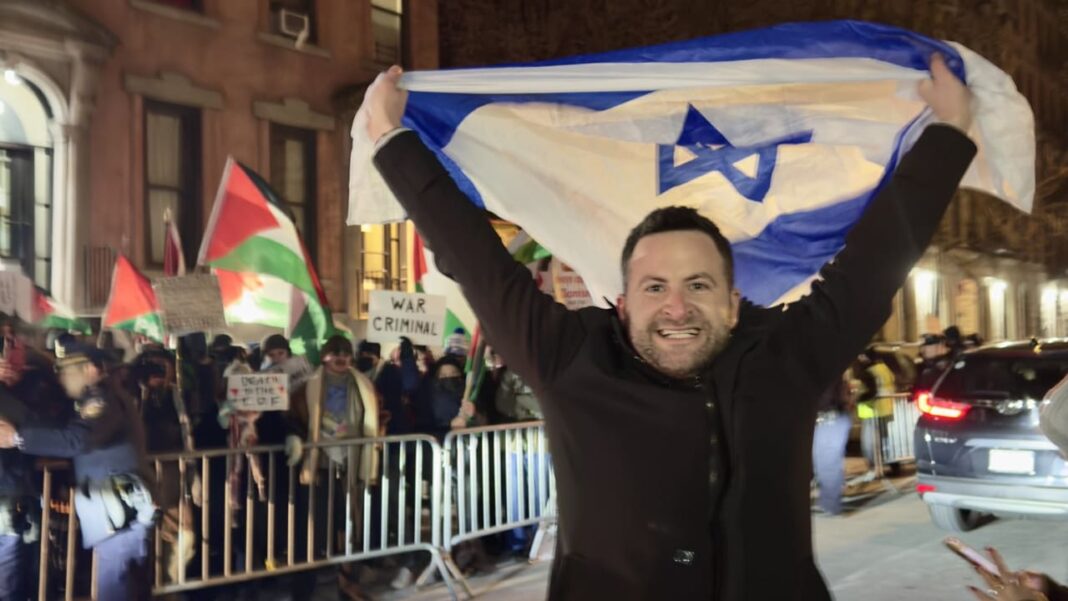
In New York City, a scheduled performance at the Broadway Comedy Club was canceled after protesters blocked audience members from entering the venue. According to the JNS report, Hochman responded not by retreating, but by performing for his audience outside the building, turning the sidewalk into an improvised stage in what supporters described as an act of defiance against intimidation.
These incidents form a pattern that reflects a growing phenomenon: Israeli artists, particularly those with military service backgrounds, are increasingly targeted not for their artistic work, but for their identity and nationality. In Hochman’s case, his service in the Nahal Infantry Brigade and his years in the IDF reserves have become focal points for political attacks, despite the fact that military service in Israel is mandatory for most citizens.
Hochman’s biography complicates the caricatures often projected onto him by critics. He is not a political propagandist in the conventional sense, but a satirical performer known in Israel for his viral street interviews, in which he humorously spoofs political rallies—often left-wing ones—by engaging protesters in tongue-in-cheek exchanges. His comedy is rooted in irony, absurdity, and self-deprecation rather than ideological preaching.
He has also been open about deeply personal struggles. In 2023, Hochman was diagnosed with testicular cancer and underwent surgery to remove one of his testicles. Rather than retreating from public life, he incorporated the experience into his comedy and public advocacy, using his platform to raise awareness about early detection and men’s health. This vulnerability has made him a relatable figure to many fans, further complicating attempts to portray him as a political symbol rather than a human being.
Since the Hamas attacks of Oct. 7, 2023, Hochman has also performed for Israeli troops as part of his reserve service. In characteristic fashion, he has humorously dubbed himself the IDF’s “Chief Smile Officer,” a satirical title that plays on the Hebrew designation for the army’s Chief Education Officer. While the title is unofficial, the IDF has embraced the joke, occasionally referencing it in publications and announcements about his performances on military bases.
The Fine Arts Theatre controversy, however, has less to do with Hochman’s biography than with what he represents in the current cultural climate. As the JNS report observed, the pressure campaign against him reflects a broader strategy in which activists seek to enforce ideological conformity through intimidation, reputational attacks, and institutional pressure. Cultural venues, increasingly risk-averse and sensitive to public backlash, often find themselves ill-equipped to navigate these conflicts.
Michael S. Hall’s apology underscores this vulnerability. He acknowledged that the decision to cancel Hochman’s show was made under duress and without adequate consideration. He also recognized that imposing political tests on artists undermines the very foundations of cultural expression. In doing so, he implicitly conceded that the theater had abandoned its own principles in the face of external pressure.
For many observers, this admission is both welcome and troubling. Welcome, because it represents accountability and a willingness to correct course; troubling, because it reveals how easily cultural institutions can be coerced. As the JNS report emphasized, the normalization of ideological vetting threatens not only Jewish and Israeli artists, but the broader principle of artistic freedom itself.
The apology also highlights a deeper anxiety within American cultural spaces: fear. Hall admitted that the theater received threats of violence, a detail that shifts the narrative from abstract political disagreement to tangible security concerns. In such an environment, decisions are no longer purely ethical or artistic—they become risk calculations.
Yet the attempt to restore trust with the Jewish community suggests an awareness that neutrality under coercion is not true neutrality. By singling out one performer for ideological scrutiny, the theater crossed a line that many believe constitutes discrimination. As JNS reported, community leaders have framed the incident as part of a wider pattern in which Jewish identity itself becomes politicized and problematized in cultural spaces.
The controversy also raises fundamental questions about the role of art in polarized societies. Should artists be required to declare political positions as a condition of participation in public life? Should cultural institutions function as ideological gatekeepers? Or should they remain spaces where expression is protected precisely because it transcends politics?
For Hochman, the answer appears clear. His refusal to issue a political declaration was not an endorsement of violence, but a rejection of coercion. As the JNS report noted, he has consistently framed his performances as comedy, not propaganda, and his public persona as that of an entertainer, not a political spokesperson.
The Beverly Hills episode may ultimately become a case study in cultural resilience—or cultural capitulation. Hall’s apology and his stated willingness to host Hochman again represent a step toward repair, but the damage has already been done. Trust, once fractured, is not easily restored.
More broadly, the incident illustrates how the Israel-Hamas conflict has extended far beyond the Middle East, reshaping cultural politics in cities like Beverly Hills, Toronto, and New York. As the JNS report documented, the globalization of this conflict has transformed artists into symbols and stages into battlegrounds.
In the end, the question is not only whether Guy Hochman will perform at the Fine Arts Theatre, but what kind of cultural environment will emerge from this crisis. Will theaters and galleries become spaces governed by fear and ideological policing? Or will they reaffirm their role as sanctuaries for diverse expression?
For now, the spotlight remains on Beverly Hills. But the implications extend far beyond one canceled show. The Hochman controversy is not merely about comedy or politics—it is about the moral architecture of cultural life in an age of polarization, and whether institutions will defend the principles they claim to embody when those principles are tested
