



|
Getting your Trinity Audio player ready...
|
“Sports. Crowds. Power.”: World Jewish Congress Exhibition at the UN Highlights How the Nazi Regime Weaponized Sport
By: Fern Sidman
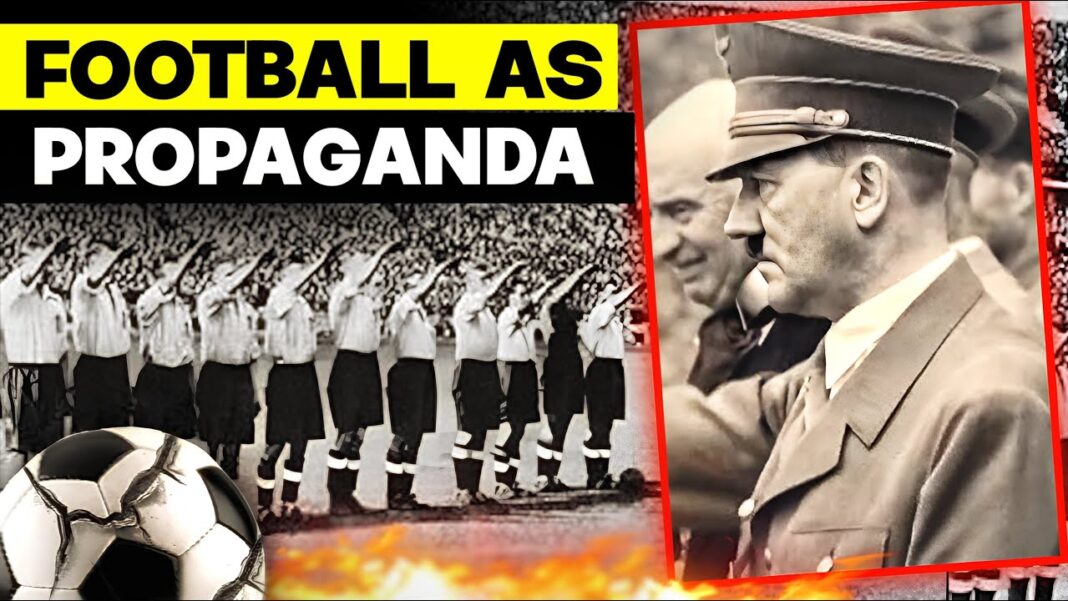
On Monday, the World Jewish Congress (WJC), in partnership with the German NGO What Matters, inaugurated the exhibition “Sports. Crowds. Power.” at the Palais des Nations in Geneva, the historic headquarters of the United Nations. The exhibition, timed to coincide with the UN Human Rights Council’s 60th session and the International Day of Peace, explores how the Nazi regime weaponized sport — particularly (soccer) football — as a vehicle for propaganda, persecution, and exclusion.
This acclaimed exhibition, first presented at Berlin’s Olympiapark during UEFA Euro 2024 in collaboration with the Berlin Sports Museum, retraces the disturbing intersections of athletic culture and authoritarian politics. By bringing it to the United Nations, the WJC and its partners have sought to embed its message within the international diplomatic arena, calling attention to how antisemitism, exclusion, and hatred can flourish when institutions remain passive.
The central thesis of Sports. Crowds. Power. is that football, perhaps the most universal of games, became both a mirror and amplifier of the societies in which it was played. In the case of Nazi Germany, the regime used football (soccer) not simply as entertainment but as a mechanism for consolidating ideological control.
The exhibition documents how Jewish athletes and clubs were systematically marginalized, excluded, and ultimately persecuted. It features harrowing stories of players who, denied access to mainstream competition, nevertheless continued to play in ghettos and even concentration camps, using football as an act of resistance and survival in the bleakest of conditions.
At the same time, the exhibition does not shy away from highlighting the failures of the post-war reckoning. Football (soccer)institutions across Europe were slow — often reluctant — to confront their complicity. This incomplete reckoning left lasting scars on Jewish athletes and underscored how the structures of sport could reinforce prejudice long after the fall of the regime.
The resonance of this exhibition is not confined to history. In her remarks at the opening, Sara Friedman, CEO of WJC Israel, connected the lessons of the 1930s and 1940s to the present moment.
“Today, as Jews and Israelis are once again being excluded from sporting and cultural forums, Sports. Crowds. Power. should serve as a stark warning of what happens when hatred and persecution are allowed to thrive unchecked,” Friedman said. “Bringing this exhibition to the United Nations is our way of sounding the alarm. The diplomatic community has an obligation to reflect on the dangers, and the deadly consequences, of silence and inaction. Ahead of the 2026 FIFA World Cup, we must ensure that the sporting community stands firmly against antisemitism.”
Her words underscored the urgency of applying historical lessons to contemporary antisemitism, which has found new expressions on sporting fields, in cultural spaces, and within the broader discourse of international institutions.
For Daniel Loercher, Managing Director of What Matters, football (soccer) is both the problem and the solution. In his address, he emphasized the duality of the sport:
“Football (soccer) has always reflected the societies in which it is played — at times reinforcing prejudice, but also creating opportunities for solidarity and resilience. By presenting Sports. Crowds. Power. at the United Nations, we want to confront the uncomfortable history of the game under Nazi rule while also inspiring players, clubs and fans today to use football’s universal reach to stand up against antisemitism and discrimination.”
This universal reach — football’s capacity to mobilize billions across cultures and nations — is precisely why the exhibition’s subject matter is so significant. What was once abused by the Nazis as an ideological tool may now be transformed into a platform for inclusion, remembrance, and human rights.
The exhibition’s presentation at the Palais des Nations reflects the scale of international cooperation behind it. It is being staged in collaboration with the Permanent Mission of Germany and the Office of the UN High Commissioner for Human Rights (OHCHR), with additional support from UNESCO, the University for Peace (UPEACE), the Organisation internationale de la Francophonie (OIF), the OSCE Office for Democratic Institutions and Human Rights (ODIHR), the European Union, and a coalition of 33 UN Member States.
This extensive backing shines a spotlight on the exhibition’s role not only as an act of remembrance but as a call for collective responsibility. In a moment when international institutions themselves are often accused of silence or inaction in the face of antisemitism, Sports. Crowds. Power. forces reflection on both past complicity and current obligations.
For the World Jewish Congress, this exhibition is one strand in a much wider strategy. As Dr. Leon Saltiel, the WJC’s Representative to the UN in Geneva, explained: “This exhibition is part of the World Jewish Congress’s longstanding engagement with the United Nations in Geneva to raise awareness about the dangers of antisemitism and the importance of learning lessons from the history of the Holocaust. Moments like these are an opportunity to join forces to protect human rights and democratic values.”
The WJC’s Geneva work has long centered on ensuring that global institutions remain attentive to antisemitism, Holocaust remembrance, and the defense of democratic norms. The staging of Sports. Crowds. Power. thus fits seamlessly into this mission.
While its debut at the Palais des Nations is significant for its diplomatic visibility, the exhibition is not confined to elite audiences. Following its Geneva UN display, Sports. Crowds. Power. will move into the heart of the city’s sporting life. From September 15 to 19, 2025, it will be hosted at Geneva’s main stadium, with the Hôtel Ramada Encore serving as a base for guided tours.
These tours are designed for schools, football (soccer) clubs, local communities, and the general public, ensuring that the exhibition’s message extends beyond the corridors of diplomacy into the grassroots of civic and athletic life. By situating the exhibition within a stadium, organizers hope to directly connect the lessons of history to the lived experience of football (soccer) fans and young athletes today.
The exhibition forms part of the WJC’s Together Through Sport initiative, launched in 2023 with What Matters. The initiative is aimed at harnessing the educational and communal potential of football to fight discrimination and promote inclusion. It focuses on three pillars: education, remembrance, and community action.
Through workshops, exhibitions, and partnerships with clubs and federations, Together Through Sport seeks to ensure that football’s enormous cultural reach is directed toward positive ends — building resilience against antisemitism, fostering intercultural dialogue, and equipping communities to resist prejudice.
Sports. Crowds. Power. resonates on two levels. Historically, it forces acknowledgment of football’s entanglement with authoritarianism and exclusion. It reminds us that stadiums and locker rooms are not immune from the currents of ideology and hate.
Contemporarily, it draws sharp parallels with the present. At a time when Jewish athletes, clubs, and fans again face exclusion from sporting and cultural forums, the exhibition stands as a warning. It signals that the silence of institutions — then and now — emboldens hatred, and that vigilance remains the only safeguard.
As the world prepares for the 2026 FIFA World Cup, the WJC and its partners are using Sports. Crowds. Power. to highlight a critical imperative: sport must be a force for inclusion, not exclusion; for memory, not amnesia; for solidarity, not hate.
By situating this exhibition first at the UN and then in Geneva’s public spaces, organizers have amplified its resonance across both diplomatic and popular arenas. It is both a commemoration of past injustices and a call to confront present dangers.
The lesson is stark: when the world turns its back on hatred in sport, the consequences can be deadly. For the WJC, for What Matters, and for the broad coalition of states and organizations supporting this exhibition, the task is clear — to ensure that football, and sport more broadly, is never again weaponized as a tool of exclusion, but embraced as a universal language of resilience, remembrance, and human dignity.
The WJC is a pathetic cowardly corrupt organization which deserves neither praise nor support. It has and continues to BETRAY the Jewish people.
“The failure of the Jewish establishment—the Anti-Defamation League, American Jewish Committee, Jewish Community Relations Councils and Jewish Federations—to protect and defend the Jewish community against the decades-long build-up and the current surge of hatred in the United States has become a subject of public concern and analysis. The organizations that have claimed to speak for us and guard us against antisemitism have proven unwilling or unable to meet the challenge.”
“Our house is on fire, and the cavalry isn’t coming – JNS.org
https://www.jns.org/our-house-is-on-fire-and-the-cavalry-isnt-coming/
“It is human nature to resist acknowledging catastrophic mistakes, especially when you have raised hundreds of millions of dollars promoting yourselves as the most competent to do the work. Jewish leaders fear that when the enormity of their errors becomes broadly known, their community support might collapse, their (often) lucrative jobs will be at risk, and they will feel public shame.”
(I believe he should have given special mention to the Democrat party.It is an intentional unwillingness, corruption, weakness and cowardice.)
I really treasure your piece of work, Great post.