



|
Getting your Trinity Audio player ready...
|
Current owner is Jacob (Jacqui) Safra, the heir of a Syrian Lebanese-Swiss banking fortune
Edited by: Fern Sidman
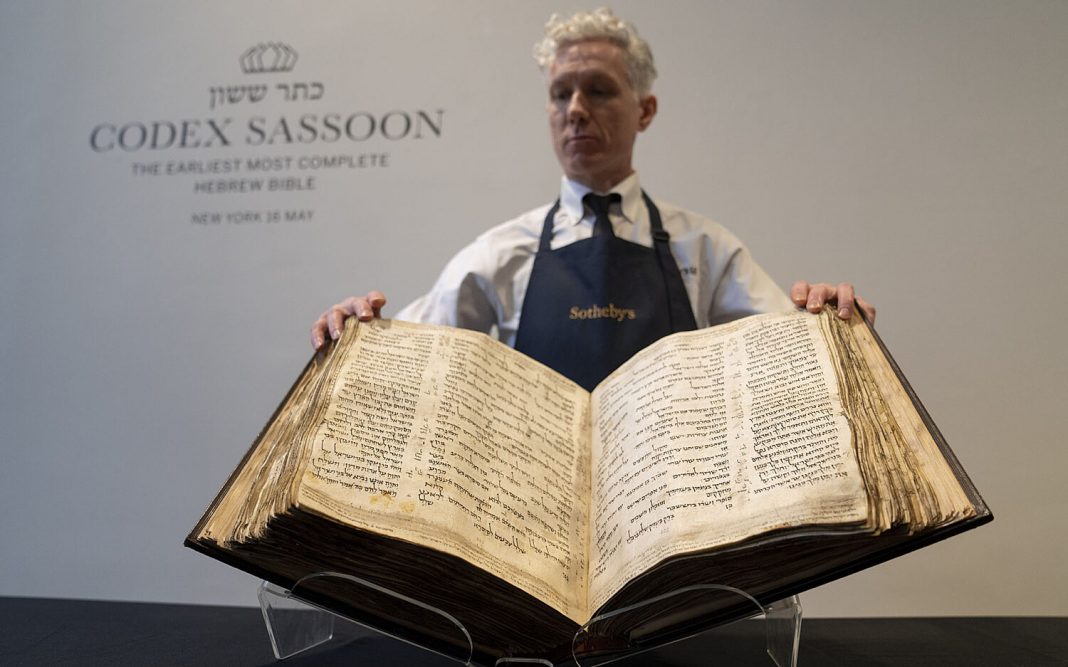
Sotheby’s will auction off the oldest surviving, nearly complete Hebrew Bible, known as the Codex Sassoon, the auction house announced Wednesday in a statement, according to a report on the ArtNews.com web site. The 1,100-year old volume carries an estimate of $30 million to $50 million, which could make it the most valuable historical document ever sold at auction.
In November 2021, billionaire and Top 200 art collector Ken Griffin set a record when he paid $43.2 million for a first printing of the US Constitution at a Sotheby’s auction, Reuters reported on Wednesday. The rare copy of the Constitution that was sold was one of just 11 surviving copies from the official first printing produced for the delegates to the Constitutional Convention and for the Continental Congress, as was reported by the AP at the time. It was the only copy that remained in private hands.
The Codex is named after businessman, philanthropist and Judaica collector David Solomon Sassoon, who acquired the Bible in 1929 and assembled one of the most significant private collections of Judaica and Hebraica manuscripts in the 20th century, Reuters reported. The document offers a critical link bridging Jewish oral tradition to the modern Hebrew Bible.
ArtNews.com reported that according to Sotheby’s, it predates the earliest entirely complete Hebrew Bible, the Leningrad Codex, by nearly a century. While the Aleppo Codex at the Israel Museum is older than the Codex Sassoon, almost two-fifths of its pages are missing.
Scholars have long been aware of the codex named after renowned Judaica collector David Sassoon (1880-1942), but it has remained largely out of public view, Sotheby’s said in a press release Wednesday, as was reported by CNN.
According to Sotheby’s, it was not until recently that the current owner, collector Jacob (Jacqui) Safra, had the Codex Sassoon carbon dated, confirming it was older than the Aleppo Codex and the Leningrad Codex, two other major early Hebrew Bibles, Reuters reported.
ArtNews.com reported that Safra is the heir of a Syrian Lebanese-Swiss banking fortune. In January, Safra sold two paintings by the Italian 17th-century painter Artemisia Gentileschi through an Old Masters auction at Sotheby’s New York.
“Codex Sassoon has long held a revered and fabled place in the pantheon of surviving historic documents and is undeniably one of the most important and singular texts in human history,” Sotheby’s Global Head of Books & Manuscripts Richard Austin said in a statement, as was reported by ArtNews.com. “With such eminence, the Codex has an incomparable presence and gravitas that can only be borne from more than one thousand years of history.”
Reuters reported that Sotheby’s said the Codex Sassoon had been dated to either the late 9th or early 10th century on both scientific and paleographic grounds and contains almost the entirety of the Bible. The oldest copies of Biblical text ever found were the Dead Sea Scrolls that were discovered in caves in 1947.
Sharon Mintz, Sotheby’s senior Judaica specialist, books and manuscripts, told CNN Wednesday that “this is the most important document to come to auction ever.”
Mintz said this “astonishing record” is likely to generate huge interest from bidders, CNN reported. “This is the most significant document that I have ever had the pleasure of examining, researching and holding,” she added.
The Hebrew Bible is the foundation of the three Abrahamic faiths: Judaism, Christianity and Islam. Reuters reported that the Hebrew Bible contains 24 separate books organized into three parts — the Pentateuch, the Prophets and the Writings.
CNN reported that the ancient Hebrew bible consists of 792 parchment pages made from animal skins — and weighing about 26.5 pounds. Mintz described it as a “lavish production that only the most wealthy could have afforded.”
The current owner purchased the codex in 1989, said Mintz, and is now “delighted to be able to share it with the world,” CNN reported.
The codex, or manuscript in book form, will be available for public viewing for the first time in 40 years next week at Sotheby’s London, according to the Reuters report. The last time the Codex Sassoon was publicly exhibited was in 1982 at the British Museum, according to the ArtsNews.com report.
Jews in antiquity came to rely on oral tradition passed down through generations to understand and preserve the message of the Bible, Sotheby’s added in their statement, CNN reported.
According to the Israel Museum that houses the Dead Sea Scrolls, the Aleppo Codex was badly damaged in a fire at the community’s synagogue in 1947 and today “no more than 295 of the original 487 leaves [pages] survived, CNN reported. ” By contrast, the Sassoon codex is only missing 12 full pages so, according to Sotheby’s, “is thus the earliest, most complete copy of the Hebrew Bible extant.”
The Codex Sassoon has Masoretic notes from early Middle Age scholars on how words in the Hebrew Bible’s twenty-four books should be spelled, read and accented, ArtNews.com reported. The Codex Sassoon also contains more than a millennium of annotations, transcriptions, commentary, and ownership records. ArtNews.com also reported that Sotheby’s said the latter provides even greater detail on how Abrahamic religions developed and spread across the ancient Levant area in the Middle Ages.
CNN reported that an entry from the early 11th century refers to a sale by Khalaf ben Abraham, perhaps in Israel or Syria, to a man called Isaac ben Ezekiel al-Attar, who later transferred it to his two sons.
The next location mentioned in the annotations came in the 13th century when it was dedicated to the synagogue of Makisin (present-day Markada in northeastern Syria), as was reported by CNN. It was likely rebound at this stage, according to Sotheby’s, and inscribed with the words “consecrated to the Lord God of Israel to the synagogue of Makisin,” the report indicated.
Makisin was later destroyed and the codex was entrusted to a community member called Salama bin Abi al-Fakhr who pledged to return it to the synagogue in the event of regeneration, CNN reported, but the synagogue was never rebuilt and the codex continued on its odyssey until it was acquired by Sassoon in 1929.
To calculate the price estimate of the Codex Sassoon, Austin told the New York Times a committee started discussing the number two years ago< ArtNews.com reported. It took into consideration the production cost of more than 100 animal skins, the careful calligraphy of a single writer, and its monumental historical value. It also looked at the two previous record-breaking sales of historic documents: the Codex Leicester, a Leonardo da Vinci manuscript bought by Bill Gates in 1994 for $30.8 million, ArtNews.com reported.
The live auction of the object will take place at Sotheby’s the morning of May 16.
