



|
Getting your Trinity Audio player ready...
|
By: Fern Sidman
The October 7, 2023 attacks by Hamas jolted the world with a ferocity that defied comprehension: coordinated massacres, mass abductions, and appalling cruelty on a scale unseen in modern Jewish history. Entire families were gunned down in their homes, music festival crowds were slaughtered in open fields, and villages along Israel’s southern frontier were left in smoldering ruins. More than 1,200 people were murdered, and 251 were taken hostage into Gaza. In the aftermath, the tragedy itself was almost immediately thrust into another battlefield—one of narratives, images, and contested truths.
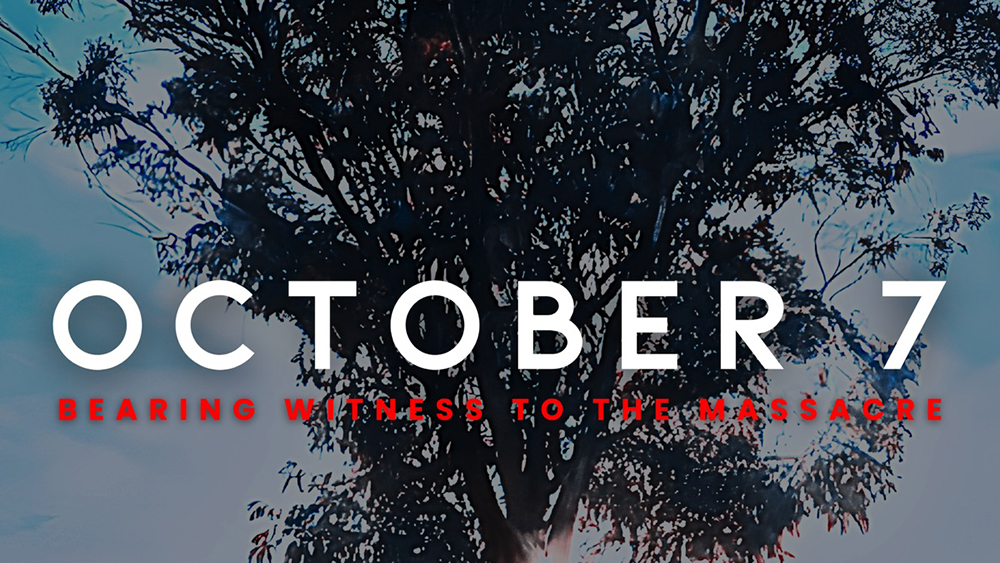
Into this fraught environment steps “October 7: Bearing Witness to the Massacre”–a new feature-length documentary that insists on confronting denial, propaganda, and selective memory head-on. Rooted in raw footage, eyewitness accounts, and expert testimony, the film is not designed to entertain. It is designed to shock, to sear memory, and to demand accountability.
At the heart of the documentary is Todd Morehead, an American Christian who arrives in Israel not as a journalist, politician, or soldier, but as a witness. His journey is framed around questions that transcend political partisanship: How could such a horror occur? What forces—historical, ideological, militant—allowed it to fester and erupt? And what responsibility does the world have to ensure it is neither forgotten nor repeated?
Morehead’s presence is symbolically powerful. By placing a non-Jewish Christian at the narrative center, the filmmakers invite audiences of all backgrounds—particularly Western viewers who might see the conflict as remote or abstract—to confront the atrocity as a human tragedy rather than dismissing it as “someone else’s war.”
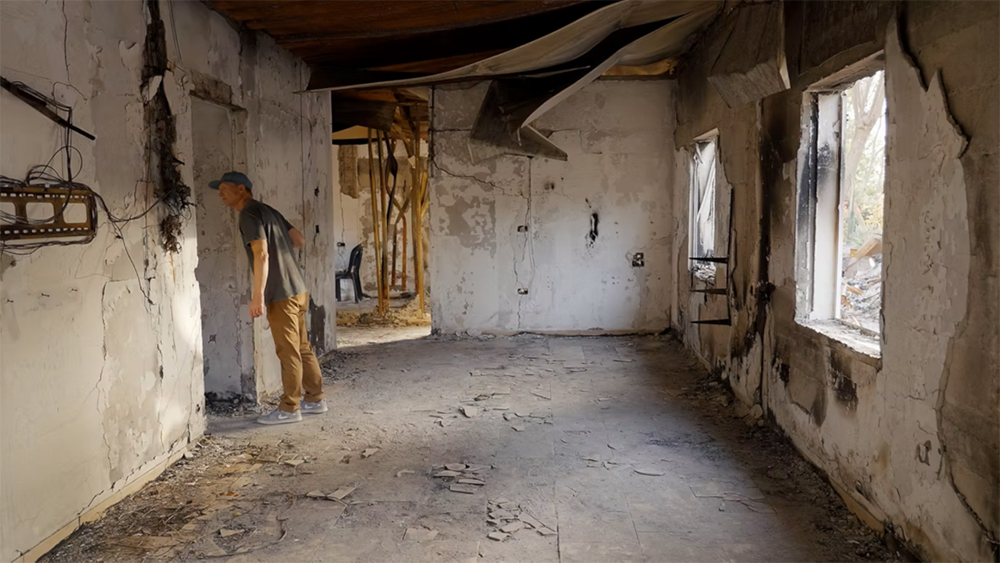
Throughout the film, Morehead meets survivors of the massacre, hostage families who still carry the unbearable weight of uncertainty, first responders who catalogued devastation, and historians who contextualize the moment within the long arc of Jewish struggle and Palestinian terrorism.
One of the film’s strengths is its refusal to present October 7 in isolation. Instead, it situates the attacks within the broader history of Gaza and the repeated cycles of withdrawal, occupation, governance, and terrorist entrenchment.
Morehead’s conversations with leading Israeli intellectuals—among them Daniel Gordis, Einat Wilf, Ronen Bergman, and Miri Eisen—provide audiences with a layered account of Gaza’s evolution. From the days of the British Mandate to Israel’s unilateral withdrawal in 2005, and from Hamas’s violent takeover in 2007 to the ceaseless rocket barrages and tunneling operations, these voices emphasize a critical point: October 7 did not emerge from a vacuum.
Rather, the massacre was the culmination of years of ideological indoctrination and terrorist preparation, enabled by a global reluctance to take Hamas at its word when it proclaimed its genocidal intent toward Jews and its absolute refusal to accept Israel’s existence.
Another major strand of Bearing Witness is its examination of Hamas as more than a governing authority in Gaza. Through interviews and archival material, the film highlights the ideological foundations of the group—foundations rooted in radical Islamist doctrine, glorification of martyrdom, and the theological demonization of Jews.
Rather than portraying October 7 as a spontaneous explosion of rage or “blowback” to Israeli policy, the documentary argues that the massacre was the logical consequence of Hamas’s long-declared agenda. From school textbooks to Friday sermons, from Al-Qassam Brigades propaganda videos to public speeches by Hamas leaders, the group has consistently framed violence against Jews not as a tragic necessity but as a sacred obligation.
This framing, the film insists, must be understood if October 7 is to be remembered not only as a moment of horror but as a warning of where unchecked Jew hatred leads.
Perhaps the most controversial and harrowing element of Bearing Witness lies in its imagery. Produced by the IDF Spokesperson’s Unit, the documentary incorporates footage taken directly from Hamas terrorists’ body cameras, cell phones recovered from victims and attackers, and documentation from first responders.
The result is graphic, raw, and profoundly unsettling. According to the film’s official synopsis, the footage includes civilians shot point-blank in their homes, cars riddled with bullets, charred remains including those of infants, mutilated bodies, and soldiers overwhelmed at border posts. Hostages—women and men—are shown being dragged by the hair, zip-tied, and forced into vehicles at gunpoint.
This is not imagery designed for comfortable viewing. It strips away the detachment of statistics and insists that audiences see what denialists and propagandists would prefer remain hidden. As the film concludes with the words of Pastor Dietrich Bonhoeffer—“Silence in the face of evil is itself evil. Not to speak is to speak. Not to act is to act”—the message is unmistakable: witnessing is itself an act of resistance.
Because of its graphic nature, screenings of the film have been tightly controlled. In Israel, lawmakers, military officials, and select journalists were shown the footage under strict security measures. Abroad, the film has been screened for diplomats, journalists, and opinion leaders in Washington, London, and Hollywood, often under non-disclosure agreements.
According to Israeli media reports, the film has been used as a tool of public diplomacy. Israeli officials believe that raw footage is necessary to combat international disbelief, distortion, and slander surrounding October 7. Some screenings reportedly left audiences in tears, while others ended in stunned silence, with lawmakers visibly shaken.
In universities, synagogues, and cultural centers, the film is beginning to circulate more widely—though often still under careful conditions, to prevent sensationalist misuse or retraumatization of survivors.
Early descriptions pegged Bearing Witness at 47 minutes, a runtime often associated with the compilation of terrorist body-camera footage. More recent listings, however, suggest a full feature-length version exists. IMDb now records the documentary as 1 hour and 50 minutes, directed by Jesse Schluntz and featuring Todd Morehead as a central figure.
The dual runtimes remain somewhat ambiguous—possibly indicating a condensed version used for diplomatic screenings and a longer cut for broader release. Regardless, both iterations underscore the film’s uncompromising commitment to showing the unvarnished truth of October 7.
As of October 3, 2025, October 7: Bearing Witness to the Massacre is available for streaming on Amazon Prime Video and Apple TV+, alongside its official website.
The film’s site confirms its availability as a “feature documentary,” with additional screenings planned in cinemas, community centers, and private venues. Viewers interested in watching are encouraged to check local announcements, as screenings may require special passes or institutional hosting due to the film’s graphic content.
This distribution marks a significant shift: what was once restricted to closed rooms and select audiences is now accessible to the wider public. The question remains how viewers will receive—and process—the imagery once confined to classified briefings.
The decision to make such raw footage public has sparked debate. Critics warn that repeated exposure to graphic violence risks retraumatizing survivors, spreading trauma contagion, or even numbing viewers. Others worry about exploitation: that sensationalists might seize upon horrific imagery for political agendas unrelated to honoring victims.
Yet defenders of the film argue that the alternative—silence, suppression, or reliance on statistics—would be worse. As one Israeli official quoted by Israel National News put it: “If the world cannot see what happened, they will never believe it happened.”
This moral dilemma is central to Bearing Witness. By choosing to show, the film bets on the power of truth to cut through noise and denial.
Reports from early screenings suggest the film leaves few indifferent. In Israel, lawmakers wept openly. In Europe, some viewers left theaters unable to finish watching. In North America, Jewish communities organized screenings framed as acts of remembrance and solidarity.
For many, the film provides validation against denialist narratives circulating on social media, where Hamas apologists and anti-Israel activists have sought to downplay or distort the events of October 7. For others, it represents a difficult confrontation with images they would rather not see.
Either way, the film ensures that indifference is not an option.
Ultimately, “October 7: Bearing Witness to the Massacre” is not simply a documentary—it is an act of advocacy. It insists that remembrance without action is incomplete, and that silence is complicity.
By closing with Bonhoeffer’s words, the film connects Jewish suffering in 2023 to the broader human obligation to resist evil. It calls on audiences—Jewish, Christian, Muslim, secular—to recognize that what happened on October 7 was not only an Israeli tragedy but a human one.
Morehead’s journey, bridging faith and suffering, becomes a metaphor: that witnessing across boundaries can itself be a form of solidarity, and that acknowledging truth can be the first step toward justice.
“October 7: Bearing Witness to the Massacre” refuses to allow October 7 to be reduced to a headline, a statistic, or a contested talking point. By forcing audiences to confront atrocity, it insists on memory, accountability, and moral clarity.
Now streaming on Amazon Prime Video, Apple TV+, and the film’s official website, it is accessible to a global audience. But accessibility does not mean ease: this is a film that will test viewers’ limits, confront their preconceptions, and challenge them to act.
In a world where propaganda and denial flourish, Bearing Witness makes one thing clear: the truth of October 7 must not be buried.