



|
Getting your Trinity Audio player ready...
|
By: Fern Sidman
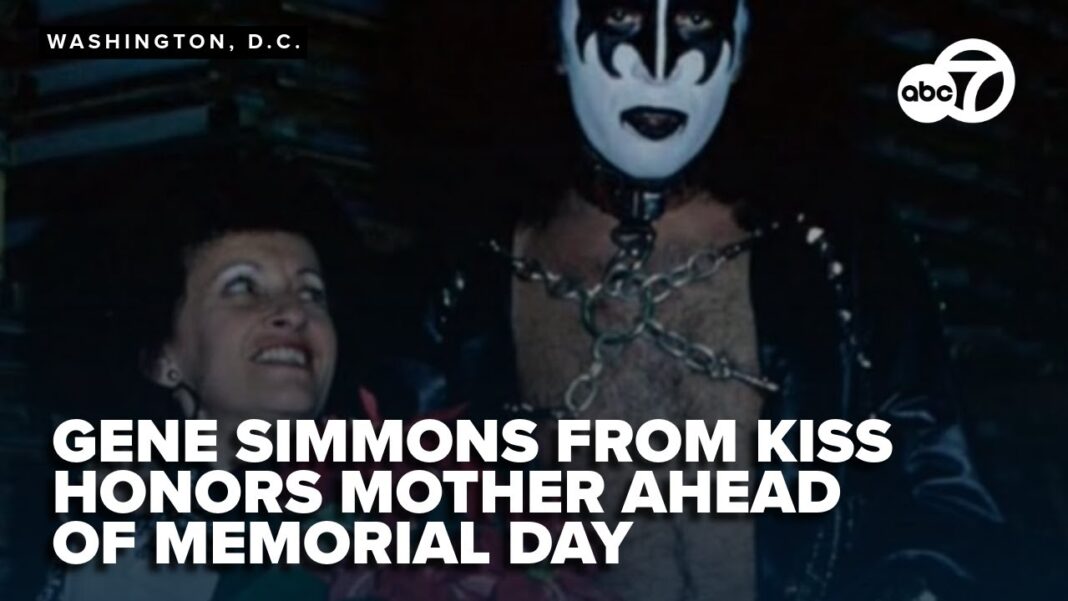
In a moving tribute that bridged generations and honored the enduring legacy of courage and survival, Gene Simmons, legendary frontman of the rock band KISS, met with 100-year-old World War II veteran Harold “Hal” Urban on Memorial Day in Washington. The encounter, which VIN News described as both “emotional” and “historically significant,” commemorated not only the liberation of the Mauthausen concentration camp, but the life of a Holocaust survivor — Flora Klein, Simmons’ mother — whose life was spared thanks to the heroism of American soldiers like Urban.
As reported by VIN News, the meeting took place during the Memorial Day parade, where Urban was recognized and honored for his role in helping liberate the Nazi death camp in May 1945. Wearing his original military jacket, Urban stood proudly among a sea of flags and grateful onlookers when he was approached by Simmons, whose presence turned a national day of remembrance into an intensely personal moment of gratitude and closure.
Simmons, born Chaim Witz in Haifa, Israel, to Hungarian Jewish parents, became visibly emotional upon meeting Urban. “If it weren’t for brave people like you,” Simmons told the veteran, “I wouldn’t be here, and neither would my mother.” According to the information provided in the VIN News report, the rock icon fought back tears as he embraced the man who had, unknowingly at the time, played a role in his very existence.
Urban, who helped liberate Mauthausen alongside other American troops, recalled the horrors of that day. “The smell was unimaginable,” he said, describing the scene of emaciated prisoners and 500 corpses that his unit buried within the first 24 hours. Though he couldn’t remember Flora Klein specifically, Urban knew that she — a 14-year-old Hungarian girl at the time — had been one of the countless lives his unit had freed from the Nazis’ grip.
Following the war, Urban returned to Illinois, built a life, raised nine children, and quietly bore the weight of what he had seen. “When you raise a family, the nightmares subside,” he said, “but when your children leave home, they return.” VIN News reported that Urban’s memories of the Holocaust and liberation have never truly left him — but meeting Simmons provided a rare, tangible outcome of his service: the enduring survival of a family.
VIN News chronicled how Simmons grew up knowing his mother had survived the Holocaust, though she rarely spoke of it. “She was in the camp at 14,” Simmons told reporters. “Now I know how close I came to losing everything.” Flora Klein, who passed away in 2018, lived a long life but carried deep scars. Simmons has often spoken of her resilience, crediting her with shaping his strong work ethic and Jewish pride.
Simmons emigrated to the United States at age 8 with his mother, settling in New York before rising to international stardom as the fire-breathing, tongue-wagging bassist of KISS, one of the most iconic rock bands in history. Despite his theatrical persona, the VIN News report emphasized that Simmons has always remained deeply connected to his Jewish roots and to the memory of the Holocaust.
This Memorial Day encounter was more than a chance meeting between celebrity and soldier. As the report at VIN News insightfully noted, it represented a profound historical circle closing — a direct link between the unspeakable atrocities of the 20th century and the resilience, artistry, and generational survival that followed.
The meeting also served as a stark reminder of the fragility of memory. With Holocaust survivors and WWII veterans now in their 90s and older, the report at VIN News stressed the importance of capturing these stories before they fade. Urban, at 100, is among the last living witnesses to the liberation of Nazi camps — and Simmons’ emotional thanks made clear that these moments matter.
In a world increasingly plagued by rising antisemitism and Holocaust denial, the image of a rock icon thanking a liberator was not only moving, but essential. “You saved my family,” Simmons said, “and I will never forget that.”
As Urban was wheeled away after the ceremony, Simmons stood silently, watching the man whose service had shaped his destiny disappear into the crowd. For a brief moment, time collapsed — and all that remained was a survivor’s legacy, a liberator’s courage, and a son’s eternal gratitude.
