



|
Getting your Trinity Audio player ready...
|
By: Russ Spencer
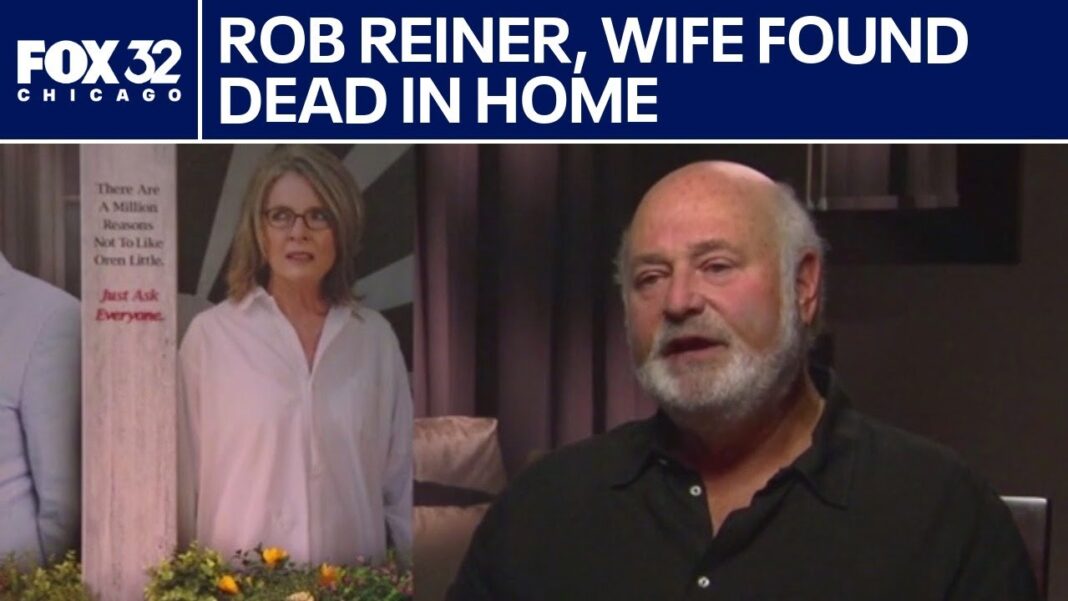
The sudden and violent deaths of Rob Reiner and his wife, Michele Singer Reiner, have sent shockwaves through Hollywood and far beyond, marking one of the most devastating personal tragedies to strike an American entertainment dynasty in decades. Multiple sources confirmed to PEOPLE.com on Sunday that the celebrated filmmaker and his wife were killed by their son, Nick Reiner, in an incident that unfolded Sunday afternoon at the couple’s Los Angeles-area home.
According to information provided to PEOPLE.com by the Los Angeles Fire Department (LAFD), emergency responders were dispatched to the residence at approximately 3:30 p.m. on Sunday, December 14, following a call for medical assistance. Upon arrival, first responders discovered a 78-year-old man and a 68-year-old woman deceased at the scene. Sources later confirmed to PEOPLE.com that the victims were Rob Reiner and Michele Singer Reiner.
Authorities have not yet released comprehensive details regarding the precise circumstances of the deaths, and the investigation remains ongoing. Nevertheless, the confirmation of the identities involved has cast a somber pall over an industry and a public that long viewed the Reiner family as emblematic of creativity, longevity, and generational influence in American entertainment.
Rob Reiner’s name is woven indelibly into the fabric of modern Hollywood. As the report in PEOPLE.com recounted, Reiner’s career spans more than five decades and encompasses some of the most beloved and enduring films in cinematic history. His 1984 directorial debut, This Is Spinal Tap, redefined the mockumentary genre and became a cultural touchstone whose influence continues to reverberate through comedy and filmmaking alike.
That success was followed by an extraordinary run of films that showcased both Reiner’s versatility and his intuitive grasp of storytelling. Stand by Me (1986) offered a poignant meditation on childhood and loss; The Princess Bride (1987) became a multigenerational fairy tale infused with wit and sincerity; When Harry Met Sally… (1989) reimagined the romantic comedy with emotional intelligence and enduring charm. In the early 1990s, Reiner further demonstrated his range with Misery (1990) and A Few Good Men (1992), films that blended psychological tension, moral inquiry, and courtroom drama.
Long before his success behind the camera, Reiner was already a familiar face to American audiences. He rose to prominence as Mike Stivic on Norman Lear’s groundbreaking sitcom All in the Family, a role that placed him at the center of some of the most important cultural conversations of the 1970s. As the PEOPLE.com report noted, the show’s fearless engagement with politics, race, and social change helped redefine television, and Reiner’s performance was integral to its impact.
Rob Reiner was born in the Bronx, New York, in 1947 into what many have described as comedic royalty. His father, Carl Reiner, was a legendary comedian, writer, director, and performer whose influence spanned radio, television, film, and literature. His mother, Estelle Lebost, was an actress and singer. Growing up in such an environment, Reiner was steeped from an early age in the rhythms of performance and the discipline of creative work.
As PEOPLE.com has often chronicled, Rob Reiner’s success was never merely a product of lineage. While his upbringing offered exposure and opportunity, his career was defined by a distinctive voice and a remarkable consistency of vision—qualities that earned him both critical acclaim and enduring affection from audiences.
Rob Reiner met Michele Singer during the production of When Harry Met Sally…, a film that would come to define a generation’s understanding of romance. Their relationship soon blossomed into marriage in 1989. Over the ensuing decades, Michele Singer Reiner became not only his life partner but also a steadfast presence in his personal and professional world.
The couple raised three children together, building a family life that, from the outside, appeared grounded and private despite Rob Reiner’s public stature. Prior to his marriage to Michele, Reiner had been married to filmmaker and actress Penny Marshall, who died in 2018 at age 75 due to complications from diabetes. That earlier marriage also linked Reiner to another towering Hollywood family, further cementing his place in the industry’s inner circles.
In its coverage, PEOPLE.com has frequently highlighted Reiner’s devotion to family and his efforts to balance a demanding career with personal commitments—a narrative that now stands in heartbreaking contrast to the events that unfolded this weekend.
Perhaps the most painful dimension of the tragedy lies in the identity of the alleged perpetrator: Nick Reiner, the couple’s son. As PEOPLE.com reported in a 2016 interview, Nick had spoken candidly about his years-long battle with drug addiction—a struggle that began in his early teens and profoundly shaped his life.
According to Nick’s own account to PEOPLE.com, he cycled in and out of rehabilitation programs starting around age 15. As his addiction deepened, he became increasingly estranged from home and spent extended periods homeless, living on the streets in multiple states. He described nights—and sometimes weeks—spent sleeping outdoors, immersed in a chaotic and unstable existence that placed him far from the security of his family.
That period of hardship later informed Nick’s creative work. He co-wrote the semi-autobiographical film Being Charlie, drawing directly on his experiences with addiction, alienation, and recovery. In the same 2016 interview with PEOPLE.com, Nick reflected on what he described as a period of relative stability, telling the magazine, “Now, I’ve been home for a really long time, and I’ve sort of gotten acclimated back to being in L.A. and being around my family.”
Those words now resonate with tragic irony.
News of Rob and Michele Reiner’s deaths has prompted an outpouring of grief and disbelief across Hollywood and beyond. Industry figures, colleagues, and fans have expressed shock at the sudden loss of a man whose work shaped decades of popular culture and whose voice remained influential well into his later years.
As PEOPLE.com continues to report, many within the entertainment community are grappling not only with the deaths themselves but with the deeply unsettling nature of the alleged circumstances. Familial violence, particularly when intertwined with long-standing struggles such as addiction and mental health, exposes fault lines that cut across fame, success, and public admiration.
Mental health advocates and addiction specialists have noted that stories like this underscore the complexity of recovery and the limits of external stability in addressing deeply rooted struggles. While Nick Reiner had spoken openly about his progress and reconnection with family, experts caution that addiction is often marked by cycles of remission and relapse, and that recovery is rarely linear.
Rob Reiner’s artistic legacy is vast and secure. His films continue to be watched, quoted, studied, and cherished by new generations. Yet the circumstances of his death ensure that his legacy will now be discussed alongside an unspeakable personal tragedy—one that complicates any attempt at simple remembrance.
Michele Singer Reiner, though less publicly visible, was a central figure in his life and family, and her death has been mourned with equal intensity by those who knew the couple personally. As PEOPLE.com has emphasized, the loss is not merely that of a public figure, but of parents, partners, and private individuals whose lives ended violently and prematurely.
Authorities have not yet released further details regarding potential charges, motives, or the precise sequence of events leading up to the deaths. As the investigation proceeds, PEOPLE.com is expected to continue providing updates, drawing on official statements and confirmed sources to clarify what remains an unfolding and deeply distressing case.
For now, the tragedy stands as a stark reminder that no measure of fame, talent, or professional success can insulate a family from profound personal crisis. The deaths of Rob Reiner and Michele Singer Reiner mark the end of a remarkable chapter in Hollywood history—and the beginning of a painful reckoning with the vulnerabilities that exist even within its most storied families.
As readers around the world absorb the news through ongoing reporting by PEOPLE.com, the collective response remains one of sorrow, disbelief, and a quiet reckoning with the fragility of human life, even at its most celebrated heights.