



Edited by: Fern Sidman
Switzerland clinched the title at this year’s Eurovision Song Contest held in Malmo, Sweden, while Israel, amid a backdrop of violent pro-Hamas and anti-Israel protests achieved a commendable fifth place. The event, which traditionally celebrates cultural diversity and musical talent, was overshadowed by the war that Hamas terrorists launched on Israel on October 7th, and as a result, influenced both the audience’s reception and the voting patterns.
Significant protests against Israel took place outside the arena in Malmo, reflecting the ongoing geopolitical tensions involving Israel in international forums. Inside the stadium, smaller protests, though less visible, also occurred, indicating a concerted effort by some attendees to express their hatred for Israel in a more subtle fashion.
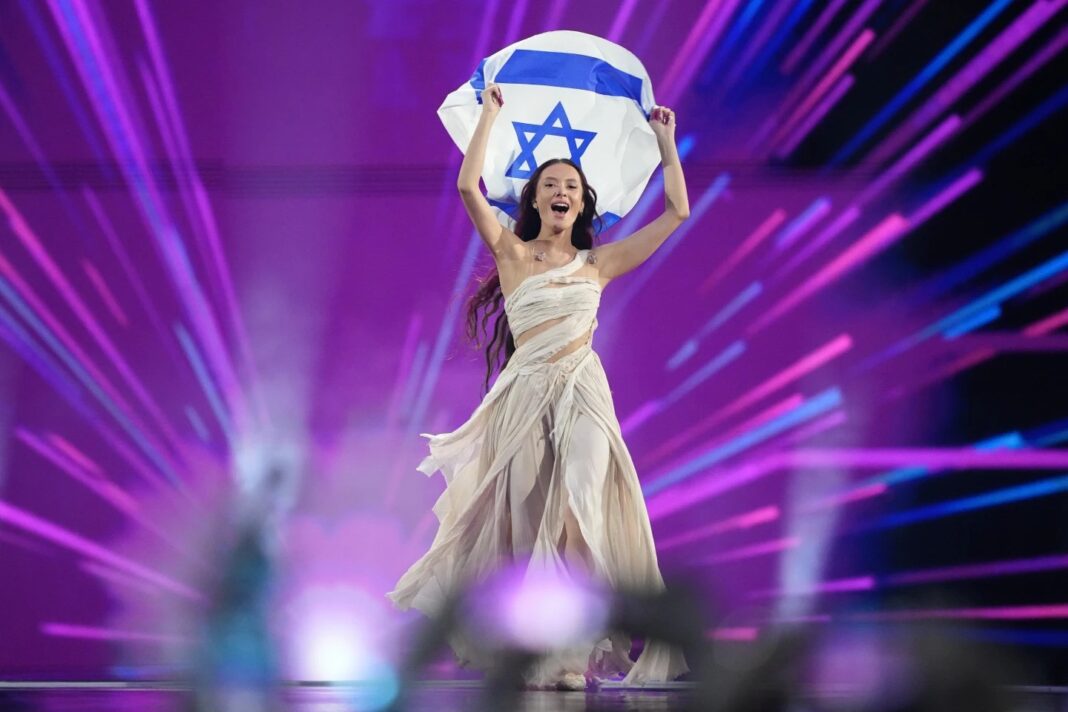
Israel was represented by Eden Golan, whose performance of the song “Hurricane” resonated strongly with the public, securing the second-highest tally in the televote with 323 points, according to a report on The Times of Israel web site. However, the jury votes told a different story, placing Israel 12th, which starkly contrasted with the public’s admiration and ultimately determined the fifth-place finish, as was reported by the TOI. The disparity between public affection and jury appraisal highlighted the anti-Israel animus of the contest’s scoring system.
Golan’s scores from the national juries varied, with the highest being 8 points each from Norway, Cyprus, and Germany. Other countries gave lower scores, reflecting the clearly biased nature of the jury opinions across Europe. The report in the TOI indicated that despite the lack of maximum scores from any jury, the support Golan received was notable, considering the competitive nature of the contest.
The competition this year was heavily influenced by political elements. Israel’s spokesperson, Maya Alkulumbre, faced a controversial moment when she appeared on screen without a yellow hostage pin—a symbol of solidarity with the hostages still in Hamas captivity in Gaza that she had worn during the preparations, according to the information provided in the TOI report. Reports from Ynet suggested that Alkulumbre was instructed by Kan, the Israeli broadcaster, to remove the pin to avoid provoking the European Broadcasting Union (EBU), though Kan did not comment on the matter, the TOI report said. This incident sparked boos during the broadcast, both when Alkulumbre presented and when points were awarded to Israel, reflecting the pervasive pro-Hamas sentiment and the contentious environment surrounding Israel’s participation.
Also noted in the TOI report was that despite the competitive and political pressures, Eden Golan expressed pride in Israel’s achievement and the impact of her performance. Her statement after the contest emphasized the dual purpose of her participation: to project Israel’s strong voice globally and to remember the ongoing plight of the hostages—a personal and national concern that she highlighted as a driving force behind her Eurovision journey.
Interestingly, this year’s Eurovision saw the deployment of anti-boo technology by the EBU during the broadcast. The TOI reported that this technology was notably used to mute audible disapproval during Golan’s performance, indicating the EBU’s efforts to maintain a focus on the contest’s artistic and cultural objectives, rather than its political undercurrents.
In the competitive realm, the Israeli-born singer representing Luxembourg, Tali, who performed the song “Fighter,” finished in 13th place. Notably, Tali’s highest points came from Israel, indicating a cultural and possibly sentimental connection that influenced the jury’s decision, the report in the TOI suggested. However, despite her robust performance, she did not emerge as a frontrunner in the contest.
The contest also served as a platform for other manifestations of visceral Jew hared. According to the information provided in the TOI report, Portugal’s representative, Iolanda, made a political statement during the opening “flag parade” by wearing a dress designed by a Palestinian designer and sporting nail art in the colors of the Palestinian flag along with a keffiyeh pattern. This fashion choice was a deviation from her semifinal appearance, suggesting a deliberate decision to make a political statement during the more widely viewed final.
Ireland’s contestant, Bambie Thug, also drew attention for political symbolism. Initially, Bambie Thug had pro-Palestinian messages written on their face in an ancient Irish language, which they were ordered to remove by the European Broadcasting Union. The TOI report noted that despite this, Bambie Thug continued to express solidarity by carrying a stuffed watermelon in the green room, a symbol that has gained recognition in pro-Hamas movements.
Throughout the event, the audience’s reactions were a mix of support and dissent. Israeli flags waved prominently in the crowd, showcasing strong support among many attendees for the Israeli contestant. Conversely, boos were reportedly heard when Eden Golan, the Israeli contestant, appeared on stage during both the flag march and her performance, although these were muted in the broadcast, the TOI report said.
Adding to the controversy, Sweden’s previous Eurovision winner, Loreen, reportedly stated before the competition that she would refuse to hand over the trophy to Golan if Israel won.
In a striking move, the representatives from Finland and Norway, tasked with announcing their country’s jury votes, chose to withdraw from their roles. Citing discomfort with the current political undertones associated with the event, their decision shed light on the divisive nature of this year’s contest, according to the TOI report. They were promptly replaced by other representatives, but the gesture marked a significant moment of political expression within the Eurovision framework.
The contest took a dramatic turn when Joost Klein from the Netherlands, a fan favorite, was disqualified by the EBU following a threatening incident with a Eurovision camerawoman. The disqualification, confirmed by the EBU as unrelated to Israel, nevertheless became a focal point for further controversy. The TOI reported that many online commentators incorrectly linked Israel to the incident, criticizing the EBU for its perceived inconsistency in enforcing rules and questioning its decision-making process in allowing Israel’s participation while barring the Netherlands. The disqualification of the Netherlands’ contestant not only shocked fans but also ignited a firestorm of reactions on social media.
The selection of Israel’s entry itself was a tale of contention and resilience amid widespread calls for its exclusion from the storied international event.
Israel initially selected “October Rain” as its entry for Eurovision. However, the European Broadcasting Union (EBU) disqualified the song on the grounds that it was too political, reflecting the strict guidelines that seek to keep the competition culturally focused and free from overt political statements, as was indicated in the TOI report.
Following the disqualification, a monthslong campaign spearheaded by activists sought to bar Israel from the competition entirely. This campaign was part of a broader effort by some groups to leverage international cultural platforms such as Eurovision to protest against political actions by the Israeli government, according to the TOI report. Despite these intense pressures, Eurovision organizers remained firm in their decision not to exclude Israel, adhering to their principles of inclusivity and non-discrimination among participating nations.
Eden Golan, with her song “Hurricane,” faced unprecedented challenges in the lead-up to the contest. Due to heightened security concerns and threats, Golan was largely confined to her hotel room, missing most of the extracurricular activities that form a part of the Eurovision experience, as was noted in the TOI report. Her participation was limited to essential appearances such as the live shows and dress rehearsals, highlighting the severity of the security concerns surrounding her and the Israeli delegation.
Amidst the glitz of Eurovision’s “turquoise carpet” event, Golan and the Israeli delegation held a small Holocaust Remembrance Day gathering, as per the TOI report. This somber observance served as a poignant reminder of the deeper historical and cultural layers that often accompany nations’ participation in such international events, offering a moment of reflection in an otherwise festive atmosphere.
With Switzerland’s victory at Eurovision, it is poised to host the 2025 edition of the competition. The country has a history of success in the contest, having won twice before. The TOI also reported that Israel, with its own storied Eurovision history including four wins, the most recent being Netta Barzilai’s 2018 victory with “Toy,” continues to be a competitive and controversial participant.