



|
Getting your Trinity Audio player ready...
|
By: Fern Sidman
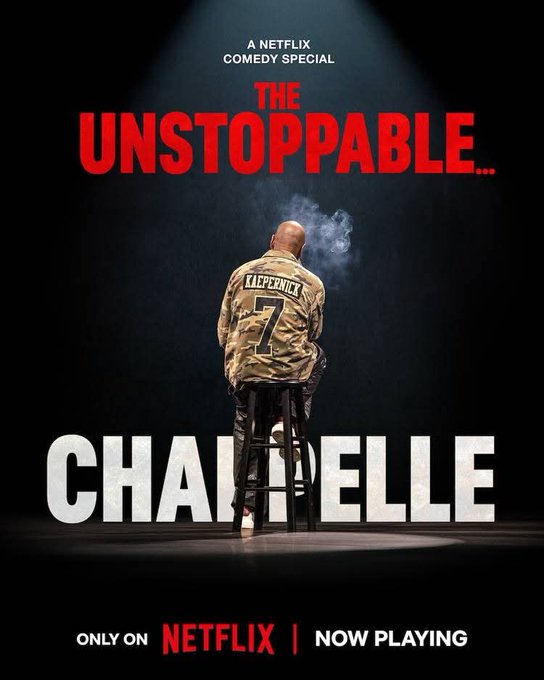
In his latest Netflix special, The Unstoppable, comedian Dave Chappelle devotes only a handful of minutes to a controversy that has nevertheless reverberated far beyond the confines of stand-up comedy. Yet those minutes—laced with derision, distortion, and an incendiary swipe at Israel—have ignited a fresh storm of criticism, with Jewish groups, media commentators, and cultural critics warning that Chappelle’s rhetoric risks legitimizing antisemitic narratives under the guise of humor. As The New York Post reported on Sunday, the episode illustrated how celebrity platforms can transform casual asides into cultural flashpoints, particularly in a climate already inflamed by war and rising antisemitism.
The controversy centers on Chappelle’s decision to perform at the Riyadh Comedy Festival in Saudi Arabia, a lavish, state-backed event that featured more than 50 high-profile comedians and reportedly paid some performers up to $1.75 million for their appearances. The festival itself was contentious from the outset. Saudi Arabia’s human rights record—most notoriously the 2018 murder of dissident journalist Jamal Khashoggi—prompted sharp criticism of entertainers willing to accept the kingdom’s largesse. As The New York Post report noted, several prominent comedians publicly rebuked their peers for what they viewed as moral compromise in exchange for a lucrative payday.
🚨 Another dumbass ignorant comedian, Dave Chappelle, who pretends he is a geo-politics expert so that he can spread his vile antisemitic rants pic.twitter.com/StiVvYY5Ax
— Raylan Givens (@JewishWarrior13) December 21, 2025
Bill Maher, host of HBO’s Real Time, was among those who raised objections, though his critique was comparatively restrained. Maher took issue with Chappelle’s assertion that it was “easier to talk” on a comedy stage in Saudi Arabia than in the United States, a claim Maher dismissed as demonstrably false. “Do your hunk on Mohammed, Dave,” Maher challenged on air, implying that true freedom of speech would require testing the limits of Saudi Arabia’s well-documented intolerance for religious satire.
Chappelle’s response, delivered on stage in The Unstoppable and recounted in The New York Post report, was neither measured nor conciliatory. Instead, he unleashed a profanity-laden tirade against Maher, dismissing him as a purveyor of “smug, cracker-ass commentary.” The outburst was startling not only for its personal venom but for what followed: a rhetorical pivot that dragged Israel into an argument where it scarcely belonged.
Addressing critics who cited Saudi Arabia’s role in Khashoggi’s murder, Chappelle scoffed at the moral calculus altogether. “They said ‘but Saudi Arabia killed a journalist,’” he recounted. “I mean, Israel’s killed 240 journalists … I didn’t know y’all were still counting.” The remark drew gasps and immediate condemnation. As The New York Post report explained, the figure Chappelle invoked appears to reference United Nations claims about journalists killed during the Gaza war—figures Israel disputes, insisting it does not target journalists and that Hamas routinely embeds operatives among civilian populations and media workers.
For many observers, Chappelle’s line was not merely factually contested but morally reckless. By reducing a complex and tragic conflict to a punchline, he trafficked in a familiar trope: portraying Israel as uniquely or wantonly murderous, a narrative that often bleeds seamlessly into antisemitic conspiracy theories about Jewish power and purported cruelty. In the words of one media analyst quoted by The New York Post, such jokes “don’t land in a vacuum; they land in a world where Jews are already being blamed, harassed, and attacked.”
Jewish advocacy organizations were quick to warn that Chappelle’s joke exemplifies how anti-Israel rhetoric can metastasize into antisemitism when amplified by global celebrities. By invoking a disputed casualty count without context, and by presenting Israel as morally equivalent—or worse—to an authoritarian regime notorious for repressing dissent, Chappelle blurred distinctions that matter profoundly in public discourse. As The New York Post has documented in other contexts, this flattening of moral complexity is a hallmark of rhetoric that fuels hostility toward Jews far beyond the Middle East.
The timing of Chappelle’s comments only heightened concerns. Antisemitic incidents in the United States have surged since the Oct. 7 Hamas attack on Israel and the ensuing war in Gaza. Synagogues have been vandalized, Jewish students harassed on college campuses, and public demonstrations have increasingly featured rhetoric that Jewish groups describe as incitement. Against that backdrop, critics say, Chappelle’s words carry a weight he either ignores or dismisses.
Yet dismissal is precisely Chappelle’s posture. In The Unstoppable, he professes indifference to the backlash. “I’ve never not felt guilty about something,” he quips, before adding, “I don’t feel guilty at all.” The line may earn laughs, but as The New York Post report observed, it also signals a troubling abdication of responsibility. When comedians of Chappelle’s stature—arguably among the most influential performers of his generation—shrug off the consequences of their rhetoric, the cultural signal is unmistakable: provocation matters more than precision, and outrage is merely collateral damage.
Chappelle further doubled down on his claim that Saudi Arabia offered him greater freedom than the United States, citing the backlash he faced for jokes about transgender people in previous specials. “Two years ago, I almost got canceled right here in the United States for transgender jokes,” he said. “But I gotta tell you something, transgender jokes went over very well in Saudi Arabia.” The comment, reported by The New York Post, was intended as a jab at American “cancel culture.” Instead, critics argue, it revealed a willingness to align oneself with repressive regimes so long as they applaud the right targets.
That willingness is precisely what troubles many of Chappelle’s former admirers. Comedy, at its best, punches up, exposing hypocrisy and speaking truth to power. In this instance, however, Chappelle appeared to punch sideways—deflecting criticism of Saudi Arabia by lashing out at Israel, a democratic state engaged in a brutal war against a terrorist organization. As The New York Post editorialized in a related commentary, such rhetorical sleights of hand do not challenge power; they obscure it.
The backlash has not been confined to Jewish groups alone. Fellow comedians including David Cross, Jimmy Kimmel, and Shane Gillis have been vocal critics of the Riyadh festival itself, questioning the ethics of performing under the patronage of an authoritarian government. While their critiques did not all address Chappelle’s Israel remarks directly, they underscored a broader unease within the comedy community about the cost of complicity. According to The New York Post report, these performers warned that the allure of enormous paydays risks eroding comedy’s credibility as a form of dissent.
Chappelle’s defenders, predictably, frame the controversy as another example of hypersensitivity and selective outrage. They argue that comedians should be free to offend and that jokes should not be parsed like policy papers. Yet this defense rings hollow to critics who note that Chappelle is not a marginal provocateur but a cultural colossus with a global audience. When he invokes Israel as a shorthand villain, they argue, he reinforces narratives that have historically endangered Jews.
As The New York Post has chronicled in its coverage of rising antisemitism, words spoken on prominent stages often echo far beyond the laughter they elicit. They become slogans on protest signs, talking points on social media, and, in some cases, justifications for harassment or worse. In that sense, Chappelle’s Netflix special is not merely entertainment; it is a case study in how celebrity speech can shape—and misshape—public perception.
Ultimately, the controversy over The Unstoppable raises uncomfortable questions about accountability in an age of unbounded platforms. Chappelle insists he feels no guilt. But as antisemitic rhetoric continues to seep into mainstream discourse, critics contend that indifference itself is a form of complicity. Comedy may thrive on transgression, but when transgression slides into distortion and demonization, the punchline comes at a cost.
For many observers, Dave Chappelle’s latest act is less about fearless truth-telling than about deflection—using Israel as a rhetorical shield to dodge legitimate criticism of Saudi Arabia, while simultaneously stoking narratives that inflame antisemitism. In a moment when words matter profoundly, that choice has transformed a stand-up routine into a sobering reminder: humor, wielded carelessly, can wound as deeply as it entertains.
They are buying everyone, including our President and his family. What to do about this? Legislation. In what form? At least there needs to be legislation protecting our country from being purchased by foreigners and foreign nations and from them “donating” to our universities, Congress, etc. That would be a start but does not solve the problem of influence buying. I read that Hillary was recently invited and went to Saudi Arabia/Qatar. Guess why?