



|
Getting your Trinity Audio player ready...
|
By: Ariella Haviv
In a tightly contested vote, House Republicans on Thursday approved a sweeping rescissions package aimed at cutting $9 billion in previously authorized federal spending — a legislative effort that has stirred sharp debate on Capitol Hill. According to a report that appeared on Thursday in The New York Post, the measure passed the House by a razor-thin margin of 216-213, reflecting deep partisan divisions and some dissent within Republican ranks.
The package, designed as a fiscal clawback targeting foreign aid and media subsidies, advanced with the support of the Republican majority, even as two GOP lawmakers — Representatives Brian Fitzpatrick of Pennsylvania and Mike Turner of Ohio — broke ranks to oppose it. All present Democrats stood united in voting against the measure.
The House faced a looming Friday deadline to act on the legislation, which was formally transmitted to Congress in June by the White House. The proposed cuts had been identified by the Department of Government Efficiency (DOGE), an agency established to evaluate and recommend reductions to federal outlays deemed redundant or wasteful.
As The New York Post reported, the Senate cleared the measure in the early hours of Thursday morning after prolonged negotiations. The upper chamber saw Republican Senators Lisa Murkowski of Alaska and Susan Collins of Maine siding with all 46 present Democrats in opposing the package. Their votes underscored the measure’s contentious nature, particularly regarding cuts to programs with international and domestic significance.
Following the Senate’s revisions, the House gave its final approval to the adjusted bill later that day. The legislation will now proceed to President Trump’s desk, where it is expected to be signed into law.
Central to the package is the retraction of nearly $8 billion in funds previously allocated to the U.S. Agency for International Development (USAID). The New York Post reported that House Republicans have long criticized the agency’s expansive foreign aid programs, arguing that they lack transparency and deliver limited returns for American taxpayers.
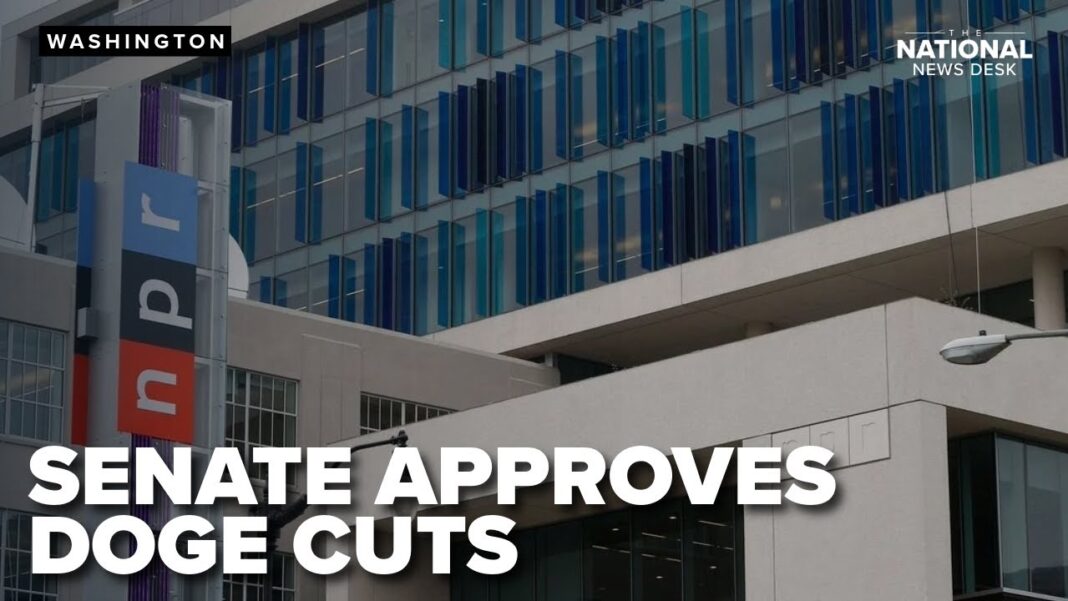
In addition, the measure claws back over $1 billion from the Corporation for Public Broadcasting (CPB), which provides federal funding to public media outlets including PBS and NPR. Conservatives have frequently targeted the CPB, contending that its operations reflect a political bias and that taxpayer dollars should not subsidize media enterprises. This aspect of the bill aligned with longstanding Republican calls to curtail federal spending on public broadcasting.
The road to passage was not without hurdles. As The New York Post report detailed, the House had initially approved an earlier version of the rescissions package last month. However, the Senate delayed action amid bipartisan concerns about specific proposed cuts, particularly those affecting global health initiatives.
One key sticking point involved a proposal to cut approximately $400 million from a federal program dedicated to combating AIDS worldwide. Following negotiations, the Trump administration ultimately agreed to withdraw that portion of the proposed cuts — a concession that cleared the way for broader Senate support.
An attempt by House Democrats to attach an amendment calling for the release of documents related to the late financier and convicted sex offender Jeffrey Epstein also emerged during deliberations. The New York Post report highlighted that the proposed amendment, introduced in the House Rules Committee, was blocked by Republican members of the panel.
Instead, Republicans advanced a nonbinding resolution expressing support for the public release of “certain documents, records, and communications related to the investigation of Jeffrey Epstein.” While the resolution carries no legal weight, it reflects ongoing congressional interest in transparency regarding Epstein’s activities and associations.
House Minority Leader Hakeem Jeffries (D-NY), known for his commanding floor speeches, chose a notably restrained approach in voicing his opposition. As The New York Post report observed, Jeffries spoke for only 15 minutes on Thursday night, opting not to invoke his procedural privilege — known as the “magic minute” — which allows House leaders to speak at length beyond standard time limits.
Jeffries’ decision contrasted sharply with his actions earlier this month when he spoke for nearly nine hours during the debate over the One Big Beautiful Bill Act, setting a new record for floor speeches in the House. His brief remarks this time highlighted a strategic choice not to prolong a vote whose outcome appeared certain.
With Thursday’s vote concluded, attention now turns to the next phase of the Trump administration’s fiscal strategy. White House Office of Management and Budget Director Russ Vought is expected to submit additional rescissions requests to Congress in the coming months. These proposals will likely continue the administration’s push to rein in federal spending and eliminate what it views as unnecessary expenditures.
The potential for further rescissions packages signals an ongoing battle between fiscal conservatives seeking aggressive budgetary reforms and Democrats, along with some moderate Republicans, wary of cuts to programs they see as vital to both domestic and international interests.
Thursday’s passage of the rescissions package marks a significant, though largely symbolic, victory for House Republicans and the Trump administration’s fiscal agenda. As The New York Post report indicated, the narrow vote reflects the deep partisan divides over government spending priorities and the broader ideological battles that continue to shape the legislative landscape in Washington.
While supporters of the measure argue that it represents a meaningful step toward fiscal responsibility and government accountability, opponents maintain that the cuts could undermine critical programs and international partnerships. Regardless of perspective, the legislation’s journey through Congress illustrates the complexities of achieving consensus on federal budget matters in a deeply polarized political environment.
The passage of the clawback bill also sets the stage for future debates on the role of foreign aid, public broadcasting, and the scope of congressional oversight. As The New York Post reported, the controversy surrounding the Epstein amendment further highlights the challenges lawmakers face when navigating politically charged issues that intersect with high-profile investigations.
Moreover, the procedural maneuvering on Capitol Hill — from committee debates to floor speeches — showcased the strategic considerations employed by both parties as they seek to advance their respective legislative agendas. With further rescissions packages anticipated, similar political showdowns are likely on the horizon.
As the Trump administration and congressional Republicans look to build on Thursday’s vote, the coming months will test the durability of their fiscal strategy and the limits of bipartisan cooperation in an increasingly divided Congress. According to The New York Post report, the outcome of these efforts could have lasting ramifications for federal spending policies and the broader political climate heading into the next election cycle.