



|
Getting your Trinity Audio player ready...
|
By: Fern Sidman
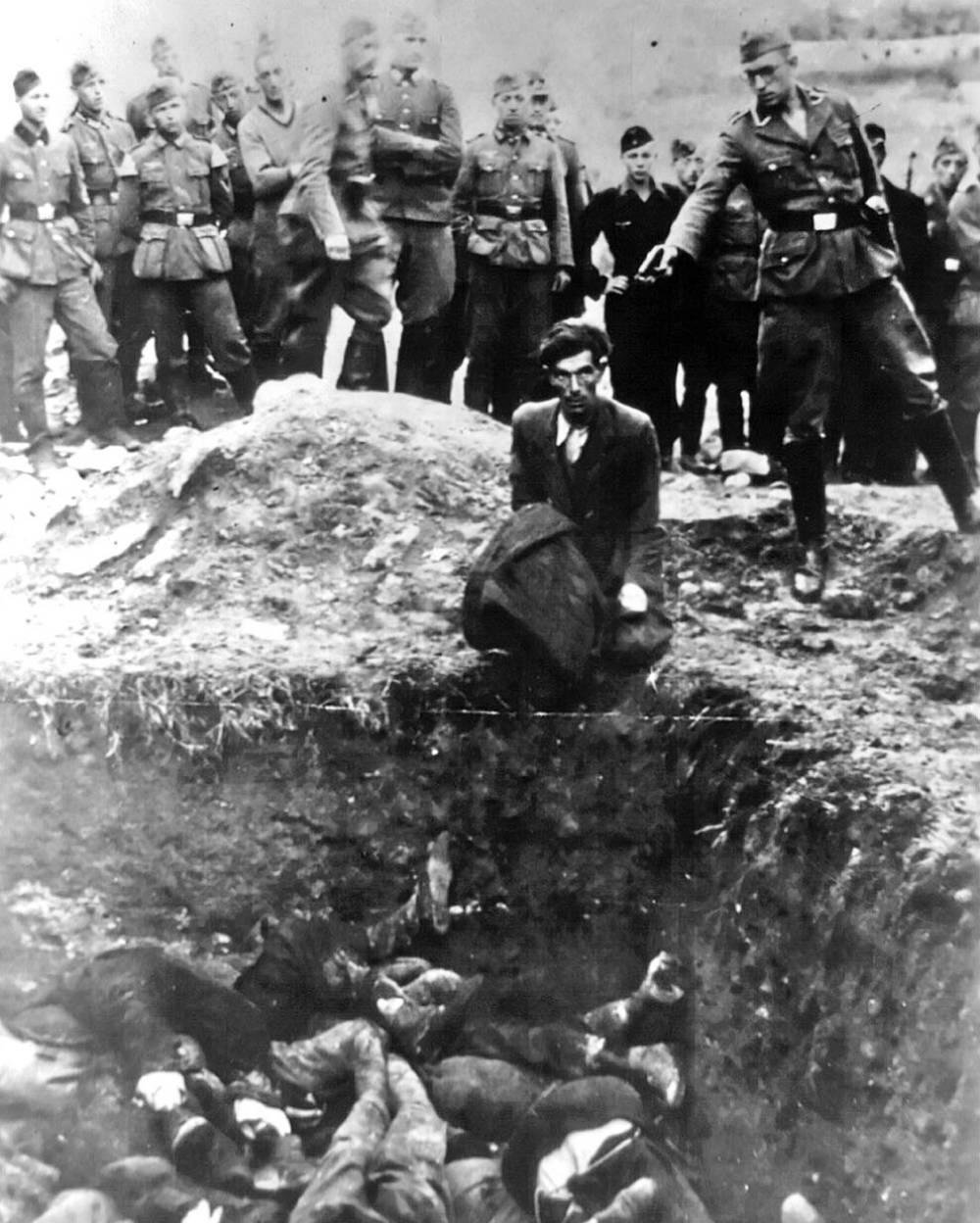
For more than eight decades, the haunting image known as “The Last Jew in Vinnitsa” has stood as one of the most chilling visual testimonies to the Holocaust. The black-and-white photograph, displayed prominently during the 1961 trial of Adolf Eichmann in Jerusalem, captures the final moments of a Jewish man’s life in Berdychiv, Ukraine: kneeling at the edge of a freshly dug pit, hands bound, while a German officer levels a pistol at the back of his head. Around them, a crowd of German soldiers stands, watching with cold detachment. The man’s name has never been recovered; his anonymity has come to symbolize the countless victims of Nazi annihilation.
Now, new research has confirmed the identity of the executioner. As VIN News reported on Sunday, German historian Jürgen Matthäus has established that the shooter was Jakobus Oehnen, a German schoolteacher turned SS officer who took part in some of the earliest massacres of Jews in occupied Ukraine.
Oehnen was born in 1906, in the turbulent years following Germany’s defeat in World War I. Before his radicalization, he trained as a teacher—an ordinary figure in German civic life. But, like many in his generation, he was drawn into the orbit of Adolf Hitler’s Nazi Party and Heinrich Himmler’s SS.
By the early 1930s, Oehnen had formally joined the SS, one of the earliest waves of recruits who would later form the backbone of Hitler’s mobile killing operations. His career exemplifies the way “ordinary” professionals—teachers, bureaucrats, clerks—transformed into perpetrators of unspeakable crimes.
According to Matthäus’ findings, cited in the VIN News report, Oehnen was dispatched in July 1941 to the Ukrainian city of Berdychiv, less than a month after the German invasion of the Soviet Union. He became an active participant in the Einsatzgruppen—the SS mobile killing units that shadowed the Wehrmacht into newly conquered territories. Their mission was chillingly direct: to annihilate Jews, communists, Roma, and other perceived enemies of the Reich.
The infamous photograph was taken on July 28, 1941, shortly after the Nazi occupation of Berdychiv began. At the time, mass executions were already underway, even before the establishment of the ghetto that would later confine what remained of the Jewish population.
Oehnen, pistol in hand, carried out his role without hesitation. Behind him, at least twenty German soldiers—members of the Wehrmacht, not just SS—are visible in the photo, watching the execution unfold. This detail underscores what Holocaust historians, and VIN News, have repeatedly emphasized: mass killings were not carried out in isolation, but often occurred in full view of regular army troops and local collaborators.
For decades, the identity of the shooter remained uncertain. The photograph, introduced during Eichmann’s trial in Jerusalem, had been used as a symbol of Nazi barbarism rather than as a piece of forensic evidence tied to specific perpetrators.
Matthäus, however, pieced together the puzzle through painstaking research.
A Wehrmacht officer’s diary described the executions carried out that summer in Berdychiv, with references to named individuals.
Photo negatives, unearthed in the archives of the U.S. Holocaust Memorial Museum, provided additional clarity. Comparing these negatives with known images of Oehnen from SS personnel files, Matthäus concluded with confidence that the executioner in the photo was indeed him.
As VIN News reported, the convergence of military records, photographic evidence, and SS documentation reveals the lengths to which historians must go to reconstruct the truth from fragments left behind after the Holocaust.
The identity of the man about to be executed remains tragically unknown. He could have been a local shopkeeper, a teacher, or perhaps even a father torn from his family during the round-ups that swept Berdychiv. What is certain, historians stress, is that he was one of the tens of thousands of Jews in the region murdered in the opening months of the German invasion.
As the VIN News report pointed out, Berdychiv, once a vibrant hub of Jewish life with a community numbering more than 20,000, was utterly decimated. By the war’s end, virtually no Jews remained in the city.
Jakobus Oehnen did not live to face justice. After participating in the mass shootings of more than 100,000 civilians in Ukraine, he was killed in combat in 1943. His death on the battlefield meant that he evaded trial, unlike many SS officials who were later brought before Allied tribunals.
The fact that Oehnen’s name has only now come to light reflects the enduring challenge of Holocaust research. Many perpetrators blended back into civilian life after the war, or—like Oehnen—died before facing accountability. As Matthäus’ work illustrates, it has taken generations for scholars to identify individuals in even the most well-known Holocaust photographs.
The “Last Jew in Vinnitsa” image has become emblematic of what historians call the “Holocaust by bullets.” Unlike the industrialized killing of Auschwitz and Treblinka, these early massacres were carried out face-to-face, often in broad daylight, with mass graves dug just beyond towns and villages.
As VIN News reported, researchers estimate that between 1.5 and 2 million Jews were murdered in such shootings across Eastern Europe, from Ukraine to Belarus to the Baltic states. The photo captures the essence of this horror: the intimate, public, and deliberate nature of the killings.
When prosecutors displayed the image at Eichmann’s trial in Jerusalem in 1961, it shocked the world. Here was not just testimony, but visible evidence of the Nazis’ methodical destruction of Jewish life. The photograph has since been reproduced in textbooks, museums, and memorials worldwide.
And yet, until Matthäus’ research, one of its central figures—the executioner—remained nameless. By putting a name and a history to the man behind the gun, historians add another layer of accountability. The photograph is no longer just symbolic; it is specific.
Holocaust survivors, Jewish leaders, and scholars have reacted to Matthäus’ findings with a mixture of relief and sorrow.
Survivor groups expressed gratitude that yet another perpetrator has been identified, even posthumously.
Historians note that this kind of meticulous archival work is essential for keeping Holocaust memory alive at a time when denial and distortion are on the rise.
VIN News, in its coverage, emphasized that the discovery is not only a scholarly achievement but also a moral act—restoring historical truth where it had long been obscured.
While Jakobus Oehnen’s name is now known, the kneeling man remains anonymous. And perhaps that, too, is part of the photo’s enduring resonance. His anonymity makes him every victim, every father, every son torn from Jewish communities that once flourished across Eastern Europe.
As Holocaust scholars often remind us, the Nazis sought not only to annihilate the Jews physically but also to erase their names, their identities, and their memory. Research such as Matthäus’ restores part of that memory by unmasking the perpetrators—even if it cannot always recover the lives of the victims.
The revelation that the executioner in “The Last Jew in Vinnitsa” was Jakobus Oehnen, a former German schoolteacher turned SS killer, is a stark reminder of how ordinary individuals became cogs in the machinery of genocide. It underscores the enduring importance of historical research, archival preservation, and journalistic coverage in bringing truth to light.
As the VIN News report indicated, this discovery highlights the moral urgency of Holocaust remembrance: to identify perpetrators, honor victims, and confront the continuing danger of antisemitism in all its forms.
The photograph remains one of the most disturbing visual records of the Holocaust. Now, with Oehnen’s identity confirmed, it is also a testament to the determination of historians to ensure that those who carried out such atrocities are never allowed to vanish into anonymity.
 |
|