



|
Getting your Trinity Audio player ready...
|
Heirs of Nazi Persecuted Jewish Art Collector See Justice as Edvard Munch Painting to be Auctioned Off in London
Edited by: Fern Sidman
An expressionist masterpiece by Edvard Munch, which a renowned German Jewish art expert was forced to sell less than four months after Hitler came to power, is expected to sell for $15-$25 million when it comes up for auction in London next week, as was reported by the Times of Israel.
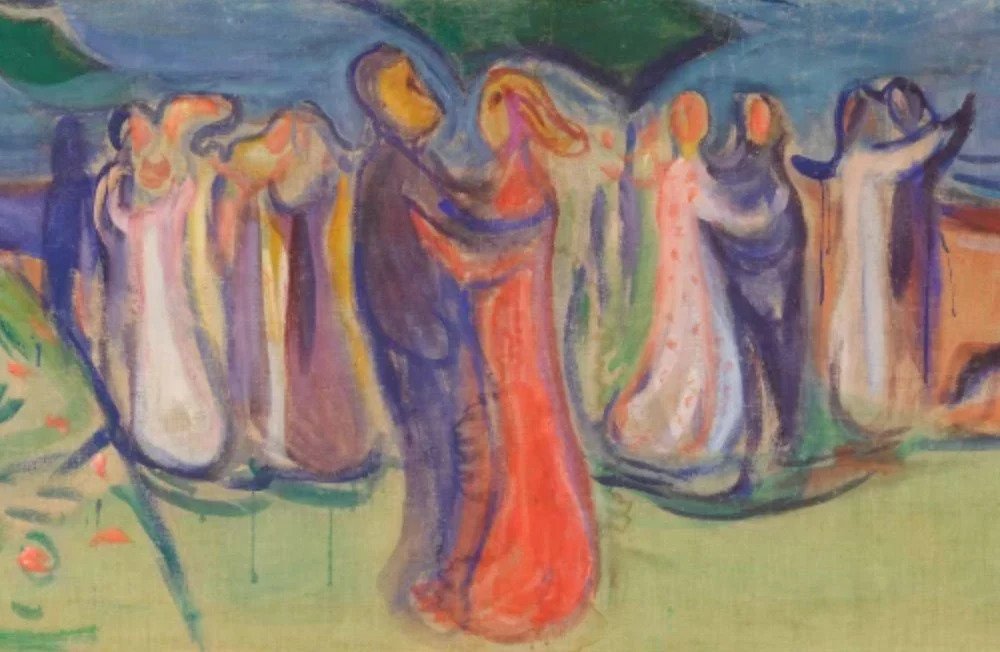
After weathering World War II in a barn tucked away in a Norwegian forest, the 13-foot-long piece, titled, “Dance on the Beach” (1906), hasn’t been up for sale in 89 years, according to a report by Molly Enking of SmithsonianMag.com.
The report by Enking on the SmithsonianMag.com web site also indicated that the painting once belonged to Curt Glaser, a Jewish art critic, collector and historian based in Berlin. By the 1930s, Glaser and his wife, Elsa, had amassed an extensive private collection of art, which included pieces by Munch—who was a personal friend of the couple—as well as Henri Matisse, Max Beckmann as well as important Old Master paintings — assembled by Glaser and his wife, Elsa.
In 1933, after the Nazis forced him to leave his position as director of the Berlin State Art Library and seized his apartment, Glaser sold his beloved art and fled the country, as was reported by SmithsonianMag.com He would eventually settle in the United States, where he died in 1943.
Months after Glaser escaped, several of the Munch pieces ended up in the hands of Norwegian shop owner Thomas Olsen. Olsen acquired “Dance on the Beach” at a sale in Oslo, Norway in 1934. Both the shipping magnate and Glaser were friends and patrons of Munch, as was reported by the Art Newspaper’s Anny Shaw, according to Enking at SmithsonianMag.com.
Olsen gave “Dance on the Beach” pride of place in the first-class lounge of the MS Black Watch, which ferried passengers between Oslo and Newcastle, in the northeast of England, between January and September 1939, as was reported by the Times of Israel. When war broke out in 1940, Germany invaded and occupied Norway. Olsen suspended the service, laid the passenger liner up, and removed the artwork. “Dance on the Beach” was one of around 30 works by Munch owned by Olsen, including one of four versions of his famous painting, “The Scream.” Fearing a German invasion, Olsen decided to place his Munch masterpieces in hiding in a barn in a Norwegian forest, the TOI report stated.
After the Nazis’ defeat, Olsen recovered “Dance on the Beach” and his other treasured artworks. The TOI report said that It has remained in the hands of the Olsen family since 1945 and is the only part of the original Reinhardt-commissioned frieze still in private hands. Nine of the pieces are held in the collection of Berlin’s National Gallery, one in the Hamburg Kunsthalle and one in Essen’s Folkwang Museum, as was reported by the Times of Israel.
The artwork was originally commissioned by the famed Jewish impresario Max Reinhardt for his Berlin avant-garde theater at the turn of the 20th century, as was reported by the Times of Israel.
“This exceptional painting is made all the more special due to its extraordinary provenance, a history that has unfolded since it was painted 115 years ago,” said Lucian Simmons, Sotheby’s Vice Chairman and Worldwide Head of Restitution, in a press statement, according to the TOI report. “Intertwined in the story of this painting are two families — both leading patrons of Munch.”
The importance of the artwork in Munch’s turbulent life and career is underlined by Sotheby’s, the Times of Israel reported. The auctioneer’s Vice-Chairman of Fine Arts, Simon Shaw, said in a press statement: “Munch was the ultimate rebel, and every brushstroke on this frieze is utterly modern and purely expressive. This composition reimagines one of Munch’s greatest images, the ‘Dance of Life,’ which was the culmination of the artist’s ‘Frieze of Life’ and places love at the centre of the artist’s ‘modern life of the soul.’”
He added that, “This work is among the greatest of all Expressionist masterpieces remaining in private hands—its shattering emotional impact remains as powerful today as in 1906,” as was reported by SmithsonianMag.com.
The SmithsonianMag.com report also said that the massive work of art features a colorful Norwegian landscape filled with swirling dancing figures. Two women in the foreground represent two of Munch’s love affairs—Tulla Larsen and Millie Thaulow—both of which ended in heartbreak, according to Sotheby’s.
“The former was a turbulent affair that would end in Munch shooting his own hand in the heat of passion, and the latter was his cousin’s wife, and Munch’s first love,” Shaw told the Observer.
The Times of Israel reported that Sotheby’s has arranged for the painting to go on public display for the first time in more than 40 years in London from February 22nd through the auction on March 1st.
David Rowland, a lawyer representing the Glaser family, praised the Norwegians’ handling of the case, calling it “exemplary.”
“The Glaser heirs want to first and foremost thank Petter Olsen for reaching a fair and just settlement with the Glaser heirs in a very correct and humanistic way,” Rowland told The Times of Israel. “His treatment of the Glaser heirs has been exemplary. Additionally, the Glaser heirs want to thank Sotheby’s for their expertise and professional handling of this matter.”
The painting was part of a pioneering 12-panel work — now known as “The Reinhardt Frieze” — commissioned in 1906 and designed as an immersive installation in the Berlin theater’s upper level, the TOI report said. “Audience members were immersed in Munch’s vision — which he titled ‘images from the modern psyche’ — before stepping into Reinhardt’s performance space,” Sotheby’s explained in a media briefing.
In 1912, however, the theater was refurbished and the frieze split into its component parts, as was reported by the Times of Israel. Dance on the Beach is the only part of the series that is privately owned. The rest are housed in museums throughout Germany, according to the SmithsonianMag.com report.
When the auction is held on March 1st, the piece is expected to fetch between $15 and $25 million, the SmithsonianMag.com report said. As part of a 2020 restitution settlement, proceeds from the auction will be split between descendants of the Olsen and Glaser families.
In the meantime, the Kunstmuseum Basel in Switzerland is exhibiting 200 works from Glaser’s collection, which it purchased soon after he escaped Germany, according to the SmithsonianMag.com report. The art will remain in the museum in exchange for financial compensation and a special exhibition celebrating Glaser’s legacy.
Glaser and his wife, Elsa, shared an enthusiasm for art, traveled extensively and hosted a weekly salon in their apartment in Berlin’s Prinz-Albrecht Strasse, the Times of Israel reported. A year after acquiring “Dance on the Beach,” Glaser and Elsa visited Munch in Oslo for the first time.
As an internationally known art historian and expert, Glaser published the first German monograph on Munch and became art editor of the daily newspaper Berliner Börsen-Courier, as well as editor of Kunst und Künstler, a monthly art review, according to the TOI report. Aside from his work on Munch, Glaser published books on a range of other artists, including Paul Cézanne and Hans Holbein. His professional career peaked with his appointment in the 1920s as director of the Berlin State Art Library. Glaser and Elsa, who died in 1932, later came to add modernist art and drawings — particularly expressionist works, like those of Munch — to their collection, the Times of Israel reported.
Olsen gave “Dance on the Beach” pride of place in the first-class lounge of the MS Black Watch, which ferried passengers between Oslo and Newcastle, in the northeast of England, between January and September 1939, the Times of Israel reported. But when war broke out and Germany occupied Norway, Olsen suspended the service, laid the passenger liner up, and removed the artwork. “Dance on the Beach” was one of around 30 works by Munch owned by Olsen, including one of four versions of his famous painting, “The Scream.” Fearing a German invasion, Olsen decided to place his Munch masterpieces in hiding in a barn in a Norwegian forest.
After the Nazis’ defeat, Olsen recovered “Dance on the Beach” and his other treasured artworks. It has remained in the hands of the Olsen family since 1945 and is the only part of the original Reinhardt-commissioned frieze still in private hands. The TOI reported stated that nine of the pieces are held in the collection of Berlin’s National Gallery, one in the Hamburg Kunsthalle and one in Essen’s Folkwang Museum.
The restitution settlement reached between the Glaser family and the city of Basel in 2020 came 16 years after the Jewish collector’s heirs had first approached the Canton of Basel-Stadt and made a claim to some of the artwork, the TOI reported. The exhibition was part of the settlement as well. The city rejected the claim but when the family made a second approach in 2017, the museum’s board of trustees launched an investigation. It concluded that Glaser had indeed sold his collection due to persecution, according to the TOI report. The heirs and the city reached an agreement under which the museum retained the collection, paid the family an undisclosed sum, and agreed to stage an exhibition about Glaser’s work.
As the New York Times reported in 2021, since 2007, 12 private collectors or individuals have agreed with the city of Basel that Glaser sold his collection as a result of Nazi persecution and either returned artworks or paid compensation, the TOI reported. Among their number are the Dutch Restitutions Committee, the Prussian Cultural Heritage Foundation in Berlin, and the Museum Ludwig in Cologne.
The Times of Israel has also reported that Rowland confirmed that the Glaser heirs are engaged in a number of other current restitution claims.
However, as the Times also reported, some institutions — including the Metropolitan Museum of Art in New York and the Museum of Fine Arts, Boston — have adopted a more skeptical approach, arguing that it is not clear that Glaser was forced to sell his artworks, the TOI report said.