



|
Getting your Trinity Audio player ready...
|
By: Fern Sidman
In a cultural moment fraught with rising antisemitism and global unrest, Guns & Moses gallops into American theaters with both urgency and firepower. Slated for nationwide release on July 18, this unapologetically bold and timely Jewish Western is being hailed by hollywoodintoto.com as the most significant film of its genre since 1979’s The Frisco Kid.
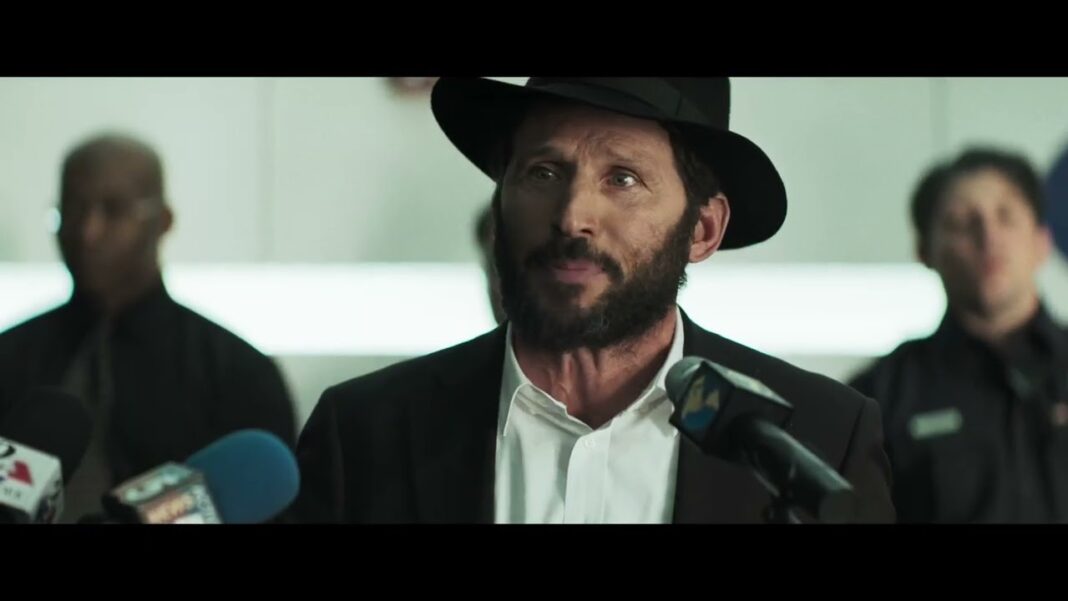
Directed by Salvador Litvak, known for his distinct ability to fuse Jewish identity with cinematic flair, Guns & Moses stars Mark Feuerstein as Rabbi Mo—a soft-spoken spiritual leader transformed into an unlikely gunslinger after a White Supremacist attack shatters his congregation’s peace. Featuring a powerhouse supporting cast that includes Neal McDonough, Christopher Lloyd, and Dermot Mulroney, the film offers a gripping blend of mystery, action, and spiritual introspection.
As reported by hollywoodintoto.com, the film’s origins trace back to the 2019 Poway synagogue shooting in California, where a gunman opened fire during Shabbat services, killing one and injuring three. The event, which shook American Jewry to its core, planted the seeds for what Litvak described as a deeply personal and communal project.
“We aimed to make Rabbi Mo an iconic character,” Litvak stated in a press release covered by hollywoodintoto.com. “Someone who reflects the soul of our community—peace-loving but resolute when danger knocks.”
Though principal photography wrapped in late 2022, Guns & Moses could not have anticipated the blood-soaked backdrop against which it would debut. From the October 7 Hamas massacre in Israel to a string of domestic terror attacks against Jews in Boulder, Washington, D.C., and Philadelphia, the film’s message of Jewish self-defense has become all the more resonant.
Unlike the typical Western hero clad in dusty boots and a ten-gallon hat, Rabbi Mo dons a tallit and a concealed carry. Guns & Moses doesn’t merely flirt with the Second Amendment—it wrestles with it in a narrative that challenges long-held assumptions within Jewish-American culture.
“I didn’t grow up around guns,” Litvak told The Times of Israel, as highlighted in the report at hollywoodintoto.com. “Like many American Jews, I didn’t consider the Second Amendment very important. But becoming an Orthodox Jew made me more visible—and more vulnerable. So I stepped up.”
His transformation, like Rabbi Mo’s, included joining Magen Am, a group devoted to training Jewish citizens to protect their communities. This real-life commitment feeds directly into the film’s tagline, which hollywoodintoto.com calls “provocative and unforgettable”: “May God and Your Glock Protect You.”
The film’s release arrives as Jewish Americans confront levels of antisemitism not seen in decades. According to reports cited by hollywoodintoto.com, in just the past month two members of the Israeli Embassy staff were gunned down in Washington, D.C. after attending a Jewish event, Jewish Pennsylvania Governor Josh Shapiro’s home was set on fire by a pro-Hamas extremist and peaceful Jewish demonstrators were set ablaze in a Molotov cocktail attack in Boulder, Colorado.
These incidents form the real-world backdrop that imbues Guns & Moses with urgency and credibility. As Litvak puts it, “If we mean it when we say ‘never again,’ we can’t just rely on other people to protect us.”
Feuerstein’s portrayal of Rabbi Mo offers a nuanced study in reluctant heroism. As the report on hollywoodintoto.com noted, the character is a departure from the neurotic or victimized Jewish archetype often seen in Hollywood. Instead, Rabbi Mo channels the quiet grit of classic Western protagonists—measured, principled, and willing to fight.
Early screenings at film festivals have been met with standing ovations and spirited debate, particularly around the film’s handling of gun rights and communal responsibility. Hollywoodintoto.com reported that audiences have praised its ability to merge humor, suspense, and theological reflection without ever descending into caricature.
Guns & Moses isn’t merely a film—it’s a cultural moment, one that, according to hollywoodintoto.com, is “arriving just when the American Jewish community needs it most.” It’s a cinematic rallying cry for empowerment at a time when Jewish visibility has become a liability in many parts of the world.
Litvak doesn’t shy away from controversy. He sees the film as a catalyst for discussion—about the vulnerability of Jewish communities, the role of personal responsibility in public safety, and the evolving definition of what it means to be a Jew in the 21st century.
“In a world that increasingly confuses pacifism with piety, Guns & Moses reminds us that being holy doesn’t mean being helpless,” writes hollywoodintoto.com.
With a stellar cast, an urgent premise, and timing that could not be more poignant, Guns & Moses is poised to be more than just a cult classic. As the report at hollywoodintoto.com asserted, it may well redefine how Jewish heroism is portrayed on screen for a new generation—armed not just with faith, but with the fierce resolve to protect it.

White nationalists? I fear the hamas sympathizers and the millions of mozIems that were allowed into America.
Just about all the anti-Semitism I see is from the progressive Left, Democrat party and Islamists.
White supremacists are a force to be reckoned with. Remember the Tree of Life Synagogue massacre in Pittsburgh?