



|
Getting your Trinity Audio player ready...
|
By: Fern Sidman- Jewish Voice News
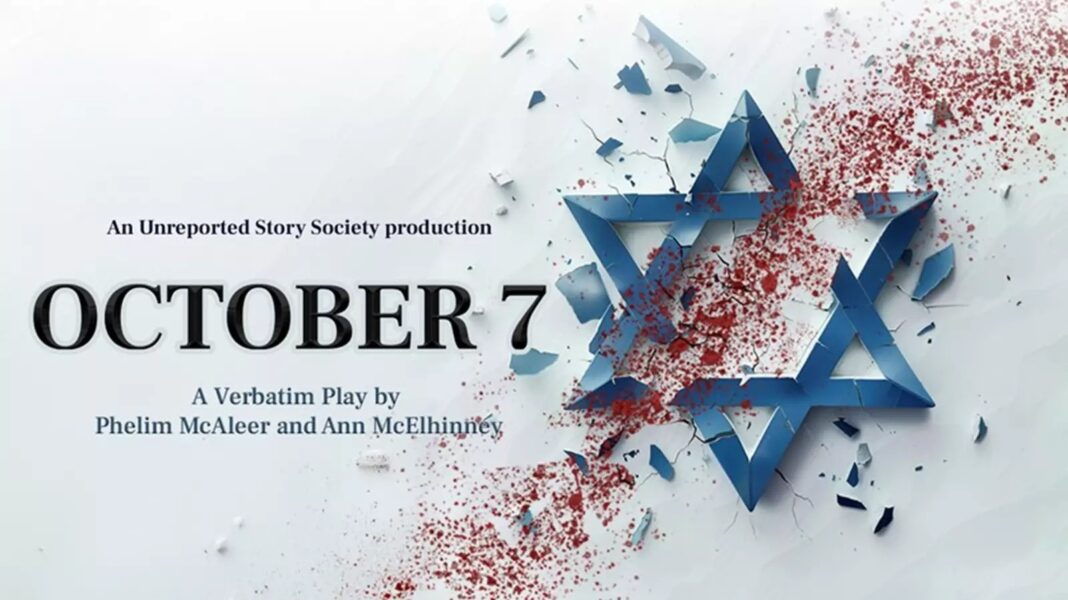
When the Kennedy Center raises its curtain on January 28, 2026, the most controversial theatrical event of the post-October 7 era will arrive in the capital—not as a spectacle of experimental stagecraft nor as a meditation on abstract geopolitics, but as a stark, devastating act of documentary truth-telling. “OCTOBER 7,” the verbatim stage production derived from interviews with survivors of Hamas’s atrocities in southern Israel, is coming to Washington after a turbulent and heavily policed run in New York. And, as Fox News Digital reported on Tuesday, its creators believe that the play’s arrival at the nation’s premier arts institution would not have been possible before President Donald Trump reshaped the Kennedy Center’s board earlier this year.
The production’s co-creator, Irish journalist and filmmaker Phelim McAleer, told Fox News Digital that the Kennedy Center’s embrace of the work marks a rupture in the institution’s cultural atmosphere—one in which ideological conformity often masked itself as artistic courage. Now, he suggests, genuine pluralism is finally being permitted on America’s most symbolically important stage.
“It sends a clear message,” McAleer said, “that real diversity—diversity of thought—is welcome in the heart of the nation’s capital.”
For the Kennedy Center, the arrival of “OCTOBER 7” is not merely another theatrical booking; it is a referendum on the cultural establishment’s willingness to confront Hamas’s crimes at a moment when public discourse is increasingly distorted by propaganda, political intimidation, and a refusal in certain corners of the arts world even to acknowledge Jewish suffering.
“OCTOBER 7” premiered off-Broadway during a six-week run that was marked by vitriolic protests, extensive security threats, and denunciations from pro-Hamas activists who insisted—without evidence—that the staging was politically manipulative, biased, or “fabricated,” according to reports cited by Fox News Digital and multiple Israeli outlets.
The work is structurally simple. There are no stylized reenactments, no interpretive flourishes, no polemical commentary. Every word spoken onstage comes directly from survivors, bereaved family members, and the first responders who fought their way through scenes of carnage during Hamas’s unprecedented massacre on October 7, 2023.
The creators—McAleer and his wife, journalist Ann McElhinney—traveled to Israel in the immediate aftermath of the attack. They spent three harrowing weeks recording testimonies from Israelis whose lives were shattered within hours: young people ambushed at the Nova music festival, mothers who hid their children under beds while militants went door-to-door, paramedics who walked into burning homes not knowing whether they would return.
These interviews became the script—unvarnished, chronological, factual. As McAleer told Fox News Digital, the purpose was not political messaging but historical preservation.
“The October 7 massacre was still ongoing when many in the media and academia were already blaming Israel,” he said, recalling the surreal experience of watching global narratives mutate in real time. “We were talking about child and baby murder here. The taking of babies as hostages is almost unprecedented in modern warfare.”
For McAleer, the play’s greatest moral imperative is simple: to prevent the world from forgetting—or willfully distorting—what happened.
The play’s New York run was accompanied by a level of security typically reserved for heads of state. According to reporting cited by Fox News Digital, armed guards, metal detectors, and law enforcement officers were present every night. Some performances required audience members to pass through security cordons after police received credible threats of disruption.
“What a damning indictment of NYC,” McAleer told the outlet, “that a play consisting solely of massacre survivors’ testimony needed police protection.”
Actors faced harassment online and, in some cases, privately worried that association with the production would damage their careers in a cultural ecosystem where pro-Israel viewpoints have increasingly become taboo. Posts in closed theatre-community social media groups labeled the production “propaganda,” “genocidal messaging,” and “fabricated”—charges that were not merely false but inverted the reality the play sought to expose.
Against this backdrop, the production’s positive critical response was striking. Stage and Cinema wrote: “‘OCTOBER 7’ insists that we look darkness in the face and make no excuses. It is an effectively rendered eyewitness account offered in the interest of radical truth telling, and altogether admirable.”
Still, the fact that a documentary play about mass murder could become a lightning rod underscored the cultural volatility surrounding the conflict—volatility that McAleer believes makes the Kennedy Center staging all the more necessary.
The Kennedy Center has always been more than an arts venue. It is a civic monument—a physical and cultural extension of Washington’s political identity. Under its previous leadership, critics frequently accused the institution of ideological homogeneity. But with Trump appointees now constituting a majority of the governing board, Fox News Digital reports that a perceptible shift has taken place: conservative artists and thinkers are no longer tacitly excluded.
To McAleer, the symbolism is unmistakable. “Hopefully this is the beginning of great art being on the stage of the Kennedy Center,” he said.
It is not lost on observers that this staging comes at a moment when pro-Hamas demonstrations and anti-Israel extremism have surged across universities and artistic institutions. That the Kennedy Center—perhaps the most visible arts institution in the United States—is now presenting a production built on survivor testimonies is a cultural moment with implications far beyond the theatre industry.
The play includes testimonies from a wide range of individuals affected by the attack: students from Tel Aviv University, farmers from kibbutzim near Gaza, young festival-goers who hid under corpses to stay alive. Their words offer an intimate window into the psychological and physical brutality inflicted by Hamas.
One of the play’s central figures is an off-duty police officer who, armed only with his service pistol, engaged two militants and rescued nearly a dozen civilians while sustaining serious injuries. Another testimony recounts a young woman’s desperate phone call to her mother during the attack—cut off mid-sentence when militants discovered her hiding place.
McAleer emphasized that the victims were not ideological caricatures but ordinary, often progressive Israelis—artists, students, engineers, LGBTQ activists, and left-leaning peace advocates.
“So many of the victims were urbane, young, educated, liberal,” he told Fox News Digital. “Many at NOVA were not religious… they supported and worked with the people from Gaza. And then they were murdered by them.”
The play’s greatest emotional force lies in this dissonance: that those who most believed in coexistence became the first targets of a group ideologically committed to their destruction.
McAleer intends to invite President Trump, members of Congress, and senior administration officials to the performance. The symbolic weight of such attendance would be considerable.
“Their presence sends a clear message,” he said, “that the U.S. will not ignore or memory-hole the events of October 7.”
In an era when activism often pressures cultural institutions to frame Israel as an aggressor and to downplay or outright deny Hamas’s atrocities, staging “OCTOBER 7” at the Kennedy Center is an act of narrative defiance. It insists on remembrance, on moral clarity, and on grounding public discourse in lived human experience rather than ideological abstraction.
Since the massacre, the global reaction has fractured along lines that few would have predicted. While Israel mourned, much of the world pivoted rapidly—not toward empathy, but toward condemnation of the Jewish state. This dynamic, documented extensively by Fox News Digital, is what prompted McAleer and McElhinney to produce the play in the first place.
“We want audiences—especially in Washington—to understand exactly what happened that day,” McAleer said. “To see the victims not as statistics, but as human beings.”
At a moment when anti-Israel activism has normalized harassment, vandalism, and even violence against Jewish communities across the West, bringing unfiltered testimony to the capital is an act of cultural correction. It restores moral gravity to a conversation too often dominated by euphemisms, historical distortions, and silence.
“OCTOBER 7” is not merely a theatrical production. It is part historical documentation, part moral indictment, and part cultural rebuttal to forces seeking to obscure or rewrite the events of that day.
On January 28, when the lights dim at the Kennedy Center and the audience listens—perhaps for the first time—to the words of those who lived through Hamas’s savagery, Washington will be confronted with the reality behind a tragedy that reshaped Israeli society and reverberated across the globe.
And, as the Fox News Digital report noted, the play’s arrival signals something larger: that the American cultural establishment may, at last, be reconsidering its reflexive antipathy toward pro-Israel narratives, and beginning to allow space for perspectives grounded not in ideology, but in fact.
Whether the Kennedy Center performance becomes a turning point in that broader cultural reckoning remains to be seen. But for the survivors whose voices fill the script, and for the families who lost loved ones on October 7, the staging represents something profound: a refusal to let their stories be drowned out by a world too ready to forget.
No offense, but they talk about an indictment of NYC. Why don’t they try to present it in native Ireland and see what happens there? Frankly, I am shocked that this initiative is from this source. More power to them.