



|
Getting your Trinity Audio player ready...
|
Comcast Bets Big on the Experience Economy with $7.7 Billion Epic Universe Launch in Orlando
By: Russ Spencer
In what media insiders are calling a landmark moment for the entertainment industry, Comcast’s NBCUniversal is opening the gates to Epic Universe, a sprawling, $7.7 billion theme park in Orlando, Florida — the first major new U.S. theme park in over two decades. As CNN reported, the grand opening, set for Thursday, is already drawing die-hard fans who are expected to camp overnight for a first glimpse of what Universal is calling the “most technologically advanced theme park ever built.”
The debut of Epic Universe is not only a pivotal chapter for Comcast’s theme park division, but also a powerful statement about the future of media. As audiences gravitate toward immersive, real-world experiences, media conglomerates like Comcast and Disney are doubling down on experiential entertainment — extending their most beloved IP into physical spaces that engage all five senses.
As the CNN report noted, Epic Universe has been more than six years in the making and represents the most ambitious infrastructure and branding project ever undertaken by Universal Destinations & Experiences. Mark Woodbury, Chairman and CEO of the division, told CNN that the project “showcases the incredible creativity, innovation, and operational excellence of our talented teams.”
Among the park’s standout features are next-generation ride technologies, including trackless ride systems, cutting-edge augmented reality, and high-resolution projection capabilities. Universal’s flagship attraction at Epic — Harry Potter and the Battle at the Ministry — is being hailed by company insiders as the most technically impressive ride ever developed by the theme park giant.
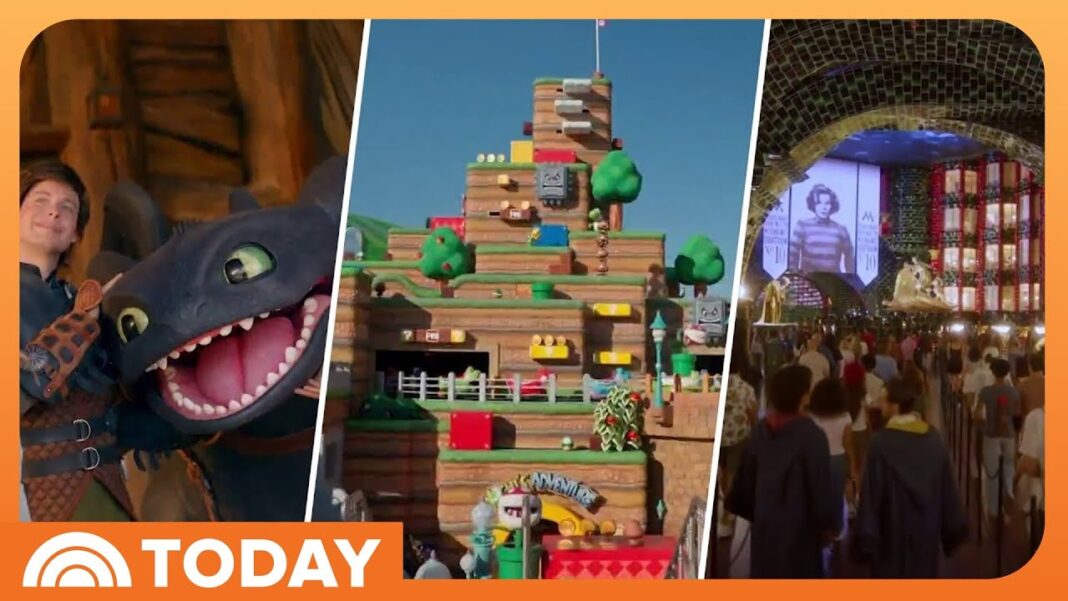
The park also features themed zones inspired by several major properties: The Wizarding World of Harry Potter (licensed from Warner Bros. Discovery, CNN’s parent company), Super Nintendo World, and How to Train Your Dragon. The diverse IP portfolio positions Epic Universe as a formidable competitor in Orlando’s ultra-competitive tourism market — historically dominated by Disney’s four flagship parks.
The launch of Epic Universe marks an escalation in what some analysts have dubbed the “theme park wars,” an extension of the “streaming wars” that have defined much of the last decade in media. Rich Greenfield, a media analyst at Lightshed Partners, told CNN that media companies are responding to a fundamental shift in consumer demand: “People want to immerse themselves in the characters and franchises and content they love.”
Greenfield, who toured Epic Universe during a media preview this spring, was struck not only by the scale of the new park but also by the room left for future expansion. “This is step one to making Universal more of the destination versus the add-on,” he observed, suggesting that Universal could soon pose a much stronger challenge to Disney’s dominance in Florida.
Historically, Universal’s parks in Orlando have been seen as optional extras for Disney-goers. But that perception may be changing. Woodbury is confident that Epic Universe will “transform Universal Orlando Resort into a full-week vacation destination that delivers mind-blowing experiences for global audiences.”
And Disney is watching closely. Over the past year, Disney has announced major expansions to its Florida properties, including new attractions and hotel concepts aimed at encouraging repeat visits. Internationally, Disney also revealed plans for a new park in Abu Dhabi and is doubling the size of its global cruise fleet.
Interestingly, Disney CFO Hugh Johnston previously told investors — as CNN reported — that new non-Disney park openings in Florida have historically had a positive effect on Disney’s own bookings. Whether that remains true with a project as expansive as Epic Universe remains to be seen.
Comcast isn’t taking any chances with the park’s rollout. All four hours of NBC’s Today show were broadcast live from Epic Universe on Wednesday morning, giving millions of viewers a guided preview. Top Comcast executives, including President Mike Cavanagh, flew to Orlando for the official launch ceremony, underscoring the park’s importance to the conglomerate’s broader strategy.
Cavanagh emphasized in recent earnings calls that theme parks are a uniquely resilient asset in the volatile media landscape. As he told analysts last month, parks are “not at all exposed to the shift in time on screens from one venue to another.” That makes them particularly valuable at a time when linear TV viewership is declining and streaming revenues remain unpredictable.
Indeed, parks have been one of the few bright spots in media conglomerates’ earnings over the last several years. With content production costs soaring and subscriber growth plateauing in the streaming space, theme parks offer not just an alternative revenue stream, but a lucrative, enduring one.
CNN reported that Universal is already planning additional projects, including a horror-themed experience in Las Vegas and a kid-focused resort in Frisco, Texas. A major theme park is also slated for the United Kingdom, with an opening date currently projected for 2031.
The unveiling of Epic Universe is about more than roller coasters and branded merchandise — it represents a broader strategic pivot for media giants. Where once the focus was on screens, now it is on experiences. As CNN puts it, Epic Universe is emblematic of a deeper media frontier: the rise of the “experience economy.”
As streaming platforms become increasingly commoditized, companies are turning back to the physical world to create value that can’t be skipped, pirated, or forgotten. A ride through a fire-breathing dragon’s lair, a live duel in the Ministry of Magic, or a walk through Mushroom Kingdom offers not just entertainment, but emotional resonance — the kind that deepens brand loyalty across generations.
Epic Universe’s launch also showcases how strategic media alliances can amplify value. While Comcast owns NBCUniversal, some of the park’s most beloved properties — such as Harry Potter — are licensed from other conglomerates. The CNN report pointed out that this cross-brand synergy highlights a willingness to prioritize guest experience over corporate silos.
With Epic Universe, Comcast is staking a bold claim on the future of media: one where intellectual property doesn’t just live on screens but leaps into the physical realm. The park’s immersive technology, billion-dollar infrastructure, and transmedia IP integrations reflect not just an amusement destination, but a paradigm shift in how media companies engage with audiences.
As fans line up to step into the worlds they once only saw on screen, Comcast and its rivals will be watching closely. In a time when the future of traditional media remains uncertain, Epic Universe could prove that the next great frontier isn’t a new streaming platform — but a place you can walk into, touch, feel, and remember.
And as CNN continues to report from the epicenter of this story, one thing is clear: the future of entertainment is not just about watching — it’s about being there.
