



|
Getting your Trinity Audio player ready...
|
By: Tzirel Rosenblatt- Jewish Voice News
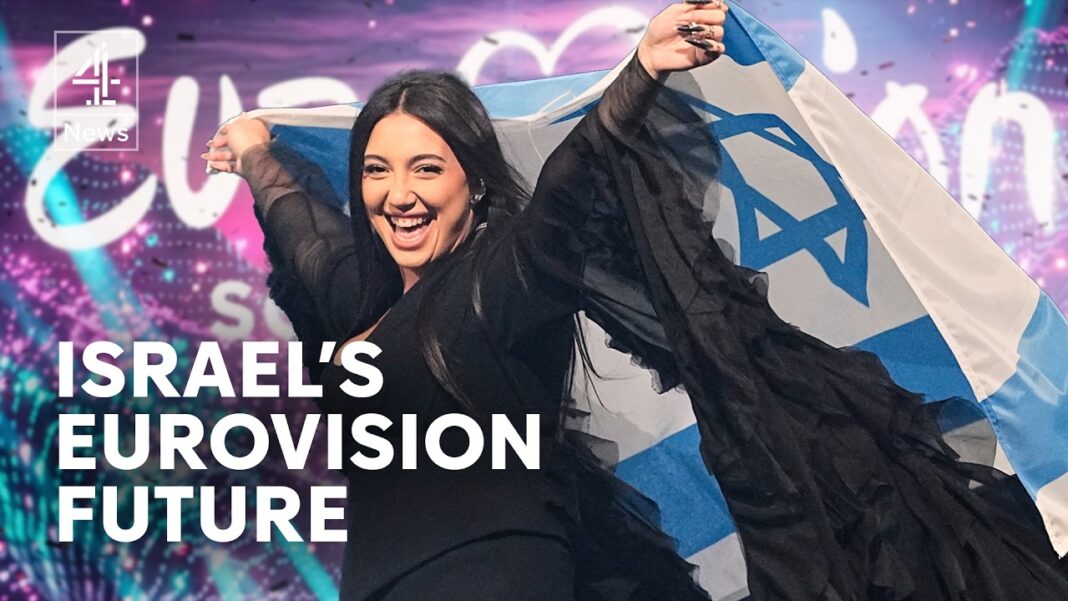
Israel will compete in the 2026 Eurovision Song Contest, following a decisive meeting of the European Broadcasting Union (EBU) on Thursday in Geneva—one that both Reuters and The Jerusalem Post described in a report on Thursday as a turning point for the famously apolitical music competition, now pulled sharply into the crosscurrents of Middle Eastern geopolitics and European cultural upheaval.
According to two EBU members who spoke to Reuters, the meeting ended without a vote on Israel’s disqualification, despite intense pressure from several European public broadcasters and artists’ groups who argued that the humanitarian toll of the Gaza war should render Israel ineligible to participate. Instead, the assembly moved overwhelmingly to adopt a package of new procedural rules intended to curb government-led manipulation of voting blocs and to safeguard Eurovision’s neutrality—a move interpreted by many as a compromise enabling Israel’s continued presence in the contest.
Israel’s inclusion immediately triggered dramatic reverberations across Europe’s broadcasting landscape. The Netherlands’ public broadcaster, AVROTROS, announced its withdrawal from the 2026 contest within hours, issuing a stunning rebuke of the EBU and citing Israel’s actions in Gaza as having “crossed a boundary” that the broadcaster said it could not ethically ignore.
Spain soon followed suit. RTVE president José Pablo López, in a statement carried widely by Reuters, charged that the EBU had abdicated its responsibility by refusing to impose sanctions on Israel from the executive level, leaving individual member states to make agonizing public choices about whether to remain in the competition.
“If no one was up in arms when Russia began its invasion, and it was exiled from global competitions and Eurovision,” Spain’s prime minister Pedro Sánchez said, “then the same should happen with Israel.”
Yet despite calls for symmetry between Russia’s 2022 expulsion and Israel’s current situation, most EBU members—according to both Reuters and The Jerusalem Post—appeared unwilling to set a precedent of ejecting democratic states during active conflicts, particularly without consensus on whether the contest could remain functional after such a rupture.
In its official statement following the assembly, the EBU emphasized that its members expressed “clear support for reforms to reinforce trust and protect neutrality.” The newly adopted measures tighten oversight of government involvement in national selection processes and codify stricter limits on promotional activity that could skew public voting—rules spurred in part by allegations that Israel “unfairly boosted” its 2025 contestant.
The EBU acknowledged that members used the meeting to air “a variety of views on participation,” with many underscoring the vital importance of protecting press freedom and independent public broadcasting, especially in conflict zones including Gaza. This acknowledgment, though diplomatically phrased, reflects the deep fractures within the union.
Eurovision expert Paul Jordan told Reuters that the contest faces a true “watershed moment”—one in which the cultural event must decide whether it can continue to operate as an apolitical celebration of music in an era when even cultural neutrality is viewed as a political stance.
Almost every broadcaster that advocated Israel’s exclusion did so by invoking the civilian death toll in Gaza, which the Hamas-run health ministry claims has exceeded 70,000 since the start of the war. As both the Reuters and The Jerusalem Post report noted, the ministry does not distinguish between combatants and non-combatants, and Israel argues that the figures are both inflated and manipulated as part of a global disinformation campaign.
The Gaza war began after Hamas’s unprecedented October 7, 2023 attack on Israel, during which 1,200 Israelis were murdered and 251 abducted, sparking the broadest ground and air campaign Israel has conducted in two decades. Israel insists that eliminating Hamas’s military infrastructure is necessary for national survival, while critics maintain that the scale of Israel’s response constitutes a disproportionate use of force—a debate that has surged into cultural spheres including sports, academia, and now Eurovision.
Despite the high-profile withdrawals of Spain and the Netherlands, some countries have taken equally emphatic stances in the opposite direction.
Germany’s State for Culture Minister Wolfram Weimer told Reuters that his country “should not participate in Eurovision if Israel is excluded,” arguing that “there must be no ESC without Israel.” His statement reflects a historical sensitivity to Jewish safety and a longstanding German–Israeli cultural partnership.
Austria’s national broadcaster ORF also declared that it supports Israel’s continued participation.
Israel’s own public broadcaster, KAN, responded to the news by announcing that it is already preparing for the 2026 contest and will soon unveil changes to its selection process. KAN said it would present its official stance regarding potential disqualification mechanisms at a later date, reinforcing that it expects its place in Eurovision to remain unchallenged.
Meanwhile, Israeli Culture and Sports Minister Miki Zohar, in comments published by The Jerusalem Post, praised the EBU’s decision as an affirmation of Eurovision’s mission to unite rather than divide.
“Music connects people and countries,” Zohar said. “The people of Israel will continue to create, connect, and illuminate the world.”
What remains unmistakable is that Eurovision, long celebrated for its flamboyant performances and borderless artistic spirit, has become a mirror reflecting Europe’s political polarization.
Reuters reported that the EBU’s internal calculus appears to rest on two pillars. They include avoiding a precedent of expelling democratic states during wartime and preventing a mass withdrawal that could imperil the competition’s viability
But the cost of this approach may be steep. Spain and the Netherlands are influential broadcasters, and both have hinted that their withdrawals could extend beyond a single year if the EBU fails to take a harder line.
Within the EBU itself, members are increasingly divided not simply over Israel, but over whether Eurovision can remain a meaningful cultural institution without more principled enforcement of its own values.
For Israel, the EBU’s decision represents a rare diplomatic win during a year of intensifying international scrutiny. It also underscores, as The Jerusalem Post reported, the extent to which Israel continues to be viewed differently from Russia—whose invasion of Ukraine led to immediate expulsion from Eurovision and other global cultural forums.
But the victory is fragile. The EBU has not silenced the debate; it has deferred it. The new rules, while procedural on their face, were approved in the shadow of a possible political vote that could resurface at any time. Countries that walked out may inspire others to follow suit.
And the potential for coordinated boycotts—both from anti-Israel activists and from states defending Israel’s inclusion—remains a looming threat.
The 2026 Eurovision Song Contest is now set to proceed with Israel participating and with a restructured rulebook intended to stabilize the competition’s integrity. But as both Reuters and The Jerusalem Post reports emphasized, the geopolitical pressures that have engulfed the contest show no signs of abating.
Eurovision’s ability to project cultural unity has been fundamentally weakened. The Gaza war—like the Russia-Ukraine conflict before it—has dragged entertainment institutions into the terrain of moral judgment, national identity, and international law.
The coming year will test whether Eurovision can survive as a forum for artistic expression above politics, or whether it will be permanently reshaped by a world in which politics intrude everywhere, even on the stage of Europe’s most jubilant and glittering musical spectacle.
Israel prepares to take the stage. But the future of Eurovision itself may be the real performance under scrutiny.