



|
Getting your Trinity Audio player ready...
|
By: Fern Sidman
The Super Bowl has long functioned as more than a championship football game; it is a grand civic ritual, a mirror held up to the nation’s aspirations, anxieties, and contradictions. In the hours after Super Bowl LX concluded at Levi’s Stadium in Santa Clara, California, the contest on the field was swiftly eclipsed in the public imagination by a far more polarizing spectacle: the halftime show headlined by the Latin trap megastar Bad Bunny. What unfolded was not merely a debate about music or choreography, but a full-fledged cultural conflagration that revealed the extent to which America’s entertainment stages have become proxies for its political and social fault lines.
According to a report on Sunday evening on Fox News Digital, the performance became a lightning rod for criticism, drawing denunciations from conservative commentators, political figures, and even the president himself, while also receiving praise from athletes and fans who viewed the show as a celebration of artistic diversity and global culture.
Fox News Digital chronicled the immediate reaction that rippled across social media platforms and cable news programs within minutes of the final notes fading from the stadium. The loudest and most consequential rebuke came from President Donald Trump, who took to Truth Social with a scathing condemnation that framed the halftime show not merely as an artistic misstep but as an affront to national values. In language that left little room for nuance, Trump described the performance as “one of the worst ever,” deriding its coherence, its aesthetic sensibilities, and its linguistic register.
The president’s remarks, as the Fox News Digital report noted, extended beyond personal taste to a sweeping indictment of what he portrayed as cultural decline, arguing that the performance failed to embody what he characterized as American standards of “Success, Creativity, or Excellence.”
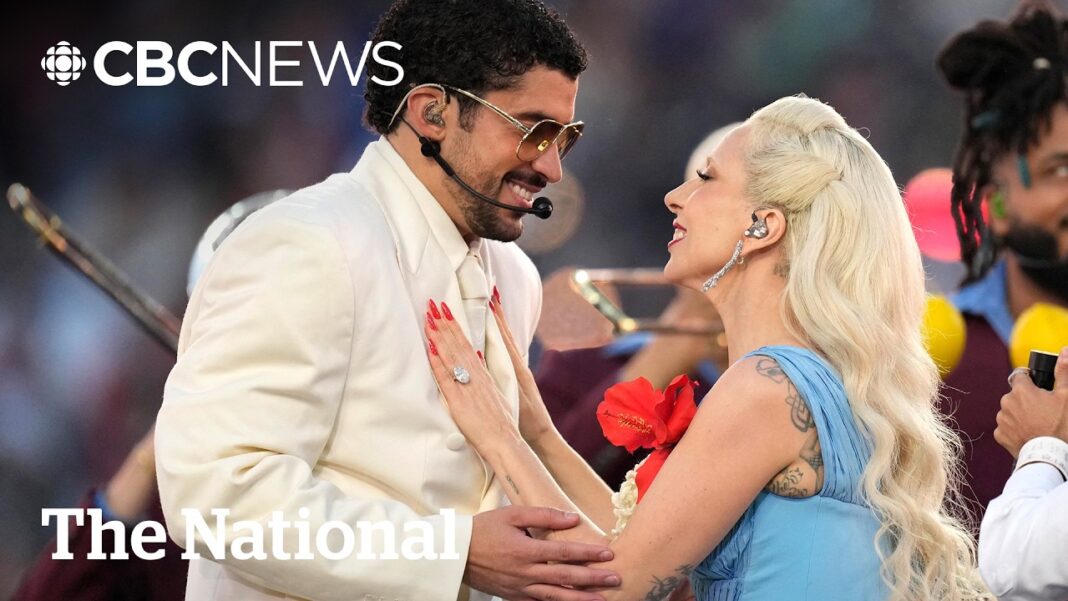
The controversy was fueled in part by the show’s heavy reliance on Spanish-language lyrics. Bad Bunny had been widely expected to deliver the first Super Bowl halftime performance sung almost entirely in Spanish, a symbolic milestone for Latin music in the United States. While the appearance of pop icon Lady Gaga to perform a duet—Bruno Mars’ “Die With a Smile”—introduced an English-language interlude, the broader tenor of the performance remained firmly rooted in Bad Bunny’s Spanish-speaking musical universe. For critics, this choice was seized upon as emblematic of what they perceive as an erosion of cultural cohesion.
Some commentators went so far as to link the performance to the nation’s contentious debates over immigration, border enforcement, and the role of U.S. Immigration and Customs Enforcement, transforming a musical interlude into a proxy battleground for policy disputes.
Yet the backlash did not arise solely from linguistic concerns. Fox News Digital reported that conservative influencers castigated the choreography as inappropriate for a family audience, accusing the performance of sexualized elements they deemed unsuitable for the millions of children who tune in to the Super Bowl each year. Harmeet Dhillon, the Assistant Attorney General for Civil Rights at the U.S. Department of Justice, joined the chorus of disapproval, lending institutional gravitas to the critique. In the polarized media ecosystem, the performance became a Rorschach test, with viewers projecting their broader anxieties about cultural change, generational divides, and the perceived politicization of entertainment onto the spectacle unfolding before them.
The symbolism embedded in the performance further inflamed the debate. The Fox News Digital report highlighted the moment when the stadium’s massive video board flashed the message, “The Only Thing More Powerful Than Hate is Love.” To supporters, this closing sentiment was a benign and even laudable appeal to unity in a fractured era. To detractors, however, the message was interpreted as a thinly veiled political statement, one that aligned with progressive rhetoric and implicitly rebuked the values of those who prioritize law-and-order narratives. The very ambiguity of the slogan—its capaciousness and malleability—rendered it vulnerable to appropriation by competing ideological camps.
Adding another layer of controversy was Bad Bunny’s decision to don a mock football jersey emblazoned with the number “Ocasio 64.” The Fox News Digital report noted that while some fans interpreted the number as a reference to the death toll initially reported after Hurricane Maria devastated Puerto Rico—a figure later revised upward to nearly 3,000—others speculated about political connotations, given the surname’s resonance in contemporary American politics. Whether intentional or not, the garment became a canvas upon which viewers projected their own interpretations, further entangling the performance in a web of symbolic disputes.
The backlash was sufficiently intense that an alternative cultural ecosystem emerged in parallel. Fox News Digital reported that a notable contingent of viewers chose to bypass the official halftime show altogether, opting instead to tune into Turning Point USA’s “All-American” halftime broadcast, headlined by Kid Rock. The roster of attendees for this counter-programming was itself a tableau of conservative celebrity: Pro Football Hall of Famers Eric Dickerson and Brett Favre, alongside former ESPN host Sage Steele, lent their presence to an event explicitly framed as a patriotic alternative to the mainstage spectacle.
The White House press secretary, Karoline Leavitt, confirmed that the president would be watching the “All-American” broadcast, remarking pointedly that he would “much prefer a Kid Rock performance over Bad Bunny.” The Fox News Digital report underscored how this bifurcation of the halftime audience mirrored the broader fragmentation of the national media landscape, in which parallel realities are curated for ideologically distinct publics.
Yet even as criticism crescendoed, Fox News Digital documented voices of support that complicated any monolithic narrative of rejection. Former NFL star J.J. Watt and New York Knicks point guard Jalen Brunson publicly praised the performance, emphasizing Bad Bunny’s global stature and the electrifying energy he brought to the stage. For these figures, the halftime show represented an evolution of the Super Bowl’s cultural ambit, reflecting the demographic and artistic diversity of a nation whose popular culture no longer conforms to a singular aesthetic template. Their endorsements served as a reminder that the performance was not universally reviled, and that for many viewers, it resonated as a moment of creative exuberance rather than cultural provocation.
NFL Commissioner Roger Goodell, anticipating the controversy, had defended the league’s choice of Bad Bunny even before kickoff. Fox News Digital quoted Goodell as arguing that the artist’s global appeal and creative vision aligned with the Super Bowl’s aspiration to function as a unifying platform. In Goodell’s telling, the halftime show is not merely entertainment but a symbolic forum in which diverse talents converge to project an image of inclusivity and shared celebration.
His remarks, offered earlier in the week, took on a retrospective poignancy as the backlash unfolded, underscoring the perennial tension between the NFL’s commercial imperative to court global audiences and the domestic audience’s divergent expectations about what constitutes appropriate representation on such a grand stage.
The ferocity of the response to Bad Bunny’s performance, as reported by Fox News Digital, illuminates a deeper truth about the Super Bowl’s place in American civic life. The halftime show has evolved into a cultural Rorschach test, its significance extending far beyond the ephemeral pleasures of spectacle. Each performance is freighted with symbolic meaning, interpreted through the prism of political allegiance, cultural identity, and generational sensibility. In this sense, the uproar over Super Bowl LX’s halftime show was less about the merits of Bad Bunny’s artistry than about the anxieties of a nation grappling with its own pluralism.
What emerges from the episode is a portrait of a country in which even the most ostensibly apolitical moments are swiftly subsumed into the machinery of ideological contestation. Fox News Digital’s reporting captured the breadth of this phenomenon, tracing how a 13-minute performance became a national referendum on language, immigration, morality, and patriotism. In the end, the halftime show did what the Super Bowl has always done at its best: it provoked conversation, revealed fault lines, and reminded Americans that their shared rituals are also arenas in which their deepest disagreements are staged.
Whether one viewed Bad Bunny’s performance as a thrilling affirmation of cultural diversity or as a disconcerting departure from tradition, the intensity of the reaction attests to the enduring power of the Super Bowl as a crucible of American identity, where sport, entertainment, and politics collide in a spectacle that is as revealing as it is divisive.

My only comment is that if Trump did not see Bad Bunny’s Half Time show how can he comment on it? I watched the half-time show and enjoyed it. As far as sexual dancing – that has been done on half-time shows for years. Also – kids (girls and boys) dancing in performances which also show sexual dimensions. Why is it that everything is so divided in this country? I am not a liberal – never have been – however we should respect each other’s views and stop expecting everyone to be the same. That is what causes division.