



|
Getting your Trinity Audio player ready...
|
By: Fern Sidman
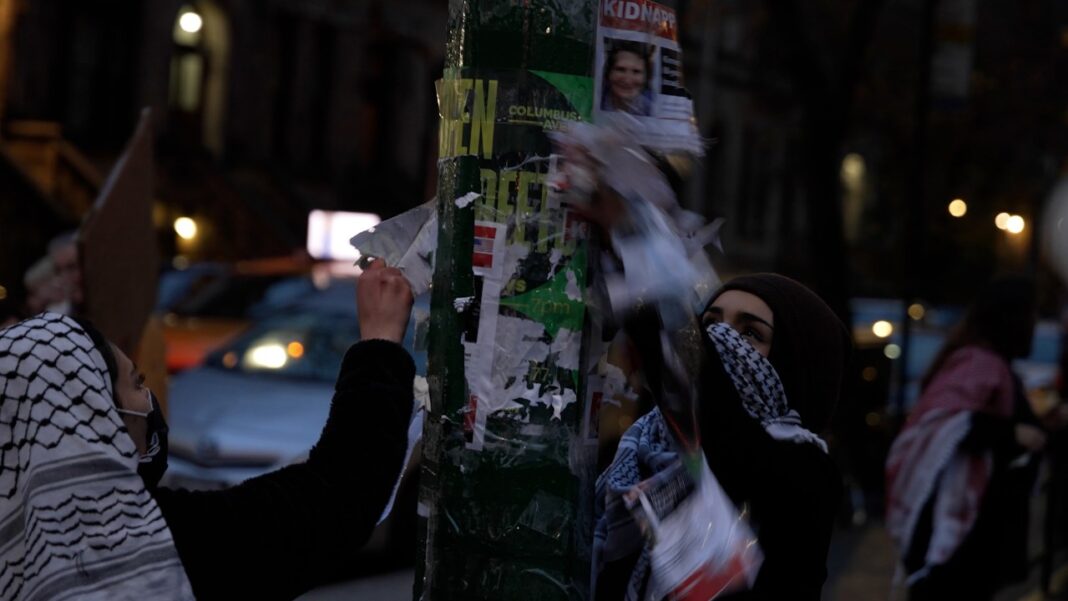
When the first posters of Israeli hostages abducted by Hamas on October 7, 2023, appeared on the lampposts, bus shelters, and storefronts of New York City, they were intended as a simple act of solidarity — a reminder of the civilians, young and old, stolen into Gaza during the deadliest single-day assault on Jews since the Holocaust. Yet what began as an expression of grief and unity quickly spiraled into a visceral conflict on the streets of America’s largest city. Within days, videos circulated of individuals tearing down or defacing the posters, sparking furious confrontations, viral social media debates, and an enduring symbol of a society fractured by the war in the Middle East.
A new documentary, “Torn: The Israel-Palestine Poster War on NYC Streets,” directed by Israeli filmmaker Nim Shapira, captures this phenomenon in painstaking detail. According to a report on Saturday at VIN News, which has closely tracked both the hostage crisis and its resonance in diaspora communities, Shapira’s work is not merely about posters but about how a seemingly small act of vandalism exposed deep ideological divides in New York and beyond.
“Not only were the posters torn down,” Shapira reflects in the film, “but the social fabric of New York was torn apart.” That observation frames the documentary’s central theme: the ways in which a humanitarian campaign for kidnapped civilians became a lightning rod for vitriol.
The 75-minute film, now streaming on torn-film.com with additional private screenings scheduled throughout November, features candid interviews with activists, family members of hostages, and the anonymous artists behind the widely recognized “Kidnapped” poster campaign. According to VIN News, these conversations offer a rare window into the emotional cost of the poster war — both for those desperate to keep their loved ones visible, and for those who saw the posters as political provocations.
The campaign began just days after October 7, when Israeli and Jewish activists abroad felt a profound sense of helplessness. With more than 1,200 Israelis murdered and 251 hostages dragged into Gaza, supporters in New York mobilized around a stark design: the word “Kidnapped” printed above photographs of hostages, accompanied by the date of their abduction.
As VIN News reported at the time, the posters were plastered across New York in an attempt to humanize the statistics and to demand international awareness. Families of the abducted insisted that the posters were not political, but an urgent cry for attention. “We don’t want our children, our parents, our siblings to disappear into silence,” one relative explained in the documentary.
But silence was not the outcome. Instead, the posters became the targets of organized tearing campaigns. Videos recorded on smartphones showed individuals ripping them down in broad daylight, sometimes jeering as they did so. When confronted, many of the individuals justified their actions by claiming the posters were “propaganda” or “incitement.”
According to the information provided in the VIN News report, these incidents frequently led to heated altercations, some of which ended in arrests. In one widely shared clip, a passerby shouted, “Why are you tearing down pictures of kidnapped children?” while another person defiantly replied, “Because they’re lies.”
The film “Torn” presents these encounters not as isolated outbursts but as snapshots of a larger ideological war. Shapira juxtaposes footage of the poster destruction with interviews of Jewish and Israeli New Yorkers who describe feeling targeted simply for demanding empathy for abducted civilians.
Among the most powerful elements of the documentary are the voices of hostage families. Parents, siblings, and spouses recount their anguish at seeing posters of their loved ones ripped away in a city that many had long considered a safe haven. One mother, whose teenage son was taken from his kibbutz near Gaza, says in the film: “When someone tears his face from a wall in New York, it feels like they are erasing him again. Twice kidnapped — once by Hamas, and once by strangers here.”
VIN News has similarly documented the frustration of these families, many of whom traveled to New York to raise awareness. The outlet noted that their appearances at rallies and vigils were often overshadowed by confrontations with counter-protesters, underscoring how the hostage crisis became subsumed into the larger Israel-Hamas debate.
The anonymous artists behind the poster campaign also play a central role in “Torn.” They describe working overnight to paste thousands of posters, only to wake up the next morning to see them ripped down or defaced with slogans such as “Free Palestine” or “End the Occupation.”
Shapira uses these testimonies to explore the role of art in political activism, and the futility of trying to keep a message intact in the digital age. As one activist notes in the film: “The posters lived and died on the streets, but they had a second life online. Every time someone tore one down, it was filmed, uploaded, and multiplied. In a way, tearing the posters spread the message even further.”
The VIN News report emphasized this paradox as well: that attempts to silence the hostage campaign instead magnified it, ensuring that millions who might never walk past a poster in Midtown still encountered the debate in their social media feeds.
At its core, “Torn” is less about the Middle East than it is about America itself. The film portrays New York City as a microcosm of global divisions, where a poster of a kidnapped teenager could ignite accusations of “apartheid,” “genocide,” or “terrorism.”
The documentary highlights the dissonance between those who see the posters as humanitarian appeals and those who interpret them as political statements. One activist interviewed says bluntly: “If you can’t agree that abducting civilians is wrong, then what can we agree on?”
The VIN News report pointed out that this inability to establish even the most basic moral consensus is what made the poster war so painful. For Jewish New Yorkers, the tearing down of hostage posters confirmed fears that antisemitism was no longer lurking on the margins but was emboldened in the mainstream.
The film is currently available for streaming through its official website, torn-film.com, with private screenings scheduled across New York through November. According to VIN News, these screenings have been met with emotional responses from audiences, many of whom see their own experiences reflected in the film. For Jewish New Yorkers in particular, the documentary validates the anger and fear they felt as they watched strangers rip down images of kidnapped children.
More than a year after the October 7 massacre, the posters remain one of the most enduring symbols of diaspora solidarity — and diaspora vulnerability. The tearing down of those posters was never just about paper and glue; it was about visibility, legitimacy, and the right to be heard.
By chronicling this struggle, “Torn” ensures that the debate will not fade, even as the posters themselves vanish from city walls. As the VIN News report observed, the film offers a sobering reminder: “What was torn from the lampposts of New York was not only the faces of the hostages, but the fragile sense of unity in a city that once prided itself on coexistence.”
